
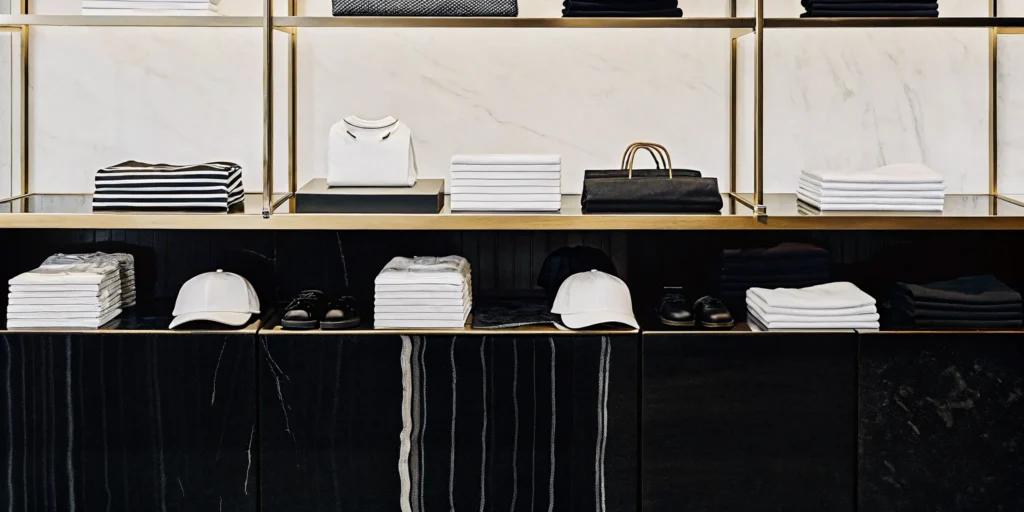
Enterprise procurement teams waste hundreds of hours each year managing scattered vendor lists, chasing order approvals, and reconciling inconsistent product quality across departments. A centralized branded merchandise catalog eliminates that friction, giving every team access to pre-approved, on-brand products without reinventing the procurement process each time.
Ready to build your branded merchandise catalog? Schedule a discovery call with Brand Vessel and let our team design a catalog that streamlines your entire merchandise program.
A branded merchandise catalog for companies is a curated collection of pre-approved apparel, promotional products, and accessories that employees across departments can order with confidence. It enforces brand consistency, simplifies procurement, reduces vendor complexity, and saves corporate teams thousands of administrative hours each year. When managed through a strategic partner like Brand Vessel, this catalog connects directly to a Custom Company Store platform with integrated logistics, fulfillment, and global distribution.
Building a catalog that serves your entire organization requires more than just picking popular items. The first step is understanding exactly which categories, specifications, and systems make a corporate merchandise catalog effective at scale. As part of a broader Branded Merchandise Strategy for Enterprise Companies, a well-structured catalog forms the operational backbone of your entire branded goods program.
Branded Merchandise Catalog For Companies: What Should Be in a Corporate Merch Catalog?
A complete corporate merchandise catalog balances variety with curation. Too few options and employees find workarounds outside the approved list. Too many and procurement loses control over brand and spend. The right catalog covers four core product categories that serve the full range of corporate use cases:
- Custom apparel. Polos, button-downs, jackets, hats, and fleece are the most frequently ordered items in any enterprise catalog. These are the items employees wear daily at events, in the office, and at client meetings. Each apparel product entry should include sizing charts, available colors, fabric composition, and approved branding methods such as embroidery or screen printing. Brand Vessel specializes in Custom Branded Apparel that maintains a polished, professional look across every team.
- Promotional products. Pens, drinkware, tote bags, and notebooks provide high-frequency brand exposure at trade shows, conferences, and client meetings. These items typically ship in higher volumes and benefit most from bulk pricing tiers.
- Office and desk accessories. Branded notebooks, desk organizers, mouse pads, and lanyards keep the brand visible in the workplace every day. These lower-cost items are ideal for new hire kits and general office supply replenishment.
- Tech and premium gifts. Power banks, wireless chargers, Bluetooth speakers, and USB drives serve as high-value rewards for top performers, client milestones, and holiday gifting programs.
Detailed product specifications are essential for a smooth ordering process. Each catalog entry should clearly list available sizes, color options, material composition, care instructions, branding methods, and unit pricing at different order volumes. When procurement teams have this data upfront, they eliminate back-and-forth emails and reduce order errors significantly. According to academic research on merchandise management, detailed product records streamline the procurement process and help department heads manage budgets more effectively across multiple units.
How Do You Organize Products by Department and Use Case?
The most effective branded merchandise catalogs are organized not just by product type but by the way different teams actually use merchandise. A one-size-fits-all catalog forces employees to search through irrelevant products, reducing adoption and increasing the likelihood of off-catalog purchases. A department-structured catalog solves this by grouping products by their primary use case:
- Marketing and events. Trade show giveaways, conference apparel, branded booth materials, and client-facing promotional items. These products need fast turnaround and bulk availability.
- Human resources and onboarding. New hire welcome kits, anniversary recognition gifts, employee milestone awards, and company-wide appreciation campaigns. These products emphasize quality and personalization to make employees feel valued from day one.
- Sales and client relations. Premium executive gifts, holiday client packages, prospect engagement boxes, and account-based reward items. These products reflect directly on the company’s brand standards and require the highest quality execution.
- Internal teams and daily use. Office apparel, department uniforms, team-building swag, and internal event merchandise. These items prioritize comfort, fit, and everyday wearability.
A well-governed catalog ensures brand consistency across every department without limiting each team’s ability to select items that match their specific needs. Marketing and communications leaders typically compile and maintain these lists to confirm that all items use approved wordmarks and visual guidelines. For deeper insight into how teams use merchandise effectively, read our guide on branded merchandise catalog for companies focused on employee appreciation programs.
How to Set Product Minimums and Lead Times
One of the most challenging aspects of running a branded merchandise catalog for companies is balancing inventory risk against availability. Set minimums too high and you tie up budget in slow-moving stock. Set them too low and you face constant reorder cycles. Enterprise procurement teams typically use a tiered approach to solve this:
- Bulk inventory items. High-turnover staples like logo polos, branded pens, and standard tote bags should be ordered in bulk to achieve the lowest per-unit cost. Brand Vessel stores these items in its secure warehouse and fulfills individual orders on demand, combining bulk pricing with single-unit flexibility.
- On-demand and dropship items. For smaller teams or one-off campaigns, on-demand ordering eliminates minimum order quantity pressure. These items ship directly to recipients without requiring minimum volume commitments.
- Custom-manufactured goods. High-end custom apparel or specialty items typically require 8 to 12 weeks from design approval to delivery, including licensing review, production sampling, and shipping. Academic institutions like CUNY recommend placing orders at least eight weeks before the desired in-hand date to allow for these steps.
Brand Vessel’s integrated Logistics and Fulfillment Services handle the complete supply chain: receiving bulk inventory from manufacturers, assembling custom kits and packages. Storing products in climate-controlled facilities, and shipping individual orders to domestic and global destinations. This vertical integration eliminates the handoffs that typically cause delays, lost inventory, and cost overruns. Standard promotional merchandise typically takes two to four weeks to produce. Custom decorated apparel can take four to eight weeks depending on the complexity of the design and the decorating method.
Keeping Your Catalog Current and On-Brand
A branded merchandise catalog is not a set-it-and-forget-it document. Products go out of stock, styles change, company branding evolves, and employee preferences shift. The most successful enterprise merchandise programs treat their catalog as a living system that requires regular attention from designated brand stewards across the organization.
Best practices for maintaining a current catalog include:
- Seasonal rotation. Introduce Q1 new arrivals, summer event collections, and holiday gift guides. Rotating product categories keeps the catalog fresh and encourages employees to check back for new items.
- Performance audits. Review order data quarterly to identify slow-moving products. Retire items that consistently underperform and replace them with alternatives that better match current demand.
- Trend monitoring. Track merchandise trends across your industry and employee preferences. Sustainable materials, for example, have become a top consideration for corporate merchandise programs, and catalogs should reflect that shift.
- Reorder tracking. Automated reorder systems help marketing and HR teams manage budgets by providing visibility into stock levels and consumption patterns across departments. When stock drops below a configured threshold, the system triggers a replenishment order automatically.
To see how other organizations have structured their merchandise programs, browse the case studies on Our Work page. Real-world examples provide a useful benchmark for your own catalog planning and execution.
Digital vs. Physical Merch Catalog Strategies
The format your catalog takes directly affects how easily employees use it and how much control your procurement team maintains. The two primary approaches are digital company stores and traditional physical or PDF catalogs, and each serves a distinct purpose in an enterprise merchandise program.
Here is a direct comparison of the two formats:
| Feature | Digital Company Store | Physical / PDF Catalog |
|---|---|---|
| Inventory accuracy | Real-time, always current | Static, outdated on print |
| Ordering process | Automated, self-service portal | Manual request, email follow-up |
| Budget controls | Per-team spending limits | No native control |
| Reporting | Live data on all orders | Manual tracking required |
| Global access | Any device, any time zone | Physical distribution needed |
| Best use case | Daily ordering and program management | Trade shows and executive reviews |
When choosing a format for your program, follow these steps:
- Assess your team sizes, locations, and ordering frequency across departments.
- Evaluate whether your procurement team has bandwidth to manage manual orders.
- Select a digital company store as your primary system for day-to-day ordering.
- Generate printed or PDF versions on demand for specific events as needed.
- Review adoption data quarterly and adjust your format mix based on usage patterns.
Digital company stores are the modern standard for enterprise merchandise programs. A digital store provides a real-time catalog that is always up to date, showing current inventory, live pricing, and accurate lead times. Features include personalized storefronts by department or location, budget controls per team, automated order routing, and global shipping address validation. A digital company store also captures order data automatically, giving procurement teams detailed reporting on what is being ordered, by whom, and at what cost. Brand Vessel helps organizations build Custom Company Stores that combine these ecommerce capabilities with integrated fulfillment, kitting, and global distribution under one partner.
Physical or PDF catalogs still serve important roles for specific audiences. Printed catalogs are effective at trade shows where attendees want to browse products offline. Executive presentations benefit from a polished printed book that decision-makers can review at their own pace. However, physical catalogs have significant drawbacks: they go out of date as soon as products change. They do not show live pricing, and they require manual reordering processes that eliminate the time savings a digital system provides.
The winning strategy for most enterprises is digital-first with on-demand print capability. The digital company store becomes the system of record. While printed or PDF versions are generated on demand for specific events, presentations, or regions where offline browsing is valuable. This approach, central to any Branded Merchandise Strategy for Enterprise Companies, ensures your brand stays consistent across every touchpoint while giving your teams the flexibility they need.
Frequently Asked Questions
What should be included in a branded merchandise catalog for companies?
A complete corporate merchandise catalog should include custom apparel (polos, jackets, hats), promotional products (pens, drinkware, bags), office accessories (notebooks, desk items), and tech gifts (power banks, chargers). Each product should list detailed specifications including sizing, color options, branding methods, and pricing tiers so procurement teams can order with confidence.
How do I organize my company’s merchandise catalog by department?
Segment your catalog by use case: marketing and events (trade show giveaways, conference gear), human resources (new hire kits. Anniversary gifts), sales and client relations (premium executive gifts), and internal teams (daily apparel, office supplies). This structure makes it easy for each department to find the right products without browsing irrelevant categories.
What are the benefits of having a company branded merchandise catalog?
A centralized catalog enforces brand consistency across all departments, simplifies procurement by eliminating multiple vendor relationships, reduces administrative overhead, and gives procurement teams full visibility into spending patterns. It also ensures that every employee has access to the same high-quality, on-brand products regardless of their location or department.
How can I keep my branded merchandise catalog current?
Rotate products seasonally, audit order data quarterly to retire underperformers, monitor merchandise trends, and use automated reorder tracking systems to maintain optimal stock levels. Treat your catalog as a living document that evolves with your brand and employee preferences.
Should I use a digital company store or a printed catalog?
Digital company stores are the best primary strategy because they offer real-time inventory, live pricing, automated ordering, and detailed reporting. Printed or PDF catalogs work best as on-demand supplements for trade shows and executive presentations rather than as the primary catalog format.
Ready to Build Your Branded Merchandise Catalog?
A well-designed branded merchandise catalog for companies transforms a chaotic vendor patchwork into a streamlined, cost-effective program that every department can use with confidence. From selecting the right product categories to setting intelligent minimums and lead times to choosing between digital and physical formats. Every decision builds toward a catalog that serves your entire organization.
Brand Vessel partners with enterprise teams to design, build, and operate branded merchandise catalogs and company stores that integrate world-class creative decorating. Global logistics, kitting, fulfillment, and customs brokerage under one roof. Whether you are launching a new catalog or restructuring an existing one, our team brings the expertise and infrastructure to make it work at scale.
Schedule a discovery call with Brand Vessel today and take the first step toward a branded merchandise catalog that your teams will actually use.