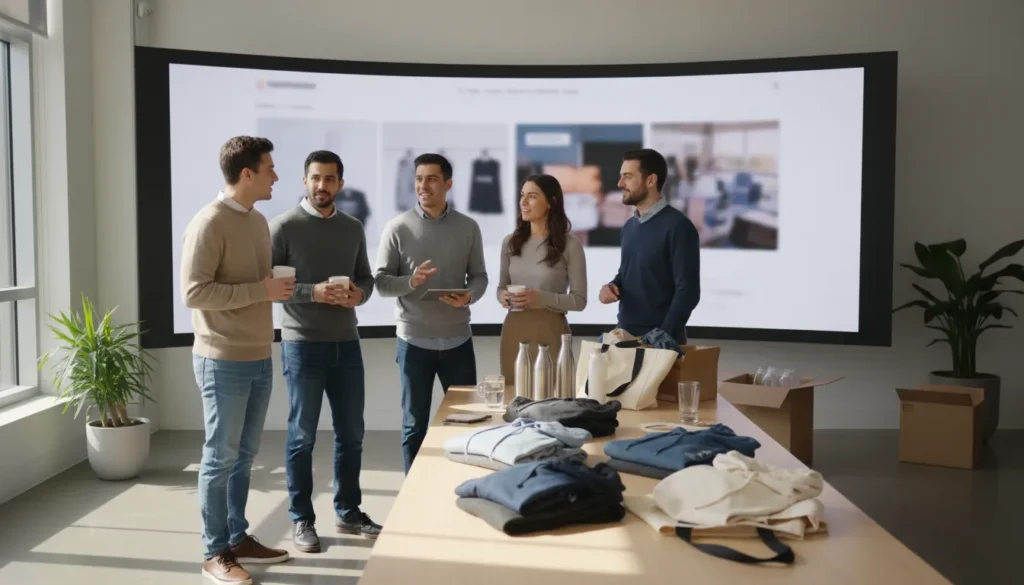
A custom company store should make branded merchandise easier for the people who manage it and more useful for the people who receive it. When the store is built well, HR can support onboarding, marketing can protect the brand. Procurement can reduce vendor complexity, and employees can choose merch they actually want to wear.
Start a Project with Brand Vessel to plan a company store that connects product selection, inventory, and fulfillment in one practical program.
The best stores do more than list products. They create a repeatable system for ordering, approvals, budgets, shipping, reporting, and seasonal updates. That system is what turns a merch idea into a reliable employee experience.
Custom company store basics for enterprise teams
A custom company store is a branded online storefront where employees, teams, customers, partners, or event attendees can order approved company merchandise. It may include apparel, drinkware, onboarding kits, recognition gifts, event items, uniforms, accessories, or internal campaign materials. For enterprise teams, the store also needs operational rules behind the scenes.
That is the part many teams miss. A store is not only a product catalog. It is also a control center for brand standards, budget use, inventory, replenishment, fulfillment, and reporting. The front end should feel simple for employees. The back end should remove busywork for HR, marketing, procurement, and operations.
For example, a people team might use the store to send new-hire kits to remote employees. A marketing team might use it to maintain approved apparel for events. A procurement team might use it to reduce one-off vendor requests. A sales leader might use it to send customer gifts without asking five people where the boxes are stored.
Brand Vessel approaches company stores as part of a broader merchandise program. The work can include high-quality branded merchandise, creative decorating, store setup, storage, logistics, kitting, and fulfillment. That matters because a store only works if the products, platform, and delivery process all support the same goal.
Why employees use some company stores and ignore others
Employee adoption starts with product relevance. If a store is filled with low-quality items, odd sizes, outdated designs, or products no one would choose outside of work, employees will visit once and stop. A better store starts with fewer, better items that fit how people actually live, travel, work, and represent the brand.
Quality is a major adoption lever. A premium hoodie, well-made hat, useful tote, durable notebook, or comfortable shirt can become part of an employee’s normal rotation. Generic items that feel like leftovers rarely do. This is why Brand Vessel emphasizes custom apparel people actually want to wear and decorating quality that holds up over time.
Make the store easy to shop
The shopping experience should be obvious. Employees should understand who can order, what budget they have, which items are available, where the products ship, and when they should expect delivery. Confusing category names, hidden rules, and unclear inventory create support tickets that defeat the purpose of the store.
Refresh the catalog with intention
A store also needs movement. Seasonal drops, event collections, onboarding updates, and recognition campaigns give people reasons to return. That does not mean adding hundreds of products. It means curating the catalog so it feels current, useful, and connected to company culture.
Launch communication matters too. Employees are more likely to use the store when managers explain what it is for, how to access it, and which moments it supports. The store should feel like a benefit and brand experience, not a forgotten link in an internal wiki.
Essential features for an enterprise-grade company store
Enterprise teams need structure. A small team may be able to manage requests through email for a while. Larger organizations need rules, visibility, and workflows. Without those features, the store becomes another manual process with a nicer interface.
| Feature | Why it matters | What to look for |
|---|---|---|
| Brand control | Keeps logos, colors, and approved products consistent. | Curated catalogs, approved artwork, and controlled product options. |
| Budget rules | Prevents overspending and clarifies who pays for what. | Allowances, department budgets, approval paths, and reporting. |
| Inventory visibility | Reduces surprises before launches, events, or onboarding waves. | Stock counts, reorder points, and clear availability by size or variant. |
| Fulfillment workflows | Turns orders into reliable shipments without manual follow-up. | Direct-to-employee shipping, bulk shipping, kitting, and tracking. |
| Reporting | Shows what employees use and what should be reordered or retired. | Order history, product performance, cost visibility, and team usage. |
Security and access are also important. Some companies need different catalogs for employees, contractors, event teams, clients, or regional offices. Others need approval workflows before certain items ship. The right structure depends on the audience, use case, and brand risk.
For global or distributed teams, fulfillment features are just as important as the storefront. A polished store that cannot ship reliably will still create frustration. Enterprise programs should account for storage, packing, customs, international delivery, and support before launch.
How does a custom company store save HR and marketing time?
A custom company store saves time by replacing repeated manual requests with a repeatable workflow. Instead of asking who has the latest logo file, which hoodie is approved, how many medium shirts are left. Or who can ship a kit to a remote employee, teams can route those tasks through one managed system.
For HR and people operations, the biggest time savings often show up in onboarding and recognition. New-hire kits can be planned in advance, packed consistently, and shipped to the right address. Employee anniversary gifts, team awards, and culture campaigns can follow a defined process instead of starting from scratch every month.
For marketing and brand teams, the store protects consistency. Approved products, decoration methods, and artwork reduce the risk of rogue merchandise that does not match brand standards. A well-managed store also helps regional teams and event owners move faster because they are choosing from items that have already been vetted.
Procurement and operations benefit because the store can reduce fragmented vendors and one-off purchase requests. Teams gain better visibility into spend, inventory, usage, and reorder timing. That visibility helps prevent duplicated orders, unused stock, and last-minute rush shipping.
Brand Vessel’s site says its company store capabilities can save teams thousands of hours. The practical reason is simple: the right store removes repeated decisions. Once the products, rules, storage, and fulfillment process are built, teams can focus on the employee experience instead of chasing details.
What products should you put in an employee company store?
The strongest product mix starts with the employee, not the logo. Ask what people will use at work, at home, while traveling, at events, or during onboarding. Then choose products that feel good, fit well, and reflect the brand without becoming clutter.
Start with proven staples
Premium apparel is usually the anchor. Hoodies, crews, jackets, tees, and hats work when the fit, fabric, and decoration are right. Practical accessories can round out the catalog, including drinkware, bags, notebooks, tech organizers, socks, and travel items. Onboarding kits can combine several of these into a first impression that feels organized and intentional.
Add moments, not random products
Every item should connect to a moment. New hires need welcome kits. Sales teams may need customer gifts. Event teams need booth and attendee merchandise. Managers may need recognition items. Remote employees may need direct-to-home options. When the catalog is organized around moments, employees understand why the items exist.
Sustainability can also guide product choices. Better materials, useful items, and thoughtful replenishment can reduce waste compared with over-ordering low-value products. A focused store with durable, desirable merchandise is often more effective than a large catalog filled with items people do not use.
Brand Vessel’s custom company store examples and project work show how apparel, accessories, and kits can support real brand moments. The goal is not to add products for the sake of variety. The goal is to build a selection employees trust.
How to build a custom company store that scales
Scaling a store starts before the platform is built. The team needs to understand who the store serves, which business problems it should solve, and what success looks like. A store built for onboarding will have different requirements than a store built for global event teams or customer gifting.
- Define the audience and use cases. Decide whether the store is for employees, candidates, customers, partners, departments, or a mix of audiences.
- Set the goals. Clarify whether the priority is saving time, improving brand control, supporting onboarding, reducing vendor complexity, increasing employee engagement, or all of the above.
- Curate the product catalog. Choose high-quality items that match real moments and brand standards. Keep the first launch focused so the team can learn from usage.
- Build the rules. Determine access, budgets, approvals, shipping options, inventory ownership, and reorder responsibilities.
- Connect inventory and fulfillment. Decide what will be stocked, what will be packed as kits, what ships individually, and what requires bulk delivery.
- Launch with communication. Explain why the store exists, who can use it, and what employees should do first.
- Review and improve. Use order data, employee feedback, and inventory movement to update products, retire weak items, and plan future drops.
The most scalable stores are treated as living programs. They are not finished the day they launch. They improve as the company learns which items employees choose, which workflows save time, and which moments need better support.
How Brand Vessel supports your store from setup to fulfillment
Brand Vessel can support the full company store lifecycle, from planning to product delivery. That is important because many store problems happen between departments. The platform may work, but the products may not be right. The products may look great, but inventory may be hard to track. Inventory may be available, but fulfillment may not support remote or global teams. A strong partner connects each piece.
Brand Vessel’s feature-rich company store services sit alongside branded merchandise, storage and logistics, and kitting and fulfillment. That combination gives teams a single partner for the strategy, the products, and the operational follow-through. It also helps reduce the number of vendors internal teams need to coordinate.
On the merchandise side, Brand Vessel helps select items employees will actually use. The team focuses on high-quality apparel, creative decorating, sustainable options where appropriate, and supplier relationships that support better products. On the logistics side, Brand Vessel supports storage, packing, in-house shipping, customs brokerage, and global distribution.
For distributed companies, that fulfillment depth matters. Brand Vessel can help merchandise reach one employee’s home or a team of 3,000, anywhere in the world. For companies running onboarding, culture, recognition, and event programs, that reliability can turn a company store from a nice idea into a dependable operating system.
You can also review the Brand Vessel company store example to see how a curated storefront can present branded gear in a clean, shoppable way. The exact store for your organization should be tailored to your audience, brand standards, and fulfillment needs.
Frequently asked questions about custom company stores
What is a custom company store?
A custom company store is a branded online storefront where approved audiences can order company merchandise. For enterprise teams, it also manages product selection, budgets, inventory, fulfillment, and reporting.
How long does it take to set up a company store?
Timing depends on the catalog, approval rules, inventory plan, design needs, and fulfillment requirements. A simple store can move quickly, while an enterprise program with global shipping and multiple audiences needs more planning.
Do employees need a budget or allowance?
Not always, but budgets and allowances are useful when teams want to control spend. They also help employees understand what they can order without asking a manager for permission.
Can a company store support remote employees?
Yes. A well-built store can support direct-to-employee shipping, onboarding kits, recognition gifts, and global distribution. Fulfillment planning is what makes the remote experience reliable.
Ready to build a company store employees use?
A custom company store works best when the products, platform, inventory, and fulfillment plan are built together. Brand Vessel helps enterprise teams create merchandise programs that feel organized for managers and worth using for employees.
Start a Project with Brand Vessel to plan a store that supports your team from product selection through global delivery.