
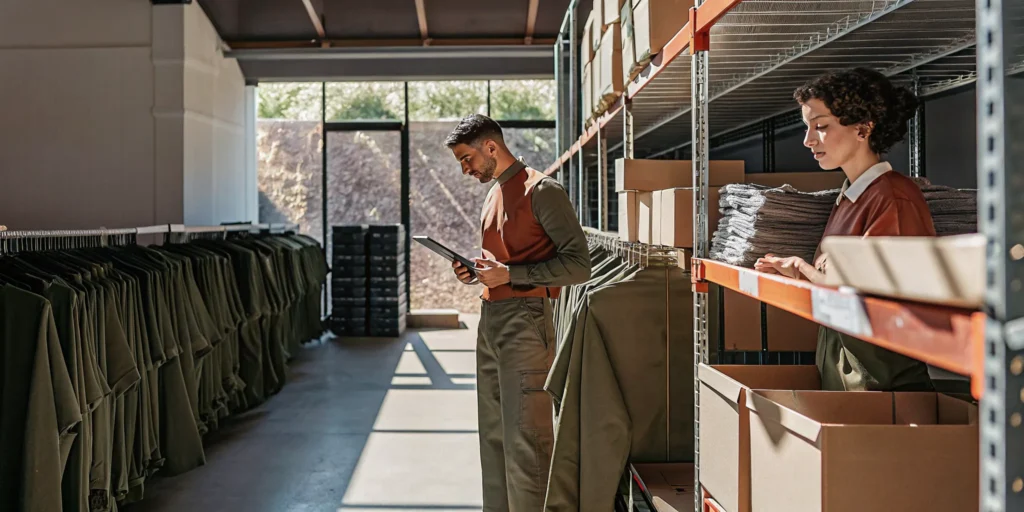
Corporate swag becomes an operational problem when purchasing, storage, kitting, shipping, and inventory decisions sit with different vendors or internal teams. The right fulfillment partner should make that system easier to manage while protecting brand consistency across employees, clients, events, and locations.
A branded merchandise fulfillment partner coordinates storing, kitting, packing, and shipping, with the visibility and inventory control needed for consistent execution. For enterprise teams, the strongest partner also connects merchandise operations with company stores, global distribution, customs brokerage, and scalable logistics.
That makes evaluation less about comparing pick-and-pack rates and more about testing how a provider handles the full merchandise lifecycle. Brand Vessel approaches this work as an integrated creative, technology, and logistics program, including the planning principles outlined in What Is Corporate Kitting? The first step is understanding exactly what the partner should own.
What Does a Branded Merchandise Fulfillment Partner Do?
A branded merchandise fulfillment partner manages the operational work between product production and the final recipient. That can include receiving inventory, storing it securely, assembling kits, packing orders, and shipping to employees, clients, event venues, or regional offices. For procurement teams, the value is not simply fewer boxes in the warehouse. It is one accountable operating model for inventory control, brand consistency, and delivery execution.
The scope matters as merchandise programs grow. The North American promotional products industry reached a record $27.7 billion in 2025, according to the Advertising Specialty Institute. The broader global third-party logistics market is projected at approximately $1.22 trillion in 2026, as reported by Mordor Intelligence. Those figures reflect an environment where merchandise operations increasingly require specialized logistics rather than ad hoc shipping support.
What services are included?
A capable partner should be able to coordinate the physical flow of merchandise across campaigns, employee programs, and ongoing company stores. Core services commonly include:
- Warehousing and inventory control: Receive products, organize stock, monitor quantities, and provide visibility before a shortage disrupts a launch.
- Kitting and assembly: Combine apparel, promotional products, printed materials, or other components into a defined package for a specific audience or event.
- Pick, pack, and shipping: Select the right items, package them to protect presentation and product quality, and route orders to the correct destinations.
- Freight and campaign support: Coordinate freight transportation, print fulfillment, and pick-and-pack requirements when a program involves multiple suppliers or high-volume deadlines.
- Global distribution: Manage international delivery requirements, including customs coordination where applicable, instead of leaving each internal team to solve cross-border shipping independently.
These capabilities align with the end-to-end model described in fulfillment research, which covers storing, assembling, packing, and shipping branded products. Effective execution also depends on inventory visibility and kit control across every distribution touchpoint. Brand Vessel combines those logistics functions with creative and company store support through Branded Merchandise Services, giving enterprise teams a more connected way to manage merchandise programs.
International programs require additional planning around documentation, duties, and destination requirements. Teams expanding beyond domestic distribution can review How to Ship Branded Merchandise Internationally when defining the workflow and responsibilities for global shipments.
In-House vs. Third-Party Fulfillment
Keeping branded merchandise fulfillment in-house can appear straightforward when order volume is low. As programs expand across employees, events, offices, and regions, the operational burden grows quickly. A specialized partner can save internal time and eliminate inventory headaches while giving procurement teams a more controlled operating model, as documented in fulfillment guidance from Kevin’s Worldwide Wholesale.
The right choice depends on whether merchandise logistics is a core internal capability or a recurring business process that deserves dedicated infrastructure.
| Evaluation area | In-house team | Specialized fulfillment partner |
|---|---|---|
| Storage capacity | Uses existing office, warehouse, or regional space. Capacity can become constrained as inventory expands. | Provides dedicated storage designed for merchandise inventory, replenishment, and organized picking. |
| Kitting expertise | Relies on employees or temporary labor to assemble kits, often alongside their primary responsibilities. | Uses repeatable processes to assemble campaign, employee, event, or VIP kits at the required volume. |
| Global distribution | Requires internal teams to coordinate carriers, destinations, customs, and regional exceptions. | Centralizes distribution through one operating partner, reducing fragmented vendor coordination. |
| Technology and company-store integration | May require separate ordering, inventory, and shipment systems that need internal coordination. | Can connect fulfillment workflows with company-store technology and ordering portals. |
| Cost model | Appears variable, but internal labor, space, software, errors, and inventory carrying costs remain part of the equation. | Converts more operational work into a managed service cost that can be evaluated against volume and service requirements. |
| Brand consistency | Depends on local handling procedures, employee training, and quality checks. | Uses standardized handling, packing, and distribution processes across touchpoints. |
| Scalability | Growth may require new space, people, systems, and processes before volume can increase reliably. | Can support a defined roadmap from design through doorstep delivery, scaling from single kits to thousands. This approach is emphasized in Imprint Engine’s fulfillment guide. |
When does outsourcing create the most value?
Third-party fulfillment is especially useful when a merchandise program spans multiple locations or combines ongoing employee orders with time-sensitive campaigns. Centralization makes accountability clearer and helps reduce the inventory and shipment issues that arise when each region manages its own process.
Brand Vessel illustrates this integrated model by combining merchandise expertise, company-store technology, storage, kitting, fulfillment, and global logistics. Procurement teams comparing operating models can also review Corporate Swag Store vs. Traditional Promo Vendors before deciding which responsibilities should remain internal.
Key Criteria for Evaluating Fulfillment Partners
The right partner should operate as an extension of your procurement, marketing, and operations teams. Evaluate the full delivery system, not only storage rates or per-order fees. A partner that combines merchandise expertise with disciplined logistics can protect brand standards while reducing execution risk.
Supply-chain resilience deserves particular attention. The National Institute of Standards and Technology notes that networks designed mainly for efficiency and cost may lack transparency and resilience. And companies can expect disruptions lasting a month or longer about every 3.7 years. Ask potential partners to explain their contingency planning, supplier visibility, and escalation process. NIST’s supply-chain guidance provides useful context for this review.
Kitting, assembly, and quality control
Confirm that the partner can assemble the specific packages your programs require, whether those are employee onboarding kits, event shipments, VIP mailers, or multi-item campaign bundles. Review how they verify quantities, decoration quality, packaging instructions, and destination-specific requirements before orders leave the facility. For more detail on the operational model, see What Is Corporate Kitting?
- Can the team manage variable kit contents and audience-specific configurations?
- Are inspection checkpoints documented for apparel sizing, decoration, packing, and final shipment?
- Can the partner provide samples, exception reporting, and a clear resolution path when quality issues arise?
Warehousing, inventory, and technology
Storage should be secure, organized, and suited to the range of products in your program. More importantly, the operating system should provide visibility and inventory control across distribution touchpoints. Real-time inventory management helps teams identify low stock before it disrupts a launch, while accurate order data supports better purchasing and replenishment decisions.
Assess whether fulfillment connects cleanly with your company store or ordering portal. The integration should support approved products, permissions, order routing, status updates, and reporting without forcing teams to reconcile disconnected spreadsheets.
Global reach, scalability, and accountability
For distributed programs, ask how the partner handles international transportation, customs documentation, duties, and country-specific delivery requirements. Global logistics and customs brokerage experience can prevent avoidable delays when merchandise crosses borders. Also test whether the operating model can scale from a routine employee order to a major event or multi-market launch without sacrificing control.
Due diligence and risk management should be built into the logistics strategy, not treated as an afterthought. The U.S. Department of Commerce identifies both as essential considerations for long-term supply-chain stability. Trade.gov’s supply-chain management guidance can help structure your diligence questions.
Finally, identify the people responsible for the relationship. A dedicated team should understand your brand standards, approval workflows, inventory priorities, and delivery deadlines. Brand Vessel’s Corporate Merchandise Program Management model reflects this broader requirement: reliable fulfillment depends on coordinated program ownership, not a warehouse acting in isolation.
Questions to Ask About Warehousing and Inventory
A capable fulfillment partner should make the operational details of a merchandise program visible before you commit. Use these questions to test whether the provider can support daily orders, campaign peaks, and distributed teams without creating another layer of manual coordination.
- Where are your warehouses located, and how do those locations support our delivery footprint? Ask whether inventory is positioned to serve your primary employee, customer, and event markets efficiently. If you ship internationally, clarify how the partner handles customs brokerage, duties, documentation, and delivery exceptions. For global distribution, confirm that the team manages both domestic and international recipients rather than handing off critical steps without clear ownership. How to Ship Branded Merchandise Internationally can help frame this discussion.
- Can we see real-time inventory levels, allocations, and reorder risks? A reliable program needs more than a periodic spreadsheet. Ask how the system reports available, committed, inbound, and reserved stock, and whether it can flag potential stockouts before a campaign launches. Real-time inventory management is a stated requirement for preventing stockouts and supporting timely campaign activation, according to the fulfillment logistics source.
- What kitting and packaging options can you manage? Ask whether the team can assemble new-hire kits, event packages, client gifts, or role-specific shipments from multiple components. Confirm how they document pack-out instructions, verify quantities, protect decorated apparel, and handle custom combinations by recipient, region, or occasion. Shipment customization should be demonstrated with a sample workflow, not described only in general terms.
- Can fulfillment integrate with our company store, swag portal, or gifting platform? The ordering experience and warehouse process should share accurate product, address, and inventory data. Ask what integrations are supported, how orders are transmitted, and what happens when an item is unavailable. Brand Vessel’s Custom Company Store Platform is a relevant example of the digital storefront layer to discuss.
- What minimums and capacity limits apply as our program grows? Clarify minimum order quantities, storage fees, peak-season capacity, international shipment thresholds, and lead times for adding new SKUs. Ask how the partner handles a small pilot becoming a recurring enterprise program without changing service quality or forcing a premature infrastructure decision.
- What reporting will our procurement, marketing, and HR teams receive? Request examples of reports covering order status, inventory movement, fulfillment accuracy, shipping performance, returns, and campaign costs. Also ask whether reporting can be segmented by department, location, event, or recipient group, so stakeholders can act on the data instead of reconciling disconnected vendor updates.
Red Flags When Selecting a Fulfillment Vendor
The wrong fulfillment vendor can create operational risk that is difficult to see until a launch is already under pressure. Watch for these warning signs during procurement and discovery:
- No real-time inventory visibility. If a vendor cannot show current inventory by SKU, location, status, and projected availability, your team is managing campaign risk through spreadsheets and assumptions. Strong fulfillment programs use inventory control and visibility to support consistent execution across distribution touchpoints. Ask to see the reporting interface, not just a sample report.
- A cost-only, opaque supply chain. A low quote is not useful if the vendor cannot explain sourcing, storage, transportation, contingency plans, or who owns each handoff. NIST notes that supply networks designed primarily for efficiency and cost may lack transparency and resilience. NIST also reports that companies should expect disruptions lasting a month or longer, on average, every 3.7 years. Review NIST’s supply-chain resilience guidance before treating price as the primary selection criterion.
- No customs brokerage or global capability. A vendor that only handles domestic parcel shipments may struggle when merchandise must cross borders, reach distributed employees, or arrive at international events. Confirm who manages documentation, customs coordination, duties, and exception handling. If the answer is a referral to several unrelated providers, accountability is already fragmented.
- Generic 3PL expertise with no branded-merchandise understanding. Branded programs involve decoration standards, apparel sizing, packaging requirements, event deadlines, and presentation quality. A warehouse that can move cartons is not automatically equipped to protect brand consistency or manage campaign-specific kits.
- No dedicated account team or quality-control process. If every issue starts with a general support inbox, escalation will be slow when a shipment, decoration, or kit is wrong. Ask who owns the relationship, how approvals are documented, and how pick, pack, and kitting errors are caught before dispatch.
- Rigid minimums that limit growth. Fixed order thresholds, inflexible storage terms, or one-size-fits-all kitting rules can make a program uneconomical at smaller volumes and obstruct expansion later. The right partner should explain how the operating model changes as locations, audiences, and order volume grow.
These concerns are not merely operational preferences. The U.S. Department of Commerce identifies due diligence and risk management as essential parts of supply-chain strategy. Trade.gov’s supply-chain management guidance supports evaluating resilience before problems occur, rather than reacting after a disruption.
Brand Vessel is an example of the integrated capability to look for: branded-merchandise expertise paired with fulfillment, kitting, inventory coordination, and distribution support. For distributed programs, see Promotional Product Fulfillment for Distributed Teams and compare the operating model against your actual requirements.
Frequently Asked Questions
What makes a reliable branded merchandise fulfillment partner?
A reliable partner combines inventory visibility, controlled kitting, careful packing, and consistent brand-quality checks. Look for an accountable team that can coordinate sourcing, storage, distribution, and exception handling rather than passing each step to disconnected vendors. The partner should also explain its risk-management and business-continuity practices before launch.
Can fulfillment services integrate with my company swag store?
Yes. A capable fulfillment operation can connect with a company store, gifting portal, or campaign ordering platform so orders move from purchase to picking and shipping without manual re-entry. Ask how inventory, order status, approval rules, and recipient data are synchronized, and confirm which system is the source of truth when quantities change.
How does fulfillment support global distribution?
Global programs require more than shipping products from one warehouse. Ask whether the partner manages regional delivery, customs documentation, duties, and exceptions, and whether it can provide shipment-level visibility. Brand Vessel provides in-house customs brokerage for global distribution, which can reduce coordination across separate logistics providers.
Is product sourcing included with fulfillment services?
It may be, but buyers should confirm the scope in writing. Some partners handle sourcing, decoration, storage, kitting, and shipping under one program, while others begin only after products arrive at their warehouse. Clarify who owns product specifications, quality approvals, replenishment decisions, and responsibility for delays or substitutions.
How can shipments be customized for different recipients?
Fulfillment teams can assemble different combinations for employees, clients, event attendees, or VIP recipients when the program has clear rules and dependable inventory. Ask whether the partner can manage recipient-level choices, regional assortments, branded inserts, and scheduled releases. Request a sample workflow before approving the operating model.
Ready to Start a More Reliable Merchandise Program?
Evaluating fulfillment alongside storage, kitting, inventory visibility, and distribution can help your team choose a partner that fits operational requirements, not just an order volume. Brand Vessel can help you assess those needs and define a practical path forward. To discuss your branded merchandise fulfillment goals, start a project with Brand Vessel.