
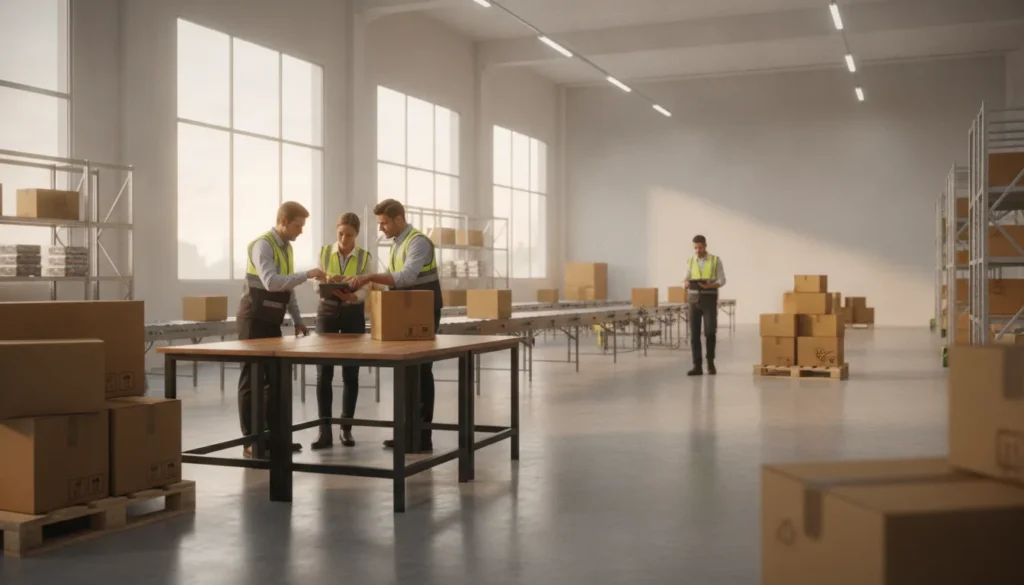
Enterprise merchandise programs rarely fail because a team chose the wrong shirt or notebook. They fail when ordering, storage, approvals, shipping, and replenishment become scattered responsibilities with no accountable operating model.
Start a project with Brand Vessel to align merchandise strategy with the logistics behind it.
The right corporate swag vendor with logistics should manage more than product sourcing. It should connect branded merchandise to storage, pick-and-pack, kitting, fulfillment, company store technology, and dependable distribution. Giving procurement and marketing teams one accountable partner as program volume and complexity grow.
That integrated approach matters especially when merchandise supports onboarding, events, employee engagement, or offices across multiple regions. Brand Vessel combines creative, technology, storage, fulfillment, and in-house customs brokerage to help enterprise teams manage the full supply chain experience. Its corporate kitting capabilities illustrate why operational depth should be evaluated before product catalogs and decoration options.
The first step is to make logistics a formal vendor-selection criterion, not a service detail reviewed after the buying decision.
Why a Corporate Swag Vendor With Logistics Should Be Your First Criterion
A corporate merchandise program can look manageable when orders are occasional and inventory fits in one closet. That changes as headcount increases, offices multiply, and teams begin requesting onboarding kits, event materials, client gifts, and regional apparel at the same time. The product matters, but the operating model determines whether the program stays reliable.
For procurement and marketing leaders, logistics capability should therefore be an early screening criterion, not an add-on discussed after product selection. Brand Vessel treats storage, order management, kitting, fulfillment, and distribution as connected parts of the merchandise experience. Giving internal teams one accountable partner instead of another recurring operational task.
- Growth turns merchandise into an operating function. Many in-house programs begin with spreadsheets, closets, and informal ownership. As organizations expand, that approach can become a logistics operation no one formally owns, creating gaps between purchasing, inventory control, and delivery. The underlying pattern is documented in fulfillment operating guidance.
- Physical handling requires repeatable capacity. A capable partner can receive inventory, store it, pick the correct items, pack orders, and ship them according to defined workflows. Outsourcing those activities gives internal teams a scalable process instead of asking People Operations, office managers, or marketers to manually count apparel and assemble welcome kits.
- Fulfillment affects more than warehouse efficiency. For enterprise programs, fulfillment is a major operating layer. It supports brand consistency, ordering controls, inventory visibility, and the experience employees or customers have when merchandise arrives. A vendor that only sells products may not be equipped to manage those dependencies.
- Better visibility supports better decisions. The research literature links supply chain digitalization and integration with stronger firm performance. A study published through the National Library of Medicine found that both digitalization and supply chain integration positively influence firm performance. The study on supply chain digitalization and firm performance also connects digital tools with visibility and operational efficiency, both of which matter when forecasting demand and setting inventory levels.
This distinction is especially important when the program spans several departments or countries. Without defined fulfillment ownership, small errors can become expensive: the wrong item is stored. A duplicate order is reshipped, or a replacement must be rushed because an upstream inventory issue went unnoticed. Those failures consume budget and internal attention while making the vendor relationship harder to manage.
Brand Vessel is built for a different standard. Its integrated model combines merchandise expertise with storage, pick-and-pack, kitting, fulfillment, global distribution, and in-house customs brokerage. That allows an enterprise team to evaluate the vendor on the full lifecycle of the program. From approved product and inventory strategy through final delivery, rather than choosing a supplier based only on a compelling product presentation.
What Full-Service Logistics Looks Like vs. Basic Fulfillment
The practical difference is what happens before and after an order is placed. A basic fulfillment vendor may move a finished package from a shelf to a carrier. A full-service logistics partner manages the operating system around that shipment, including inventory intake, storage, assembly, approvals, international requirements, and reporting. For enterprise teams, that distinction affects workload, control, and the consistency of the employee or client experience.
When evaluating a corporate swag vendor with logistics, examine the operating model rather than the sales pitch. Can the partner own the complete receive, store, pick, pack, and ship cycle? Can it support different inventory pools, kitting requirements, and offices in multiple regions? The answers reveal whether the vendor is equipped to become an extension of your team or is only handling the final transaction.
| Full-Service Logistics Partner | Basic Fulfillment Vendor |
|---|---|
| Receives merchandise, verifies inbound inventory, stores it, and manages pick, pack, and ship workflows. | Receives finished inventory and ships individual orders, with limited responsibility for the broader program. |
| Builds kits, welcome packages, event bundles, and other multi-item shipments according to defined specifications. | Ships items as stocked, while assembly or special packaging may require a separate provider. |
| Coordinates international distribution and customs requirements for organizations serving multiple regions. | May ship internationally through standard carrier services, but often leaves customs complexity with the client. |
| Supports order rules, approvals, inventory reservations, company stores, and workflows for different departments or audiences. | Processes submitted orders, with fewer tools for controlling access, budgets, or inventory allocation. |
| Reports on inventory movement, order activity, fulfillment performance, and patterns that inform procurement decisions. | Typically reports shipment status and basic order activity without broader program analysis. |
This broader scope matters as headcount and office locations grow. Manual handling that begins with a spreadsheet or storage closet can become a logistics operation no one formally owns. Outsourcing the physical side of the program lets internal marketing, People Ops, and procurement teams focus on their core responsibilities while specialists manage the repeatable work.
Global distribution is especially important when brand standards must remain consistent across offices, countries, and employee populations. Brand Vessel combines storage, pick-and-pack, kitting, fulfillment, and in-house customs brokerage rather than treating each need as an unrelated handoff. Its global promotional products distribution capabilities are designed for organizations that need coordinated delivery across regions.
Storage is also an active management responsibility, not merely a place to hold boxes. With branded merchandise warehousing, teams can establish clearer inventory ownership and reduce the risk of paying to store the wrong items, reshipping duplicates, or rushing replacements after an upstream error. That is the value of choosing a partner that manages the program end to end.
Red Flags in Vendor Logistics Proposals
A polished proposal can still conceal operational gaps that become expensive after launch. Buyers should evaluate the workflow behind the promised service, not only product selection, unit pricing, or a convenient ordering interface. A proposal from a corporate swag vendor with logistics should explain how inventory accuracy, approvals, fulfillment charges, and exception handling work in practice.
Use the following review checklist during procurement. Each item points to a question the vendor should answer with process detail, system evidence, or a clearly defined commercial term.
- Vague inventory controls. Be cautious when a proposal promises storage and shipping without explaining how stock is received, counted, reconciled, and reported. Inventory inaccuracies can result in duplicate shipments, rushed replacements, and unnecessary storage of the wrong items. Ask how the vendor identifies an upstream error before another order is released. Fulfillment guidance on inventory accuracy highlights these avoidable downstream costs.
- One bundled logistics fee with no service definitions. A low headline price may exclude storage, pick-and-pack, kitting, returns, special handling, or rush fulfillment. Pricing should state what is included, which events trigger additional charges, and whether rates change by shipment profile or service level. Opaque pricing makes a proposal difficult to compare and can turn routine activity into an unplanned operating expense.
- No automated approval workflow. If every requester can order from the same catalog without spend limits, department rules, or designated approvers, budget drift is predictable. Large programs need controls for who can request which items, in what quantities, and for which business purpose. The vendor should demonstrate how approvals are configured, recorded, and escalated rather than describing governance as a client-side responsibility.
- Too many requesters with no access rules. A proposal may celebrate broad employee or department access while overlooking inventory allocation. Ask whether onboarding kits, event stock, executive gifts, and regional inventory can be separated by permissions or cost center. Without those rules, demand from one group can consume stock reserved for another, creating avoidable reorders and service complaints.
- Strong pitch, thin operating model. A proposal focused on product samples and launch enthusiasm, but light on reporting, service-level expectations, escalation paths, and implementation responsibilities, leaves critical work undefined. Evaluate how the program will run after the first order, including who owns exceptions and how performance is reviewed. Brand Vessel approaches merchandise as an integrated program spanning storage, fulfillment, and governance, rather than treating logistics as an afterthought.
Before selecting a partner, request a sample monthly report, a complete fee schedule, an approval-flow demonstration, and a written exception process. These materials reveal whether the vendor can provide repeatable operational control or is primarily selling a catalog. The right proposal should make accountability visible before procurement signs.
How to Evaluate Warehousing and Customs Capabilities
A capable corporate swag vendor with logistics should be able to explain what happens after products leave production. Enterprise buyers need more than a warehouse address. They need a defined operating model for receiving inventory, forecasting demand, controlling stock, preparing orders, clearing customs, and delivering consistently across regions.
Start by asking for evidence of how the partner manages the full flow. A provider that handles storage, pick-and-pack, and distribution through connected processes can give your procurement, marketing, and People teams a clearer view of inventory and service performance. Research published in the International Journal of Environmental Research and Public Health links supply chain digitalization and integration with improved visibility, operational efficiency, and firm performance: the study is available through PubMed Central.
Ask how the warehouse supports your program
Do not evaluate capacity only by square footage. Ask whether the vendor can segment inventory by department, event, onboarding program, market, or approval level. Request examples of inventory reporting, reorder planning, cycle counts, and exception handling. Digital tools should support accurate demand forecasting, which in turn informs appropriate inventory levels and warehouse requirements. The goal is not to stock as much as possible. It is to maintain the right merchandise in the right locations without tying up budget in slow-moving items.
- Warehousing capacity: Where is inventory stored, how is it organized, and how does the partner scale during launches or seasonal demand?
- Customs and brokerage: Who prepares documentation, classifies shipments, manages duties, and resolves clearance issues when goods cross borders?
- Global lanes: Which regions and shipping lanes can the vendor serve directly, and how are delivery standards maintained across countries?
- Tracking and reporting: Can authorized stakeholders see order status, inventory movement, shipment exceptions, and fulfillment performance without relying on manual updates?
Test customs readiness before launch
Customs should be evaluated as an operating capability, not a line item added after the proposal is approved. Ask who owns classification, commercial invoices, country-specific requirements, duty questions, and communication with carriers or authorities. Clear ownership reduces the risk that a delayed shipment becomes an urgent internal escalation.
Brand Vessel differentiates its model with in-house customs brokerage alongside storage, pick-and-pack, kitting, fulfillment, and global distribution. That combination gives enterprise teams one accountable partner for the merchandise supply chain rather than separate handoffs between a distributor, warehouse, and customs intermediary. For programs that combine products into employee or event packages, review Brand Vessel’s guide to corporate kitting to understand how coordinated assembly fits into the operating model.
Finally, ask the vendor to walk through a realistic scenario: a multi-region launch with a forecast change, a customs hold, and a replacement order. The quality of the answer will reveal more than a capabilities deck. Look for documented escalation paths, usable data, and a team that can explain how it protects delivery timelines without shifting avoidable work back to yours.
What Does Getting Logistics Wrong With a Swag Vendor Cost?
The cost of a weak logistics model rarely appears as one obvious line item. It accumulates through purchasing decisions, warehouse activity, shipping exceptions, and the time internal teams spend resolving avoidable problems. Over-ordering slow-moving inventory ties up cash and storage capacity, while inaccurate counts can create a second expense when the wrong item is stored. A duplicate is re-shipped, or a replacement must move by expedited freight.
These issues become more likely as a company adds locations, programs, and ordering audiences. Research on merchandise fulfillment describes how a program that begins with spreadsheets and office closets can become a logistics operation no one formally owns. The result is often a collection of manual loose ends assigned to People Ops, Marketing, or Office Management rather than a controlled operating model. Fulfillment should be treated as an operating layer, not just a warehouse task.
Where the costs show up
- Storage: Slow-moving or incorrectly forecast inventory occupies warehouse space and may require additional handling before it can be used. Better demand visibility supports more disciplined inventory and warehouse planning, according to research on supply chain digitalization: the academic study on supply chain digitalization and firm performance.
- Expedited freight: An upstream inventory or order error can turn a standard shipment into a rushed replacement. The freight premium is only part of the cost. A missed onboarding date, event deadline, or employee delivery can also create unnecessary escalation.
- Rework labor: Someone must investigate the discrepancy, confirm the correct SKU or decoration, contact the recipient, update records, and coordinate a new shipment. Repeated exceptions consume the same skilled staff needed for campaign planning and employee experience.
- Brand inconsistency: Uncontrolled ordering and fragmented fulfillment can send outdated, off-spec, or mismatched merchandise to different offices and audiences. That weakens the consistency procurement and marketing teams worked to establish.
- Turnover risk: When welcome kits arrive late, sizes are wrong, or event merchandise is unavailable, the operational failure becomes part of the employee or client experience. It can undermine confidence in the teams responsible, even when the root problem is an unmanaged vendor process.
A capable branded merchandise fulfillment partner should help prevent these costs through accurate inventory controls, clear ordering workflows, reporting, and dependable pick-and-pack execution. Brand Vessel treats storage, kitting, fulfillment, and distribution as connected services, not disconnected add-ons. That logistics depth gives internal teams a clearer owner for the physical program and a more reliable way to protect budget, timelines, and brand standards.
How Do Logistics Capabilities Shape a Corporate Swag Program?
Logistics determines whether a corporate swag program feels reliable or becomes another operational burden for People Ops, Marketing, and office teams. The right corporate swag vendor with logistics can coordinate inventory, fulfillment, and distribution around the moments that matter, from a new-hire start date to a multi-office customer event.
That coordination starts with treating merchandise as an operating program rather than a collection of products. As headcount and office locations grow, spreadsheets, storage closets, and informal requests can turn the program into a logistics operation that no one formally owns. A partner with a defined operating model gives the work clear ownership, repeatable processes, and visibility into what is available, where it is stored, and how it moves.
Different use cases need different inventory plans
Onboarding kits and events may use overlapping products, but they should not necessarily draw from one undifferentiated pool. Effective merchandise management reserves specific inventory for distinct purposes, such as employee onboarding versus external events. That allocation protects the employee experience while ensuring a sales kickoff, conference, or client presentation is not delayed by an earlier wave of welcome-kit orders.
For remote employees, distributed offices, and global teams. The program also needs a distribution model that can serve multiple regions without making each local office responsible for procurement and shipping. A vendor’s global distribution capability helps centralize standards while accommodating the practical requirements of different destinations. Brand Vessel supports this broader model through storage, kitting, fulfillment, and distribution services designed to connect merchandise planning with delivery.
Strong logistics improves measurable program outcomes
When the operating layer is designed well, the benefits extend beyond convenience. A corporate swag program can improve:
- On-time onboarding: Welcome kits are assembled and shipped through a consistent process instead of depending on last-minute internal coordination.
- Event readiness: Inventory can be planned and reserved for conferences, launches, and customer-facing events before demand competes with other use cases.
- Consistent branding: A single partner can help maintain approved products, decoration standards, and packaging across departments and countries.
- Lower waste: Better visibility and demand planning reduce the risk of over-ordering slow-moving items, storing the wrong products, or paying for duplicate shipments.
Research on supply chain digitalization has found positive relationships between digitalization, supply chain integration, and firm performance, with visibility and operational efficiency serving as important mechanisms (review of supply chain digitalization research). For merchandise teams, that principle translates into practical controls: defined inventory ownership, appropriate access rules, reliable order data, and reporting that supports better purchasing decisions.
Brand Vessel approaches swag as an integrated service, combining creative merchandise expertise with company store technology and logistics depth. A single partner managing the program can reduce handoffs between departments and preserve brand consistency as the organization expands. The result is not merely faster shipping. It is a more dependable employee, event, and customer experience with less manual work behind it.
Start a project with Brand Vessel to evaluate your current vendor’s logistics capability and build a swag program that stays dependable as headcount, offices, and events grow.
Frequently Asked Questions
What should I look for in a corporate swag vendor with logistics capabilities?
Evaluate the operating model, not only the product catalog or sales presentation. Confirm that the vendor can receive, store, pick, pack, and ship inventory; manage approval workflows; report on usage; and support distribution across the regions your organization serves. Ask who owns exception handling, inventory accuracy, and customs coordination.
How do logistics services impact corporate swag programs?
Managed logistics moves fulfillment from an informal task handled by office or People Ops teams into a defined operating layer. Standardized inventory, ordering, and shipping processes reduce manual work, protect brand consistency, and give procurement better visibility into demand. Supply chain digitalization and integration are also associated with improved operational efficiency and firm performance, according to research published in a peer-reviewed study in PMC.
What services are included in corporate swag logistics?
A full-service program can include inventory receiving, branded merchandise warehousing, pick-and-pack, kitting, company store management, order approvals, domestic and global shipping, reporting, and customs brokerage. The exact scope should match your program, including onboarding kits, event shipments, employee orders, and region-specific distribution requirements.
Can a logistics partner help reduce overstock waste?
Yes, when the partner combines inventory reporting with demand planning and clear controls over who can order which items. Usage data can inform replenishment and help distinguish inventory reserved for onboarding, events, or other purposes. Those controls reduce the risk of storing slow-moving or incorrect items, reshipping duplicates, or rushing replacement orders.
Ready to Build a More Connected Swag Program?
A corporate swag program works better when product selection, storage, fulfillment, distribution, and customs coordination support the same operating model. Brand Vessel can help you assess the requirements and plan a program built around your team’s workflows. Start a project with Brand Vessel to discuss your branded merchandise and logistics needs.