
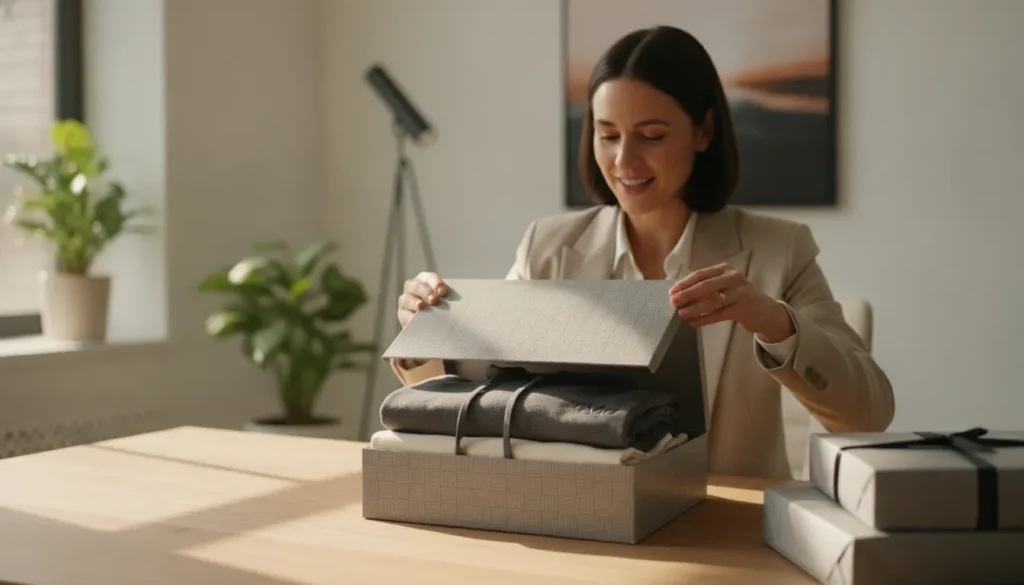
A branded shirt, welcome kit, or client gift does more than carry a logo. The way it arrives, from material selection to the final arrangement inside the box, signals how carefully a company manages its brand. For teams distributing merchandise at scale, presentation is part of the delivery experience, not an afterthought.
Start a project with a partner that can connect creative execution with fulfillment.
Corporate merchandise packaging is the designed presentation and protection of branded products during storage, shipment, and unboxing. It matters because every delivery creates a brand touchpoint: thoughtful materials, organization, and finishing details can make merchandise feel intentional, reinforce quality, and help recipients remember the company behind it.
That experience depends on more than a custom box. It requires the right products, decorating methods, assembly standards, inventory controls, and distribution plan working together. Brand Vessel supports that broader process through its Corporate Kitting Guide, while the next section examines why packaging belongs inside the brand experience itself.
Why Packaging Is Part of the Brand Experience
Packaging does more than protect corporate merchandise in transit. It helps attract attention, identify the sender, communicate quality, and promote the product or program inside. Packaging design is therefore a functional brand asset, not an afterthought added once product selection and fulfillment decisions are complete.
That role has become more important as e-commerce has reduced the number of physical retail interactions between brands and customers. Research from Yale School of Management notes that e-commerce adoption accelerated by an estimated four to six years within a matter of months during the COVID-19 pandemic. As more merchandise reaches recipients through shipping rather than a store counter, the package may be one of the few physical brand touchpoints they experience.
For a corporate merchandise program, the package can reinforce the organization behind the gift, welcome kit, employee uniform, or event shipment. Consistent color, material, structure, and labeling can make an order feel intentional before the recipient sees the merchandise itself. Those details also help distinguish a carefully managed program from a collection of unrelated products placed in a generic carton.
Packaging has to work for several audiences at once. The recipient should understand what has arrived and why it matters. The procurement or operations team needs a repeatable process that protects products, supports accurate assembly, and scales across locations. Brand stakeholders need confidence that the presentation reflects approved visual standards. A strong packaging plan accounts for all three without sacrificing practicality.
The delivery moment is especially valuable because it creates an opportunity to connect without relying on a physical store. Yale describes delivery and receipt as an underused touchpoint for innovation, while noting that many consumers now purchase and receive items without visiting a retail environment. The package can create that sense of arrival through thoughtful sequencing, useful inserts, product grouping, and presentation that matches the purpose of the shipment.
Execution matters as much as visual design. Brand Vessel’s Kitting and Assembly Services can help coordinate how merchandise is grouped, packed, and prepared for distribution. That operational layer keeps the experience consistent when kits must be assembled repeatedly, shipped to multiple recipients, or delivered on a defined schedule.
Effective corporate merchandise packaging makes the brand recognizable at the point of delivery while doing essential logistical work behind the scenes. When presentation and fulfillment are planned together, every shipment can communicate the same level of care as the merchandise it contains.
Custom Box and Tissue Paper Options for Corporate Kits
Packaging decisions should follow the purpose of the kit, the products inside it, and the experience you want the recipient to have. A welcome kit for a new employee may need efficient assembly and dependable protection, while an executive gift or event mailer may justify a more tactile, presentation-focused format. The strongest corporate merchandise packaging balances brand expression with storage, handling, and shipping requirements.
Color, shape, imagery, material, and convenience all influence how packaging communicates a brand. Research on packaging design identifies these elements as important contributors to brand perception, so the outside of the kit and the details inside should work as one system. Brand Vessel can help align those choices with the merchandise, audience, distribution plan, and operational requirements behind the campaign.
- Custom mailer boxes: Lightweight, efficient mailers can carry apparel, accessories, and smaller merchandise while presenting a consistent branded exterior. They are a practical choice for employee kits and direct-to-recipient programs.
- Magnetic closure boxes: A rigid box with a magnetic closure creates a more deliberate opening sequence for executive gifts, milestone packages, and high-touch brand moments. The structure should be sized to the contents rather than oversized for appearance alone.
- Custom tissue paper: Printed tissue adds a branded layer between the recipient and the merchandise. It can reinforce campaign colors and create visual consistency without requiring every product inside the box to carry the same treatment.
- Compartment inserts: Custom-fit inserts keep multiple items organized and reduce movement during transit. Compartments are especially useful when the kit contains products with different sizes, shapes, or presentation priorities.
- Branded cards and notes: A welcome message, event note, usage guidance, or personalized insert gives the kit context. This small component can clarify why the recipient is receiving the merchandise and connect the package to a larger employee, customer, or partner initiative.
The table below matches common packaging styles to the purpose of the program.
| Packaging option | Best for | Protection | Presentation | Scalability |
|---|---|---|---|---|
| Custom mailer box | Employee kits, direct-to-recipient programs | Solid for lightweight goods | Clean branded exterior | High |
| Magnetic closure box | Executive gifts, milestone moments | Strong rigid structure | High, deliberate opening | Low to medium |
| Custom tissue paper | Apparel and soft goods | Light cushioning | Branded reveal layer | High |
| Compartment inserts | Multi-item kits | Prevents shifting damage | Organized, intentional | Medium |
| Branded cards and notes | Context and personalization | Minimal | Adds narrative | High |
The delivery moment can carry more emotional weight than procurement teams sometimes expect. A Yale School of Management analysis reports that 52% of consumers felt receiving a package was like getting a gift. Suggesting that thoughtful presentation can turn a routine shipment into a positive brand touchpoint. For additional planning inspiration, see Swag Box Ideas for Employees.
For a scalable program, packaging should also be evaluated against pack-out time, dimensional weight, replenishment, storage space, and distribution destinations. A beautiful box that slows fulfillment or creates avoidable shipping damage is not a successful kit. Brand Vessel can coordinate the creative packaging layer with kitting and logistics so the finished experience remains consistent from the first assembly run through ongoing replenishment.
How Corporate Merchandise Packaging Shapes Brand Perception
Corporate merchandise packaging is often the first physical interaction someone has with a brand after placing an order or receiving a company kit. That interaction can reinforce the quality, care, and consistency promised by the organization, or it can create friction before the recipient sees the merchandise. Packaging therefore deserves the same strategic attention as product selection, decoration, and fulfillment.
Point-of-sale research illustrates the influence of presentation. One academic review reports that around 73% of purchasing decisions are made at the point of sale, where packaging design is a major factor. While corporate merchandise is frequently distributed through employee programs, events, onboarding, or direct shipment rather than a retail shelf, the underlying principle still applies: visual and physical cues shape judgments quickly. See how Brand Vessel connects creative execution with logistics through Branded Merchandise Services & Company Stores.

Make the unboxing moment carry the brand
Recipients may encounter a box, mailer, tissue paper, insert, and product in sequence. Each element can create a coherent progression, from anticipation to discovery to use. A well-planned presentation might use restrained color, a clear opening sequence, and placement that keeps the most important item visible first. The objective is not decorative excess. It is to make the experience intuitive while expressing the organization’s standards.
Research on delivery experiences emphasizes peak moments, the points people remember most strongly. Brands can use unboxing to create a memorable moment while communicating their values, rather than treating delivery as an invisible operational step. In a corporate setting, this can support an employee welcome, recognize a milestone, or make a client gift feel considered. A consistent ritual, such as opening a branded sleeve before revealing the kit, can also make the experience easier to recall.
Use sensory and visual cues with purpose
Texture, weight, finish, and even a subtle scent can influence how a package is perceived. Yale research identifies textures and scents as underused tools for making an unboxing experience more memorable. These choices should fit the audience and the merchandise. A soft-touch finish may suit a premium apparel launch, while durable, easy-to-open materials may better serve a large employee distribution program.
Distinctive design also helps a brand stand apart from comparable vendors and campaigns. Good packaging design can differentiate a brand and instill a particular perception in the recipient’s mind. For procurement teams, that means defining the intended impression before selecting materials: efficient and practical, elevated and giftable, or creative and energetic. The strongest corporate merchandise packaging makes that impression consistent without adding unnecessary complexity to storage, assembly, or shipping.
Can Sustainable Packaging Keep Corporate Merch On-Brand?
Yes, when sustainability is treated as part of the brand experience rather than an afterthought. Packaging communicates before the recipient reads a message, tries on a garment, or uses the merchandise. Material choices, the amount of space left in a box, and the ease of disposal all signal how a company translates its stated values into operational decisions.
That signal can work against the brand when the presentation relies on unnecessary layers. Research on influencer PR gifts found that excessive packaging can conflict with a company’s green rhetoric and create waste that is largely overlooked in the public conversation. The broader lesson applies to employee kits, event merchandise, customer gifts, and company-store orders: a polished unboxing does not need to be wasteful.
For corporate merchandise packaging, the right standard is purposeful restraint. Packaging should protect products in transit, preserve presentation quality, and make the recipient’s next step clear without adding materials that serve no functional or brand purpose. Brand Vessel can coordinate those decisions alongside storage and distribution requirements through Branded Merchandise Warehousing Storage, so the packaging approach remains consistent as orders move through fulfillment.
Sustainable packaging options for branded merchandise
- Recycled cardboard: Use sturdy recycled-content boxes sized for the actual kit, apparel, or product mix rather than defaulting to oversized cartons.
- Soy-based inks: Apply brand color and messaging with soy-based inks when the substrate and production specifications support them.
- Minimal void fill: Reduce empty space with right-sized packaging and only enough protective material to prevent shifting, scuffing, or damage.
- Recyclable mailers: Select recyclable mailers for appropriate lightweight shipments, while confirming that the material fits the product and destination requirements.
These options do not require a neutral or generic presentation. A restrained palette, accurate color reproduction, a thoughtful opening sequence, and a short message can keep the package recognizably on-brand. The creative brief should define what the recipient should feel and do. While procurement and fulfillment teams confirm that the materials can be sourced, stored, packed, and processed at the required volume.
Consistency matters as much as the individual material. If one campaign uses minimal recyclable packaging while another arrives with layers of disposable inserts. Recipients may experience a gap between the company’s stated sustainability position and its behavior. Packaging choices should therefore be documented as part of the merchandise program, reviewed with the kitting partner, and evaluated against protection, cost, scalability, and disposal realities.
Brand Vessel’s role is to help connect that brand standard to the practical work of inventory handling and shipment preparation. The result is packaging that supports the merchandise, the recipient experience, and the company’s sustainability position without asking presentation to depend on excess.
What to Include in Your Packaging Brief for a Kitting Partner
A strong packaging brief gives a kitting partner the information needed to balance brand presentation with warehouse, shipping, and assembly requirements. Packaging must protect products in transit, support efficient handling, identify the kit clearly, and promote the brand when the recipient opens it. Packaging design serves all of these functional and promotional roles, not just the visual one. Research on packaging design identifies protection, transportation, storage, identification, and promotion as interconnected objectives.
Include the following details before production begins:
-
Product list and kit contents
List every item, variation, and component that belongs in the kit. Include product names, quantities per kit, sizes, colors, SKUs, and any rules for substitutions. Note which items are fragile, moisture-sensitive, temperature-sensitive, or likely to damage other contents. A complete product list allows the kitting team to plan protection, compartmentalization, assembly, and quality checks accurately.
-
Design and brand assets
Provide approved logos, colors, typography, artwork, usage rules, and examples of related branded merchandise. Specify where branding should appear and whether the outside of the package, interior lid, inserts, or individual components require decoration. Include final artwork files and identify the person authorized to approve proofs.
-
Packaging materials and print specifications
Describe the desired box, mailer, insert, tissue, labels, protective padding, and closure method. State dimensions, finish, print coverage, color requirements, and tolerance for variation. Materials should reflect the products and shipping conditions. Packaging may use paper, plastic, glass, metal, or other materials depending on the nature of what the container must hold, protect, and transport.
-
Sustainability requirements
Define recyclable, reusable, compostable, recycled-content, or plastic-reduction requirements in measurable terms. Clarify whether sustainability claims need documentation or approved wording. Packaging choices communicate brand values without explanation, so unnecessary layers or oversized materials can undermine an otherwise responsible merchandise program.
-
Unboxing structure
Map the order in which recipients should encounter the contents. Identify the first visible item, placement of welcome cards or instructions, reveal points, and any finishing details. The sequence should feel intentional while remaining practical for assembly. If the kit is meant to create a launch, onboarding, recognition, or gifting moment, state the desired recipient response.
-
Quantity and budget
Provide estimated launch quantities, reorder volumes, delivery dates, destinations, and budget ranges for packaging and assembly. Include expected peaks, regional requirements, and whether kits will ship individually or in bulk. These details help a kitting partner recommend a structure that is attractive, protective, scalable, and financially workable across the program lifecycle.
The more precise the brief, the fewer assumptions remain between creative approval and finished shipment. It also gives Brand Vessel a practical basis for coordinating packaging, kitting, fulfillment, and distribution as one connected operation, consistent with the process outlined in the Corporate Kitting Guide.
Start a project to align your packaging brief with a kitting partner that can carry it from concept to delivery.
Frequently Asked Questions
How can corporate merchandise packaging improve brand impact?
Packaging turns delivery into a deliberate brand touchpoint. Coordinated color, structure, materials, and inserts can make the contents feel considered before the recipient uses them. A well-planned unboxing also gives employees, clients, or event attendees a clearer sense of the organization behind the merchandise.
What should be included in custom corporate merchandise packaging?
Start with a package that protects the merchandise and fits the fulfillment process. Depending on the kit, useful elements may include a branded box or mailer, tissue paper, a product or welcome card, customized inserts, and a personalized note. The contents, dimensions, and packing sequence should be defined together.
Is custom packaging worthwhile for employee welcome kits?
It can be, especially when the kit is intended to introduce company culture or create a consistent experience for distributed employees. Custom packaging helps the welcome moment feel intentional, while a kitting partner can standardize assembly, inventory handling, and shipping across locations.
How does packaging affect the unboxing experience?
Recipients encounter the packaging before they encounter most of the merchandise, so opening order, accessibility, visual balance, and material feel all influence the experience. Design should create a clear progression from exterior to contents without adding unnecessary layers, frustrating closures, or difficult-to-recycle components.
Can sustainable packaging be used for corporate merchandise?
Yes. Recycled or recyclable paperboard, right-sized cartons, reusable components, and minimal protective materials can support a lower-waste approach. The best choice depends on the merchandise, shipping conditions, presentation goals, and available recovery systems. Sustainability should be addressed in the packaging brief rather than treated as an afterthought.
Ready to Start a Project?
Thoughtful corporate merchandise packaging can help connect the product, presentation, and brand experience into one cohesive delivery. Brand Vessel can help you plan the packaging details alongside the merchandise, kitting, and fulfillment requirements. Start a Project to share your goals and discuss a practical path from concept to delivery.