
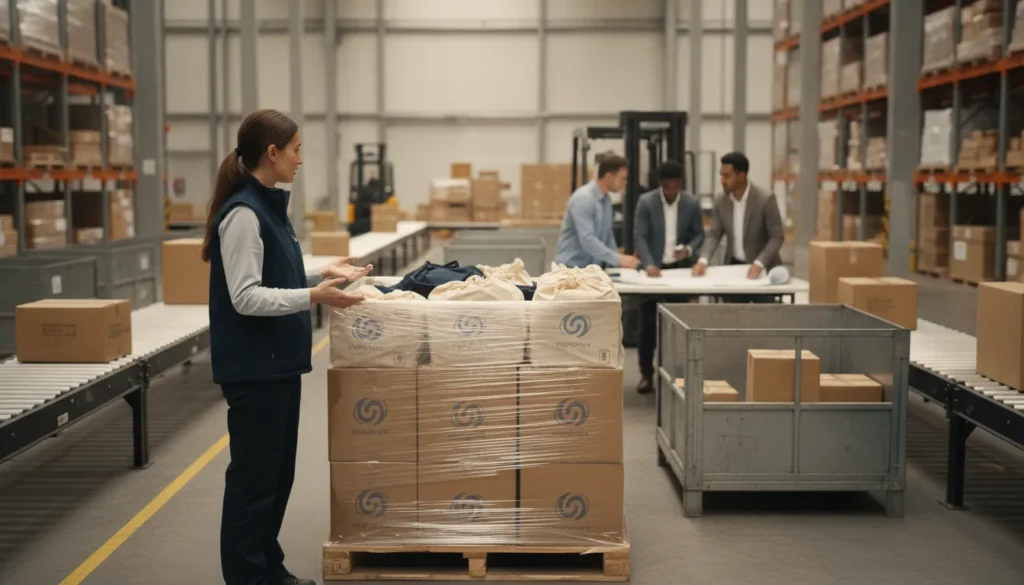
Global merchandise programs rarely fail because a team cannot move a box. They fail when regional requirements, partner handoffs, inventory decisions, and brand standards are managed as separate problems. An enterprise program may need one consistent identity while adapting product selection, delivery methods, documentation, and customs processes for each market.
Start a project with Brand Vessel to build a more coordinated merchandise distribution program.
Effective global promotional products distribution combines centralized brand and inventory controls with regional operational flexibility. Enterprise teams need partners that can coordinate sourcing, company stores, kitting, fulfillment, and customs brokerage while adapting execution to local requirements. Brand Vessel supports that connected model through global fulfillment logistics and integrated merchandise services.
The operating challenge is deciding what should remain consistent, what must be localized, and how every partner contributes to a dependable experience. That starts with understanding why international distribution becomes more complex as regions, regulations, and stakeholders multiply.
The Challenge of Global Promotional Products Distribution
Global promotional products distribution is difficult because enterprise programs must coordinate brand standards with different cultures, regulations, geographies, and economic conditions. A scalable approach preserves the core identity of the brand while adapting products, channels, and delivery processes to each market. Success depends on making those decisions deliberately rather than treating every region as operationally identical.
For enterprise brands, the challenge is rarely the product alone. A shirt, kit, or event item may be approved centrally, but its route to the end user can cross multiple borders, suppliers, distribution partners, and internal teams. The CAGE framework from the University of Minnesota identifies four sources of international distance that affect marketing and distribution decisions:
- Culture: Color, imagery, sizing, messaging, gifting customs, and product preferences can vary substantially by market.
- Administration: Import requirements, documentation, tax treatment, and local institutions can affect how merchandise moves.
- Geography: Distance, time zones, infrastructure, and delivery conditions influence lead times and service expectations.
- Economics: Purchasing power, market costs, currency conditions, and local distribution economics shape viable program choices.
These differences make a single global playbook difficult to apply without modification. The CAGE framework explains that companies must decide where to adapt their approach and where to avoid unnecessary complexity when entering or serving international markets. For a merchandise program, that can mean defining which elements are globally fixed, which are regionally configurable, and which require local review.
Why standardization does not work everywhere
Standardization can improve purchasing control and protect visual consistency, but it does not remove local operating realities. Research published through Drexel University identifies culturally distant distribution behavior, rigidity in distributive institutions. And international functional fragmentation as forces that inhibit a firm’s ability to standardize channel strategy. In practice, a process that works smoothly in one country may not transfer directly to another because the channel structure, expectations, or responsibilities differ.
That tension is especially visible when a central procurement team selects merchandise for a decentralized workforce. A universal item list may simplify approval, yet regional teams may need different products, sizes, packaging, or delivery options. Conversely, unrestricted local purchasing can create inconsistent branding, duplicate vendors, and limited visibility into inventory. The operating objective is not total uniformity. It is controlled flexibility.
A practical global program separates the brand system from the market execution. Central teams can establish approved logos, core colors, quality standards, and usage rules. Regional teams can then provide input on relevant products and local requirements within those boundaries. This approach supports consistent brand messaging while recognizing that local preferences and regional market needs may justify product variations. As described by the University of Minnesota’s international business research.
The same principle applies to physical movement. A distribution model should account for where items are stored, how kits are assembled, and which delivery route best serves each audience. Planning around global fulfillment logistics helps connect brand governance with the practical work of preparing and delivering merchandise across regions. Without that operational layer, a well-designed global brand program can still produce uneven employee experiences, avoidable delays, and costly rework.
What Partners Are Needed for a Global Merch Program?
Enterprise merch programs rarely succeed through product sourcing alone. The operating model also needs partners that can move goods, manage inventory, navigate borders, and give distributed teams a controlled way to order approved items. Each partner should have a defined role, measurable service levels, and the systems needed to coordinate with procurement, marketing, human resources, and regional offices.
Kitting and fulfillment partners
Kitting and fulfillment support becomes especially important when a program includes onboarding kits, event shipments, campaign packages, or recurring employee orders. A capable partner can store approved merchandise, assemble kits from multiple components, and ship finished packages from a central location. Brand Vessel describes corporate kitting and fulfillment as a way to support efficient storage, packing, and global shipping of promotional items to employees or clients worldwide. See What Is Corporate Kitting? for the operating model.
For an enterprise buyer, the evaluation should focus on execution details rather than a broad promise of global reach. Look for:
- Inventory storage with clear counts, reorder thresholds, and ownership rules.
- Kit assembly processes that document component selection, quality checks, and pack-out requirements.
- Shipping workflows that support regional addresses, delivery windows, and exception handling.
- Reporting that connects order status, fulfillment performance, and inventory usage.
Customs brokers and trade-compliance specialists
International shipments can be delayed when product classifications, documentation, duties, or local import requirements are incomplete. Customs brokerage expertise helps an enterprise address those requirements before merchandise reaches a border. Brand Vessel identifies customs brokerage as a complex part of global distribution, requiring specialist knowledge to support compliance and avoid shipping delays. The related guide, What Is Customs Brokerage for Branded Merchandise?, provides additional context.
This partner should be involved early, not only after a shipment is held. Procurement teams should confirm who prepares commercial invoices, determines classifications, manages broker communications, and escalates customs exceptions. It is also useful to define how the program handles products that vary by market. Since a standardized item list may not satisfy every region’s regulatory or import conditions.
Centralized inventory and company-store technology
Technology gives a global program a control layer between approved merchandise and local demand. A centralized inventory platform can help branches access current, approved collateral while preserving visibility into stock and replenishment. Brand Vessel states that centralized inventory management supports global consistency by giving every branch access to approved branded collateral.
A company-store platform extends that control to decentralized workforces. In practice, the right system should make it easy to manage permissions, regional assortments, budgets, approvals, and reporting without allowing local teams to create uncontrolled variations. Enterprise teams can assess this model through Custom Company Stores.
The strongest global promotional products distribution programs connect all three partner capabilities. Fulfillment moves the right package, customs expertise helps it cross the right border, and centralized technology helps each region order from the right assortment. Together, these functions create a more reliable operating model than treating each shipment or office as a separate project.
What Regional Compliance Issues Affect Branded Products?
A global merchandise program cannot treat every shipment as a domestic order with a longer delivery address. Customs requirements, duty treatment, product restrictions, and labeling obligations can change by destination, product category, and intended use. Research on international distribution also shows that culturally distant distribution behavior, rigid local institutions, and fragmented international functions can limit a company’s ability to standardize its channel strategy. That research reinforces a practical point for procurement teams: global promotional products distribution requires a controlled framework that still allows regional adaptation.
Before approving a product for broad rollout, teams should identify the compliance questions that apply in each destination market. Common categories include:
- Customs declarations: Shipment descriptions, classifications, values, quantities, and country-of-origin details must accurately reflect what is moving across the border. Incomplete or inconsistent information can create avoidable questions during clearance.
- Duties and tariffs: The landed cost of a branded product may differ by destination. Duty treatment can affect whether a standard product, locally sourced alternative, or regional inventory model makes the most operational sense.
- Labeling and consumer-safety rules: Some markets require specific product, fiber, packaging, or warning information. California Proposition 65-style requirements are one example of why a label or packaging approach that works in one location may need review before use elsewhere.
- Restricted materials: Batteries, chemicals, treated materials, food-contact items, and other regulated components may require additional documentation, handling, or transport controls. Product substitutions should be evaluated before a campaign is committed.
- Intellectual property and brand protection: Approved artwork, trademarks, and licensed marks need controls across suppliers and regions. A product that is technically importable can still create risk if decoration, sourcing, or distribution does not follow brand authorization rules.
These categories are interconnected. A product change made to satisfy a local labeling rule can alter its tariff classification, packaging dimensions, or fulfillment process. Likewise, a regional variation may be strategically appropriate when local preferences or market conditions make a single standardized product unsuitable. The University of Minnesota’s international business guidance describes this broader tension: global firms must account for differences in culture. Administration, geography, and economics when deciding how to adapt or enter international markets. Its CAGE framework provides useful context for planning, but the operational review still needs to happen at the shipment and product level.
That is why customs brokerage should be part of the program design, not an emergency escalation after a shipment is held. Expert brokerage helps connect commercial documentation, classification, duties, and regulatory requirements before merchandise moves. Brand Vessel is differentiated by its rare in-house customs brokerage capability, giving teams a knowledgeable partner for the compliance work that sits between approved merchandise and successful delivery. For a deeper explanation of the function, see What Is Customs Brokerage for Branded Merchandise?
Procurement and marketing teams can also use How to Ship Branded Merchandise Internationally: A Logistics Guide when building shipment requirements. The goal is not to eliminate every regional difference. It is to document those differences early, assign ownership for review, and preserve a consistent brand experience wherever local rules permit.
How to Manage a Global Merch Program from One Platform
A global merchandise program becomes easier to control when employees, regional teams, procurement leaders, and logistics operators work from the same operating system. Instead of maintaining disconnected spreadsheets, email approvals, and local vendor relationships, an enterprise can coordinate approved products, ordering rules, inventory, and fulfillment through one platform.
A centralized approach does not mean every market must receive identical merchandise. Global programs still need room for regional preferences, shipping requirements, and local purchasing practices. The advantage is that those variations can be managed deliberately while the core brand standards remain consistent.
For enterprise teams evaluating Custom Company Stores, the platform should connect the storefront experience to the operational work behind each order. Brand Vessel combines a creative platform with vertically integrated logistics, giving teams one place to manage the customer-facing program and the physical movement of merchandise.
- Consolidate the approved catalog. Define logos, colors, apparel standards, and eligible products once so every region orders from the same branded source of truth.
- Configure regional guardrails. Assign products, budgets, permissions, and delivery options by region, business unit, or user group inside the platform.
- Connect fulfillment and kitting. Link storefront orders to storage, kit assembly, and shipping so approval, inventory, and fulfillment share one workflow.
- Publish reporting to stakeholders. Give procurement, brand, and regional teams visibility into order volume, spend, demand, and inventory by market.
Centralize the inventory your teams are allowed to order
Centralized inventory management helps maintain brand consistency across global branches by giving each location access to approved branded collateral and merchandise. The platform becomes the controlled source of truth for product availability, artwork, decoration specifications, and replenishment needs. That reduces the risk of one office ordering outdated apparel or an unapproved product variation.
Centralization also gives procurement teams a clearer view of demand. They can identify which products are moving by region, which items need replenishment, and where excess inventory may be sitting. Those decisions are more reliable when product and order information is managed in one system rather than reconstructed from multiple local reports.
Configure regional rules without losing global control
A decentralized workforce may need different ordering experiences, but local flexibility should operate inside defined guardrails. A global platform can assign products, budgets, permissions, and delivery options by region, business unit, office, or user group. That lets a North American sales team order one approved kit while an international office selects a regionally appropriate option from the same branded environment.
Regional configuration is especially important because global distribution is shaped by cultural, administrative, geographic, and economic differences. Research on international marketing and distribution identifies these differences as the CAGE factors that require companies to adapt how they operate across markets. A single platform makes those adaptations visible and governable rather than leaving each branch to improvise.
Build reporting and approvals into the workflow
Technology should make oversight easier, not add another dashboard for teams to maintain. Look for capabilities such as:
- Automated reporting: Track order volume, spend, product demand, inventory levels, and regional activity without manually consolidating branch data.
- Brand approvals: Route new products, artwork, decoration methods, and campaign kits through an approval process before they become available to users.
- Multi-currency support: Present budgets and order values in the currencies relevant to each market while preserving centralized visibility for finance and procurement.
- Shipping controls: Apply destination-specific shipping methods, delivery instructions, and fulfillment rules to reduce avoidable exceptions.
- Inventory controls: Set availability and replenishment rules so high-priority teams can access the merchandise they need without compromising program-wide planning.
Company stores are well suited to this model because they can scale ordering across decentralized global workforces while keeping brand representation consistent. When the store, inventory, kitting, fulfillment, and shipping processes are connected. Brand Vessel can help enterprise teams manage global promotional products distribution with fewer handoffs and a clearer operational record.
What to Expect From a Global Merch Distribution Partner
| Capability | Commodity vendor | Global distribution partner |
|---|---|---|
| Customs and trade compliance | Highest-bidder freight forwarding, reactive escalation | In-house brokerage and documentation owned early in program design |
| Warehousing and kitting | Point-of-sale shipping only, minimal assembly | Controlled storage, documented kit specs, and quality checks |
| Fulfillment reach | Single region or carrier relationships | Multi-region shipping with agreed SLAs and exception handling |
| Inventory visibility | Batch reports, limited real-time data | Current available, allocated, and replenishment data per program |
| Brand control | Each office sources independently | Centralized approvals and approved assortments across regions |
A capable partner should make international merchandise operations more predictable, not add another layer of coordination. Managing a global supply chain requires decisions about where products are sourced and distributed so operations remain smooth across regions. According to the University of Minnesota’s overview of global marketing, distribution, and supply-chain management. The source explains how sourcing and distribution choices shape international operations.
That standard applies to promotional products as much as any other distributed program. Your partner should be able to define service levels, document ownership at each handoff, and report performance against agreed expectations. The deliverables should cover the physical movement of merchandise as well as the information procurement, brand, and regional teams need to make decisions.
- Customs brokerage and border support: International shipments require attention to customs processes and regulatory requirements. A partner with customs brokerage expertise should coordinate the information needed for compliant movement and help reduce avoidable delays. Define who owns classification, documentation, duties, and exception management before launch. Brand Vessel’s Branded Merchandise Fulfillment Partner: Evaluation Guide can help procurement teams structure that evaluation.
- Warehousing and kitting: Storage should connect directly to assembly and fulfillment workflows. Kitting and fulfillment support the efficient storage, packing, and global shipping of branded merchandise kits from a central location. Expect documented kit specifications, quality checks, order cutoffs, and an escalation path for missing or damaged components. For a deeper look at the operating model, see What Is Corporate Kitting? A Complete Guide for B2B Teams.
- Global shipping coordination: A distribution partner should explain how orders move from inventory to destination, including the handoffs that affect transit time and delivery status. Service-level agreements should identify expected processing windows, supported destinations, carrier responsibilities, and the process for exceptions. The goal is not a single universal promise for every region, but clear, measurable expectations by shipment type and destination.
- Inventory visibility: Enterprise teams need a current view of available, allocated, and replenishment-sensitive merchandise. Ask whether stakeholders can see inventory by location or program, how frequently records are updated, and how low-stock conditions are communicated. Visibility allows teams to make sourcing and distribution decisions before a shortage disrupts a campaign or employee initiative.
- Brand-consistent packaging: Packaging requirements should be documented alongside product and kit specifications. A reliable partner can apply approved packaging standards while still accommodating the operational needs of different regions, audiences, or campaigns. This is especially important when merchandise is distributed through multiple channels and handled by local teams.
- Reporting and continuous review: Reporting should connect activity to the service levels agreed at the outset. Request a practical cadence for order status, inventory, shipment exceptions, and fulfillment performance, with named owners for reviewing the data. Reports are most useful when they surface decisions and risks, rather than only listing completed transactions.
Use the discovery process to test whether a proposed partner can integrate these capabilities into one accountable operating model. Kitting is not an isolated add-on. It is an essential component of global distribution because it links storage, packing, and shipping to the experience the recipient receives. For additional enterprise context, review Corporate Swag for Large Companies: Scale and Quality.
Before signing, document the scope of each SLA in operational terms: what is measured. When the clock starts, which regions or order types are included, how exceptions are reported, and who resolves them. That level of specificity gives Brand Vessel or any shortlisted provider a clear basis for designing a global promotional products distribution program that procurement and regional teams can manage with confidence.
Why Global Promotional Products Distribution Matters for Enterprise Brands
Enterprise brands rarely operate from one office, one market, or one set of employee needs. A global promotional products distribution program gives procurement, marketing, and regional teams a shared operating framework without forcing every market to use an identical assortment. The objective is controlled consistency: approved brand standards, dependable fulfillment, and enough local flexibility to keep merchandise relevant.
That balance matters because international distribution is shaped by more than distance. The CAGE framework identifies cultural, administrative, geographic, and economic differences as factors that affect how companies approach international markets and distribution decisions. Research also finds that culturally different distribution behavior and fragmented international functions can limit a firm’s ability to standardize channel strategy.
For enterprise brands, a well-run program turns those constraints into manageable operating decisions. It can help teams:
- Protect brand consistency: Centralized approval processes make it easier for regional offices to access the right logos, colors, apparel standards, and campaign assets instead of sourcing inconsistent substitutes.
- Support useful local adaptation: Regional teams can select products, sizes, decorating methods, or delivery approaches that fit local preferences while staying within defined brand guardrails. Standardization should govern the brand system, not eliminate every market-level decision.
- Control costs and lead times: Coordinated sourcing, inventory planning, storage, and fulfillment reduce the need for each office to solve the same purchasing and shipping problems independently.
- Keep decentralized workforces on-message: Employees in different countries can order approved merchandise through a consistent process. Giving distributed teams a practical way to represent the brand at events, in customer meetings, and during internal initiatives.
This is where a company store and disciplined fulfillment model become operational tools rather than simple ordering conveniences. Custom Company Stores can give authorized teams access to approved merchandise while preserving central visibility into what is being ordered and where demand is developing.
The strongest programs also connect ordering with the physical work behind distribution. Storage, kitting, delivery coordination, and regional requirements must support the brand promise after an item leaves the catalog. By planning global promotional products distribution around both brand governance and regional realities. Enterprise organizations can scale merchandise programs with fewer avoidable surprises and a more consistent experience for every office and audience.
Start a project with Brand Vessel to design a global distribution program that keeps your brand consistent across every region.
Frequently Asked Questions
What are the main challenges of global promotional products distribution?
Enterprise programs must coordinate customs, shipping costs, inventory, and regional compliance while preserving a consistent brand. Cultural preferences and local market conditions can also require product or messaging adjustments. The CAGE framework highlights the effects of cultural, administrative, geographic, and economic differences on international distribution (University of Minnesota).
How do customs and duties affect international merchandise programs?
Customs classification, documentation, duties, and local requirements can increase landed costs or delay delivery when they are not managed early. A partner with customs brokerage expertise can review shipment details, coordinate required paperwork, and help reduce avoidable border issues before products move between regions.
What role does technology play in managing global distribution?
A centralized merchandise platform gives approved teams visibility into inventory, ordering, and distribution across locations. Company stores can support decentralized workforces while maintaining approved product and branding standards. The right system should also make regional reporting and replenishment decisions easier for procurement teams.
How should an enterprise choose a global promotional products distributor?
Evaluate the partner’s sourcing and distribution capabilities, customs knowledge, inventory controls, fulfillment capacity, technology, and quality processes. Ask how it handles regional variations, kitting, returns, and service-level reporting. A strong partner should connect creative production with storage, fulfillment, and international logistics rather than treating each function as a separate handoff.
Ready to Start a Global Distribution Project?
Global promotional products distribution requires coordination across regions, partners, and compliance requirements. Brand Vessel can help you establish a more consistent operating plan for sourcing, fulfillment, and delivery across your markets. To discuss your requirements, start a project with Brand Vessel and share the regions, product categories, and program goals your team needs to manage.