
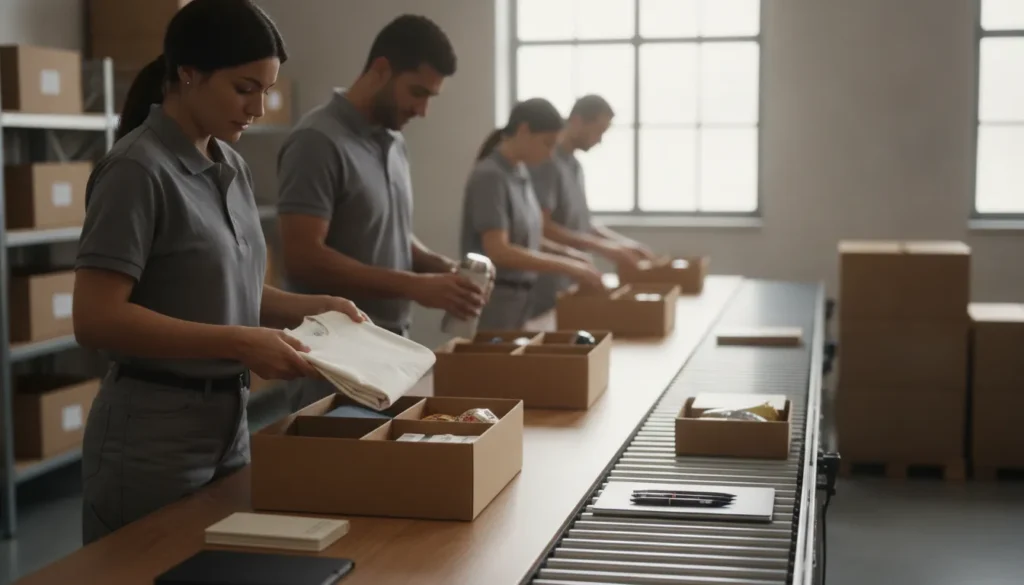
When a merchandise program includes apparel, accessories, printed materials, and fulfillment requirements, the assembly work can become a hidden operational bottleneck. Teams may be able to source every component, but coordinating inventory, packaging, quality checks, and shipment timing often pulls procurement, marketing, and HR away from higher-value priorities.
Start a project to plan a more efficient merchandise fulfillment program.
Kitting and assembly services combine separate products into organized, ready-to-distribute packages. For businesses, that can mean onboarding kits, event merchandise, company store orders, or campaign bundles assembled with consistent components, packaging, and quality control. Outsourcing the work can also provide scalable labor and more precise inventory coordination.
The right approach depends on what is being combined, how orders will be fulfilled, and where quality responsibility sits. Brand Vessel connects merchandise sourcing, packaging, logistics, and fulfillment, as outlined in What is corporate kitting. That integrated view helps clarify what the service includes and where it creates value.
What Are Kitting and Assembly Services?
Kitting and assembly services are managed operations that turn separate merchandise or product components into a finished, distribution-ready package. For a B2B buyer, that can mean a new-hire onboarding kit, a company store order, an event package, or a multi-item campaign assembled to a defined specification. The provider manages the labor, inventory controls, packaging, and handoff so internal teams do not have to coordinate each piece manually.
Kitting groups the right components together
Kitting is the process of selecting multiple individual items and grouping them into one defined kit. The contents may include apparel, promotional products, printed materials, packaging, or other branded merchandise. A kit can be built for a specific recipient, campaign, employee group, or fulfillment workflow.
For example, a company may create a new-hire package containing a branded shirt, notebook, welcome materials, and an access item. Instead of treating each component as an unrelated pick, the provider establishes the kit as a repeatable unit. That approach is especially useful for company store programs and recurring employee or customer distributions.
Assembly adds the hands-on preparation
Assembly describes the physical work required to prepare those components for use or shipment. Depending on the program, that may include inserting items into custom packaging. Applying labels or stickers, arranging products in a prescribed order, adding protective materials, or completing secondary packaging. Purdue’s MEP documentation lists kitting and assembly alongside labeling, repack and rework, display builds, and other production-support services, showing the broader scope a professional operation may cover: Purdue MEP’s kitting and assembly service examples.
The terms overlap, but the distinction matters when evaluating a provider. Kitting defines what belongs together. Assembly defines how those components are prepared, presented, and made ready for the next step. A capable partner can manage both under one documented workflow.
Why managed workflows matter to procurement teams
Outsourcing this work gives businesses access to scalable labor rather than requiring a fixed internal team to absorb seasonal peaks or large launches. The process can also improve inventory precision by tracking individual SKUs as components move into each kit. Brand Vessel’s overview of What is corporate kitting explains how pre-assembled kits support more controlled fulfillment.
- Single-SKU consolidation: Multiple components can be treated as one finished kit for the relevant logistics workflow, simplifying picking and helping reduce shipping and handling complexity.
- Inventory visibility: Component-level tracking helps teams understand what is available, committed, assembled, and ready for distribution.
- Consistent execution: Written specifications and repeatable checks help each recipient receive the intended items in the intended presentation.
- Scalable capacity: A managed workforce can support onboarding waves, corporate events, and campaign deadlines without expanding permanent headcount.
For procurement, the value is not merely faster packing. It is a controlled service layer connecting merchandise, inventory, packaging, and fulfillment. That creates a more predictable experience for the teams ordering kits and the people who receive them.
How Kitting Differs from Simple Bundling
Bundling and kitting both bring multiple products together, but they support different fulfillment models. A bundle is generally a group of items placed together for a promotion or sale. Professional kitting goes further by treating those components as one prepared unit, with a defined configuration, inventory logic, quality checks, and shipping outcome.
That distinction matters when a program includes hundreds or thousands of recipients, multiple fulfillment destinations, or a fixed delivery window. A team may be able to place items in the same carton manually, but a kitting operation is designed to make the result repeatable and traceable. Brand Vessel uses this type of structured approach across branded merchandise, company stores, onboarding packages, and event kits. For additional context, see What Is Corporate Kitting.
| Criteria | Simple bundling | Professional kitting |
|---|---|---|
| Definition | Places several related items together so they can be presented or shipped as a group. | Combines specified components into a consistent, ready-to-ship set that functions as a single fulfillment unit. |
| SKU and logistics | Items may remain separate in inventory, with staff picking and packing each component when an order is received. | Components are consolidated into a single SKU or kit configuration for clearer logistics and more efficient handling. Pre-assembly can streamline shipping and handling for complex fulfillment operations. |
| Quality control | Checks may depend on the individual packer and may occur informally during order preparation. | Uses a defined assembly process to verify that every required component is present and presented consistently. Professional assembly can also include labeling, stickering, repack, rework, and secondary packaging, as described by Purdue MEP’s profile of Accion Performance. |
| Target use | Best suited to straightforward promotions or low-volume orders where flexibility matters more than process control. | Useful for company stores, employee onboarding, corporate events, recurring campaigns, and other programs that require repeatable preparation at scale. |
| Outcome | Creates a convenient grouping, but may leave more picking decisions and quality variation at the point of shipment. | Improves order accuracy by grouping required components in advance and can optimize how materials fit shipping containers, reducing unnecessary volume and packaging waste. |
The operational difference is especially important when inventory must be managed at component level. Specialized kitting systems can track the individual SKUs inside each kit, while the finished configuration remains easy to order and distribute. That visibility helps a procurement or marketing team identify shortages before a distribution window opens instead of discovering them during final packing.
In practice, bundling can be one step in a larger kitting workflow, but it is not the whole service. If the program depends on consistent contents, documented handling, accurate inventory, or efficient shipping. Specify the finished kit, component rules, and quality requirements rather than asking a provider only to “put items together.”
Industries That Rely on Professional Kitting
Professional kitting supports more than one-time promotional shipments. It gives teams a repeatable way to assemble, brand, track, and distribute coordinated packages across locations, audiences, and delivery windows. Brand Vessel works with organizations that need dependable execution, whether the program involves a few hundred recipients or an ongoing global merchandise operation.
- Technology and software companies: New-hire onboarding kits, launch packages, conference materials, and customer welcome boxes often combine apparel, accessories, printed materials, and other branded items. A managed process keeps each package consistent while allowing recipient or location-specific components.
- Corporate events and conferences: Large events may require hundreds or thousands of attendee kits assembled on tight deadlines. Professional kitting coordinates the contents, packaging, labeling, and distribution schedule so event teams are not manually preparing packages alongside their core responsibilities. See Brand Vessel’s swag kitting for corporate events for a closer look at this use case.
- Ecommerce and retail programs: Ecommerce businesses can use kitting to group products for promotional bundles, subscription shipments, or retail-ready fulfillment. When the fulfillment system connects with ecommerce operations, inventory levels can update as kits are ordered and assembled, giving teams better visibility into available components.
- Seasonal marketing campaigns: Holiday promotions, product launches, employee appreciation initiatives, and event-specific campaigns often have narrow distribution windows. Kitting teams can assemble seasonal materials at scale, helping organizations move campaign packages quickly without creating a temporary internal labor burden.
- Company store programs: Company stores frequently require coordinated management of branded apparel, merchandise, storage, logistics, and fulfillment. Kitting can turn commonly ordered combinations into a consistent package, supporting new-hire programs, recognition initiatives, or department-specific requests while preserving brand standards.
- Healthcare and manufacturing: These organizations may distribute kits containing varied components, protective materials, instructions, or equipment-related items. Experienced assembly teams can combine fragile and non-fragile pieces with appropriate protective packaging and follow defined handling requirements for sensitive products.
- Global programs: International employee, customer, and event programs add shipping coordination, destination requirements, and customs documentation to the assembly process. A qualified partner can manage domestic and international distribution while accounting for the documentation needed to move kits across borders.
The common thread is operational complexity. Brand Vessel’s company store, fulfillment, logistics, and corporate kitting capabilities help organizations manage the details behind each kit, from component availability through final distribution.
How to Brief a Kitting Provider on Your Requirements
A strong brief gives a kitting provider enough operational detail to quote accurately, plan inventory, and deliver consistently. It should function as a shared specification, not a general request for “some kits.” Brand Vessel recommends documenting the requirements below before requesting a proposal. Especially when the project includes multiple components, recipient groups, or distribution windows.
- Define the kit contents and quantities. List every component, SKU, variant, and required quantity per kit. Include acceptable substitutions, component dimensions, expiration or lot requirements, and the total number of kits for the initial run and anticipated replenishment. If one program has several kit versions, identify each configuration separately. A precise bill of materials gives the provider a clear production baseline and helps prevent missing-item errors.
- Set branding and packaging specifications. Describe how each item should be presented, including decoration requirements, placement of branded materials, packaging type, insert order, protective materials, and finished-kit dimensions. State whether the provider must create custom labels or recipient documentation. Those services can support campaign-specific personalization, but the provider needs the rules and approved artwork before assembly begins. Packaging choices also affect shipping volume, material use, and the final presentation.
- State service levels and deadline windows. Provide the required in-hand date, ship-by date, delivery locations, expected order volume, and any milestone dates for receiving components, approving samples, or releasing orders. Clarify whether the program requires one production run, rolling fulfillment, or rapid replenishment. For events and onboarding programs, identify the consequence of a late delivery and any priority shipment requirements. This allows the provider to match labor and warehouse planning to the actual service level.
- Agree on the per-unit pricing model and inventory management. Ask how the cost-per-unit is calculated and which charges sit outside that rate, such as receiving, storage, assembly, packaging, pick-and-pack, freight, or special handling. Tailored CPU pricing can account for kit complexity and diverse product lines, but the assumptions should be written into the proposal. Also define who owns component inventory, minimum stock levels, reorder triggers, damaged-item handling, and the process for approving substitutions. Brand Vessel’s Branded Merchandise Fulfillment Partner Evaluation Guide can help structure this provider comparison.
- Establish reporting and quality assurance expectations. Specify the information your team needs, such as component availability, kits assembled, orders shipped, exception status, tracking details, and remaining inventory. Confirm reporting frequency, dashboard access, data formats, and named contacts for escalations. Real-time order tracking and reporting can keep stakeholders informed throughout kitting and fulfillment. While documented inspection steps confirm that the correct components, labels, and packaging appear in each kit. Agree on approval samples, acceptable error thresholds, photo documentation, and the corrective-action process before production starts.
Once these points are documented, ask the provider to return a scope that mirrors them. Any gap between the brief and the proposal should be resolved before components are purchased or the assembly window is reserved.
Quality Control in the Kitting and Assembly Process
Professional kitting depends on a repeatable quality system, not a final visual check performed just before shipment. Brand Vessel establishes standard operating procedures for each assembly project, then uses quality audits to confirm that every kit matches the approved specifications. Those controls matter when a campaign includes multiple SKUs, packaging formats, decoration methods, or recipient groups.
Quality gates from receiving through shipment
A reliable process begins with the component list and continues through receiving, storage, assembly, labeling, and fulfillment. Teams verify that the correct items are available, inspect components for damage or defects, and confirm that the approved sequence is being followed. At each quality gate, exceptions can be isolated before they affect a larger production run.
Automation can increase assembly speed while maintaining precision when it is paired with defined inspection points. Brand Vessel uses automated assembly and kitting technology where it improves consistency, while quality-control standards remain in place throughout production. This approach supports volume without treating speed as a substitute for review.
Order accuracy is another essential control. Grouping the required components before an order reaches the recipient reduces picking errors and helps ensure that every kit contains what the campaign specifies. For programs with multiple versions, serialized items, or recipient-specific inserts, the bill of materials and final pack-out check should be treated as production controls, not informal packing notes.
Protecting components and the recipient experience
Not every kit can be assembled the same way. Fragile components may need protective packaging, separation from heavier items, or a specific placement sequence to prevent damage in transit. Experienced assembly teams account for those requirements before production begins and confirm that the completed package is secure without making it unnecessarily difficult to open.
Product safety and cleanliness also belong in the quality plan. Dedicated assembly environments help protect products and support sanitation requirements, particularly when kits contain sensitive items or materials that must remain clean. Clear handling procedures, organized work areas, and documented checks reduce the risk of contamination, mix-ups, and inconsistent presentation.
For a deeper explanation of how kitting supports inventory accuracy and fulfillment, see What is corporate kitting. Businesses evaluating the broader operational model can also review Brand Vessel’s Branded Merchandise Services, which connects kitting with storage, logistics, and fulfillment.
The result is a process that can be measured and improved: defined specifications, trained handling, documented audits, and an order-level check before release. That foundation gives procurement and marketing teams greater confidence that the kit arriving at each destination reflects the approved product, quantity, and presentation.
Frequently Asked Questions
What is the difference between kitting and assembly?
Kitting groups existing components into a ready-to-ship set, while assembly combines separate components into a finished item or configured product. A provider may perform both services in one workflow, including protective packaging, labeling, stickering, repacking, or other secondary packaging steps.
What does a kitting specialist do?
A kitting specialist plans the workflow, verifies component availability, groups the correct items, performs required assembly or customization, and checks the finished kit before shipment. The role can also include inventory tracking, packaging decisions, labeling, and coordination with fulfillment systems.
How is a kitting fee usually calculated?
A kitting fee is generally a per-unit charge for preparing each kit. The final cost depends on the number and type of components, assembly complexity, packaging requirements, labeling, quality checks, storage, and order volume. Ask for a cost-per-unit model that clearly separates one-time setup work from recurring fulfillment charges.
What is an example of kitting in a warehouse?
A new-hire onboarding kit might combine a branded backpack, notebook, welcome card, and other approved merchandise into one packaged shipment. The warehouse verifies each component, assembles the set to the required standard, and fulfills it as a single kit rather than picking every item separately for each order.
Bring Your Kitting and Assembly Program to Brand Vessel
Kitting and assembly become easier when merchandise, packaging, storage, logistics, and fulfillment operate as one connected workflow. Brand Vessel manages all of it under one program, from custom apparel and branded merchandise to company stores, kitting, and global distribution.
To get an accurate scope for your onboarding, event, campaign, or company store kits, start a project and share your component list, quantities, and delivery windows. Brand Vessel will help define the finished kit, quality checks, and per-unit pricing before production begins.
Start a project and plan your kitting and assembly program with Brand Vessel today.