A drinkware item can be useful long after an event ends, but enterprise programs need more than a logo on a tumbler. The right assortment considers where employees will use it, how it will be decorated, how consistently it will represent the brand, and how orders will be stored and delivered.
Corporate branded drinkware works best when it combines practical products, thoughtful decoration, and dependable program operations. Tumblers, bottles, and mugs can support employee engagement and brand visibility, while a managed merchandise system helps control assortment, inventory, approvals, and fulfillment as the program grows.
That program perspective matters when teams are distributed, vendors are fragmented, or different groups need different products. Brand Vessel combines branded merchandise with company stores, storage, logistics, kitting, and fulfillment, giving enterprise buyers a framework for connecting product decisions to day-to-day operations. The first step is understanding why drinkware earns a place in the broader merchandise mix.
Why Is Corporate Branded Drinkware a Useful Enterprise Merch Category?
Corporate branded drinkware earns a place in enterprise merchandise programs because it combines practical daily use with visible brand reinforcement. Bottles, tumblers, mugs, and event cups can support employees, clients, recruiting, and events, while a managed program keeps product quality, decoration, ordering, inventory, and distribution aligned with broader brand standards.
A useful drinkware program gives people an item they can use repeatedly in the office, at home, while traveling, or at an event. That repeated utility creates more opportunities for a brand to remain part of a person’s routine than a product selected only for a one-time handout. The value is not an assumed impression count. It is the fit between the item, the recipient’s habits, and the moment in which it is distributed.
Practical utility also improves the quality of the buying decision. Procurement and brand teams should evaluate how the drinkware will be used, what level of durability the audience expects, how it will be packed, and whether it can move efficiently through the organization’s distribution model. A remote employee gift, a conference giveaway, and a new-hire kit may require different formats and fulfillment plans.
Brand consistency depends on more than placing a logo on a cup. Color, artwork, decoration placement, packaging, and product quality should work together across the merchandise assortment. Brand Vessel’s stated quality focus is on products clients will actually want to wear, with attention to every stitch and creative execution. That same program-level discipline helps teams select drinkware that feels intentional rather than interchangeable.
Drinkware is strongest when it is connected to a broader merchandise strategy. It can complement custom apparel, onboarding kits, client gifts, event materials, and employee recognition without becoming an isolated product category. The operational question is whether one partner can coordinate the product, decoration, storage, ordering, and fulfillment experience. Brand Vessel combines branded products with company stores, storage, logistics, kitting, and fulfillment as part of its Branded Merchandise Services & Company Stores.
For enterprise buyers, this integrated approach can reduce fragmented vendor management and make standards easier to apply across teams and regions. It also creates room to adjust the assortment by audience while preserving a coherent brand system. Corporate branded drinkware therefore belongs in the merchandise plan not because every recipient needs the same bottle, but because a thoughtfully managed category can support multiple business moments through one consistent operating model.
Which Drinkware Styles Fit Different Corporate Programs?
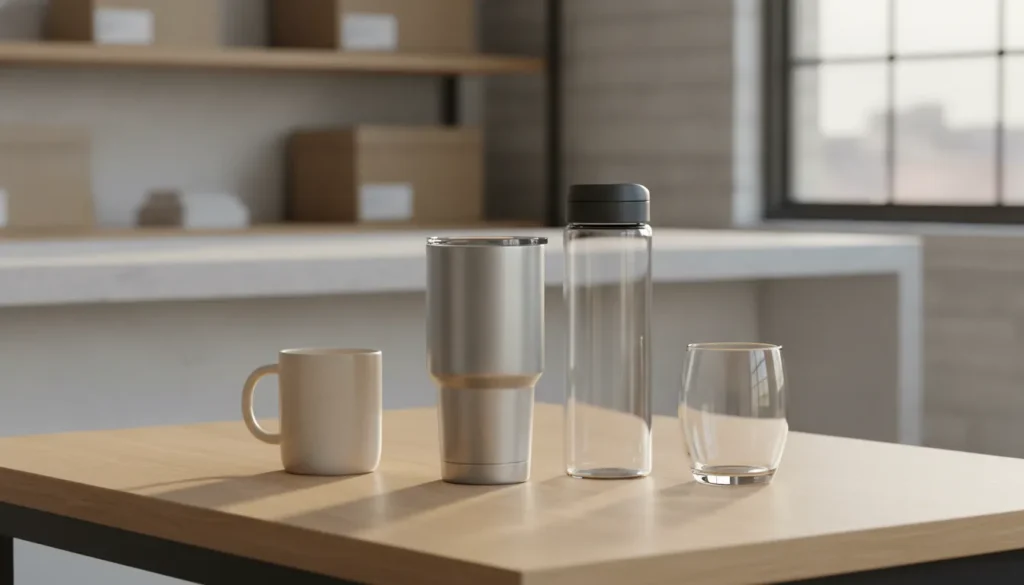
Corporate drinkware works best when the format matches the setting, audience, and distribution model. Tumblers and reusable bottles suit everyday use and employee gifting, while mugs support desk-based programs. Glassware can elevate hosted experiences, and event cups can simplify high-volume gatherings. The right choice balances brand context with durability, storage, and shipping needs.
Product categories overlap, but the operational demands do not. A bottle selected for a distributed workforce may need a different decoration approach, packaging plan, and replenishment strategy than a mug intended for a headquarters kitchen. Promotional drinkware catalogs commonly group water bottles, coffee mugs, and travel mugs together, while broader custom drinkware assortments also include insulated tumblers, stemless wine glasses, and stadium cups. VistaPrint’s listed drinkware categories illustrate the range available, not a universal recommendation for every program.
| Style | Best fit | Program considerations |
|---|---|---|
| Tumblers | Employee gifts, offices, travel, and recognition | Useful for visible daily branding; assess lid design, packing protection, and storage footprint. |
| Reusable bottles | Distributed teams, wellness initiatives, and outdoor or field programs | Consider portability, audience preferences, material documentation, and individual shipping needs. |
| Mugs | Office kitchens, onboarding, client gifting, and desk-based teams | Strong fit for workplace routines; ceramic or other heavier formats require careful storage and protective packaging. |
| Glassware | Executive gifting, hospitality, celebrations, and hosted events | Creates a more elevated setting; plan for breakage protection, controlled distribution, and appropriate use environments. |
| Event cups | Conferences, festivals, team gatherings, and high-volume activations | Prioritize event context, efficient packing, clear brand presentation, and a practical post-event handling plan. |
Use case should lead the selection
Start with how people will receive and use the item, rather than choosing a familiar product name. These questions help procurement and brand teams narrow the assortment:
- Who is the audience? Employees, clients, executives, event attendees, and field teams may value different formats.
- Where will it be used? Desk, commute, conference venue, hospitality setting, and outdoor work each create different practical requirements.
- How will it move? Bulk delivery to one office is simpler to plan than individual shipments across regions.
- How much handling will it receive? Select a format and protective packing approach that fit the expected environment.
- What should the brand experience communicate? Everyday utility, premium hospitality, event energy, or a consistent employee welcome may call for different styles.
Brand examples can also guide audience expectations, but they should not replace program criteria. VistaPrint lists brands such as Owala, Stanley, YETI, Hydro Flask, MiiR, and Contigo among its drinkware assortment, with availability and suitability varying by program. Brand Vessel can help connect the product decision to decoration, inventory, and fulfillment requirements so the selected drinkware works as part of a broader merchandise system.
How Should You Choose Branding and Decoration for Drinkware?
Choose drinkware decoration by matching the method to the item’s surface, material, artwork, use environment, and expected wear. Review color count, edge placement, wash exposure, and proofing before production. A decoration technique documented for broader merchandise or apparel is not automatically suitable for every bottle, tumbler, mug, or glass.
Start with the physical item rather than the logo file. Curved surfaces, textured finishes, handles, lids, powder coatings, and narrow print areas can change what is practical. Material also matters. A method that works on one coated metal tumbler may not produce the same result on glass, ceramic, plastic, or a different finish. Confirm the decoration plan against the selected product’s actual surface.
Match the artwork to the decoration method
Keep the artwork decision specific to the application. One-color printing can suit a simple mark or wordmark, while more detailed artwork may call for a digitally printed approach where the product and supplier support it. VistaPrint, for example, lists one-color printing and digital inkjet printing as drinkware options. Those listings should be treated as product-specific guidance, not a universal method for every item. Review the available imprint area, color count, fine detail, and contrast before approving a direction.
Brand Vessel documents creative decoration capabilities including embroidery, screen printing, custom patches, specialty washes, all-over prints, and custom labels. Those capabilities demonstrate a broad creative toolkit, but they do not mean every technique belongs on drinkware. The right recommendation should be based on the drinkware material and the conditions in which employees or customers will use it.
Test for durability and consistency
Consider the use environment before selecting the final treatment. A bottle carried outdoors, a tumbler used daily, and a ceramic mug used in an office may face different handling, washing, heat, abrasion, and moisture exposure. Ask how the decoration is expected to perform under the item’s intended care instructions, and avoid approving artwork from a flat digital proof alone.
Request a physical proof or representative sample when placement, color, finish, or fine detail is important. Check the mark from normal viewing distance, including how it wraps around a curved surface. Document the approved product, artwork version, color references, placement, and decoration method so repeat orders remain consistent. That discipline supports Brand Vessel’s focus on quality and creative execution across an ongoing merchandise program. When approved drinkware is offered alongside other items, Custom Company Stores can provide a managed route for presenting the approved assortment without losing those standards.
What Makes a Drinkware Program More Responsible?
A more responsible drinkware program considers the item’s full role, from repeated utility and material selection to food-contact review, durability, replacement patterns, packaging, and delivery. Reuse can be valuable, but no material or product is automatically sustainable. Enterprise buyers should evaluate documented attributes and operational decisions together.
Start with utility. The CDC recommends carrying a reusable water bottle as one way to drink more water, and notes that plain drinking water contributes to daily intake. Those points support choosing drinkware employees can realistically use, not treating every reusable item as an environmental solution. Water needs vary by factors such as age, activity, pregnancy, and breastfeeding status, so avoid turning a merchandise item into health advice or a universal workplace recommendation. The CDC’s guidance on water and healthier drinks provides the relevant context.
Evaluate materials and food-contact use
Material sourcing deserves specific documentation. Brand Vessel’s work includes examples such as recycled polyester backpacks for Uber and bamboo journals for Samsung. Those examples do not establish a blanket sustainability claim for every drinkware product. Ask what the item is made from, how it is intended to be used, and what supplier documentation supports the stated material attributes.
Food-contact review is separate from environmental impact. The FDA explains that its food-contact regulations and notification program assess likely migration from packaging materials into food. The goal is to ensure migration occurs at safe levels.
For a bottle, mug, tumbler, or cup, procurement teams should review supplier information for the intended beverage and use conditions. The FDA also identifies BPA as a structural component in polycarbonate beverage bottles. That is a reminder to examine material specifications instead of relying on broad marketing language.
Design for a longer service life
Durability affects replacement behavior. Select a finish, lid, handle, and decoration approach that fits the actual use environment, whether that is a desk, commute, event, field site, or distributed employee program. A quality-focused partner should also consider whether the item is useful enough to keep, because a product that is quickly abandoned or repeatedly replaced may undermine the program’s intended value.
Packaging and shipping matter as well. Right-size protective packaging, avoid unnecessary components, and coordinate consolidated or direct-to-employee distribution according to the program’s needs. Brand Vessel’s Corporate Merchandise Packaging: Boosting Brand Impact work connects custom packaging design with consistent kitting and presentation. Reviewing packaging, storage, and shipment paths together helps buyers make a more complete decision than product material alone.
How Do You Manage Drinkware Through a Company Store?
A company store turns corporate branded drinkware into a controlled program rather than an isolated product order. Teams can choose approved items, place orders through a branded storefront, and follow defined budgets or approvals. Behind the storefront, inventory, storage, fulfillment, reporting, and distribution rules keep the experience consistent across locations and employee groups.
- Define audiences and use cases. Start by identifying who will receive or purchase the drinkware and why. Employee onboarding, office use, recruiting, events, client gifting, and field programs may require different products, quantities, decoration, and shipping methods. Separate employee self-service orders from centrally planned event or team shipments so each use case has a clear owner and budget.
- Build an approved assortment. Create a focused catalog of bottles, tumblers, mugs, or other suitable options instead of presenting an unstructured product list. Map each item to its intended audience, brand application, and operating environment. Use custom categories and personalized recommendations where they help employees navigate the selection. A managed storefront can give stakeholders access to approved merchandise while protecting brand consistency. Learn more about Custom Company Stores.
- Set inventory rules. Decide which items should remain continuously available, which belong to seasonal campaigns, and which should be replenished only for specific events. Establish ownership for stock reviews, reorder triggers, discontinued products, damaged items, and returns. Automated inventory management and reporting can make these decisions more visible, while a documented process helps prevent popular items from quietly becoming unavailable. For a deeper look at this operating layer, see Corporate Merch Inventory Management: Returns and Reorders.
- Connect ordering and approvals. Configure the storefront around how each audience is authorized to order. Company stores can support self-service employee ordering, budget allocation, and approval workflows. Some organizations may also use HRIS connections, single sign-on, or API integrations where those capabilities fit the broader program. The important decision is not to add technology for its own sake. It is to make the approved path clear, accountable, and easy to use.
- Plan storage and fulfillment. Define where drinkware is stored, how orders are picked and packed, and when shipments move individually or in bulk. A centralized operation can support in-house shipping, inventory management, and distribution to a single employee or teams of more than 3,000. For programs serving multiple countries, document regional delivery requirements and customs responsibilities early. Brand Vessel provides worldwide distribution and in-house customs brokerage as part of its logistics capabilities. See Global Promotional Products Distribution for Enterprises.
- Review data and refine the program. Use reporting and analytics to evaluate ordering patterns, stock movement, approval activity, and demand by audience or location. Review the assortment on a regular cadence, then adjust categories, recommendations, replenishment rules, or fulfillment plans based on observed behavior. This keeps the store aligned with actual employee and business needs without turning every change into a separate manual vendor project.
Where Does Drinkware Fit in a Larger Merchandise Program?
Drinkware works best as one practical element of a coordinated merchandise program. It can reinforce apparel, support onboarding and event experiences, and give employees a useful branded item they can order or receive directly. When storage, kitting, fulfillment, and distribution are planned together, drinkware becomes easier to manage across audiences, locations, and occasions.
A strong program connects the item to a specific employee or business need rather than treating it as an isolated product. For example, a reusable bottle or tumbler can sit alongside custom apparel in an onboarding kit, while mugs or event cups may support an office gathering, recruiting event, or customer-facing activation. The right assortment depends on the setting, audience, brand standards, and how the merchandise will be distributed.
Build drinkware into key employee and brand moments
Drinkware can add consistency to several recurring workflows:
- Onboarding: Pair a useful drinkware item with apparel, accessories, and other new-hire materials.
- Events: Coordinate drinkware with booth materials, staff apparel, and attendee gifts so the brand experience feels intentional.
- Employee gifting: Offer a considered item for milestones, recognition, or seasonal programs without creating a separate purchasing process.
- Company stores: Include approved drinkware alongside apparel and other merchandise, with audience-specific categories where needed.
This approach also helps procurement, HR, and brand teams work from a shared assortment. Brand Vessel combines branded products with creative execution, company stores, storage, logistics, kitting, and fulfillment, positioning the program as an operating system rather than a series of disconnected orders. Its stated quality focus is on merchandise people will actually want to use or wear, with attention to the finished execution.
Plan the operational layer with the merchandise
Drinkware often has to move through the same operational path as apparel and kits. Inventory can be stored centrally, assembled into consistent packages, shipped in bulk to an event, or sent individually to employees. Brand Vessel documents support for storage, inventory management, in-house shipping, worldwide distribution, and in-house customs brokerage. Distribution can support a single employee or teams of more than 3,000, which matters when a program serves a distributed workforce.
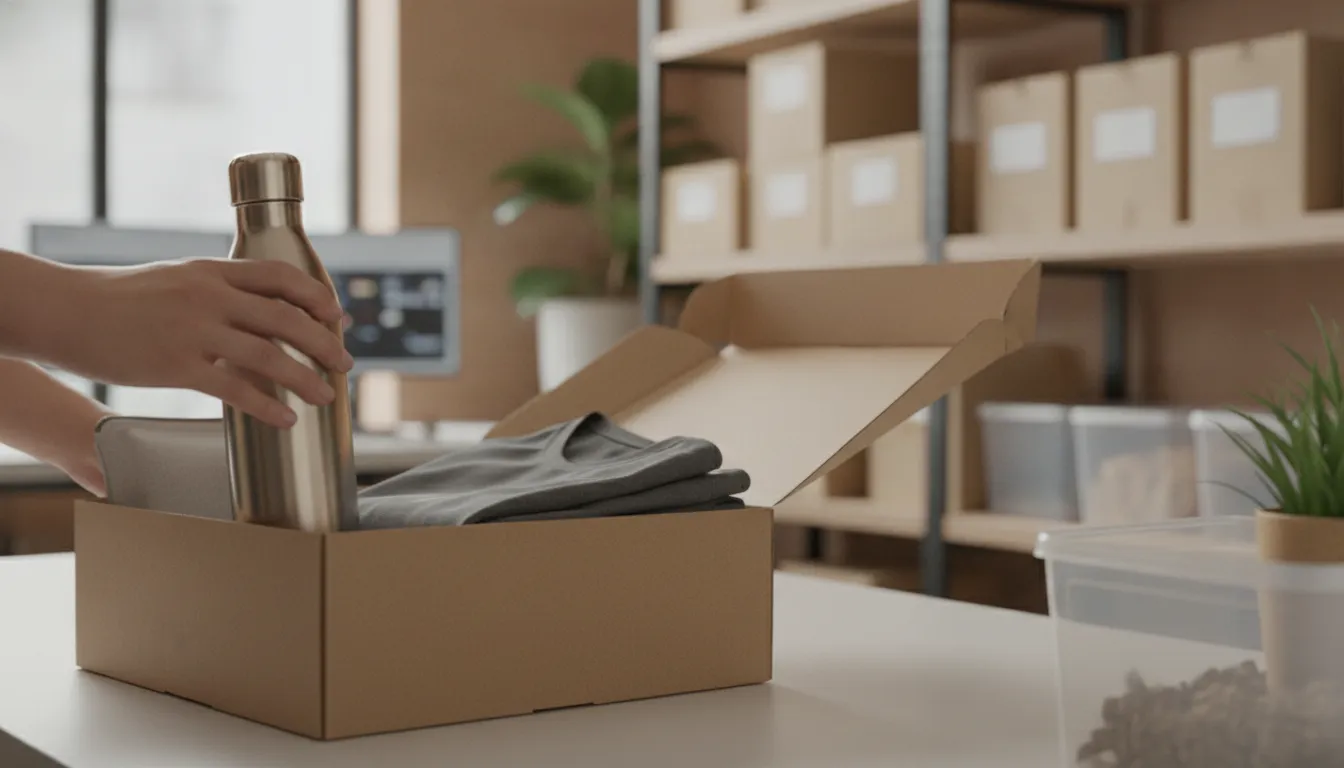
For a closer look at the storage considerations behind a scalable program, see Branded Merchandise Warehousing Storage: What You Need. If drinkware is part of a welcome package or campaign kit, Corporate Merchandise Packaging: Boosting Brand Impact explains how consistent assembly and custom packaging design can strengthen presentation.
The result is a more coherent merchandise experience: products are selected together, stored with a clear purpose, and distributed through the channel that fits each audience. Drinkware remains useful on its own, but its value increases when it supports the broader program around it.
Frequently Asked Questions
How do you choose drinkware for different employee and event use cases?
Start with where and how people will use it. Tumblers and reusable bottles suit everyday workplace or remote-work programs, while mugs may fit office kitchens, onboarding, or client gifting. Consider durability, portability, decoration area, storage requirements, shipping method, and whether the item complements the rest of the merchandise assortment.
What decoration options work best for branded drinkware?
The right method depends on the material, surface shape, artwork, color count, and expected use. Request a production proof before approval so the logo remains legible at the intended size and the finished item aligns with other branded products. Do not assume a decoration method used for apparel will produce the same result on every drinkware material.
How can a company store simplify drinkware distribution?
A managed company store can give employees a branded storefront for self-service ordering while supporting inventory management, reporting, budget allocation, and approval workflows. It can also organize products by audience or use case, helping procurement and brand teams maintain an approved assortment as needs change.
What should buyers evaluate when selecting more responsible drinkware?
Review the material, expected lifespan, cleaning requirements, packaging, replacement behavior, and shipping plan together. A reusable item may support repeated use, but responsible selection still requires specific evidence about materials and lifecycle tradeoffs. For food-contact products, FDA review considers whether substances may migrate from packaging into food at safe levels: FDA food-contact guidance.
Can drinkware be shipped directly to employees?
Yes, a merchandise program can be structured around individual or bulk shipments, depending on the audience and occasion. Brand Vessel documents storage, in-house shipping, worldwide distribution, and in-house customs brokerage, which can help centralize fulfillment for distributed teams while keeping ordering and inventory processes coordinated.
Get Started With a Corporate Branded Drinkware Program
A well-planned drinkware program can give enterprise teams a practical, consistent way to support employees, events, and broader merchandise initiatives. Brand Vessel can help you connect product selection, decoration, company-store ordering, and fulfillment into a coordinated approach that fits your organization.
Start a Project to discuss your corporate branded drinkware and merchandise program with Brand Vessel.