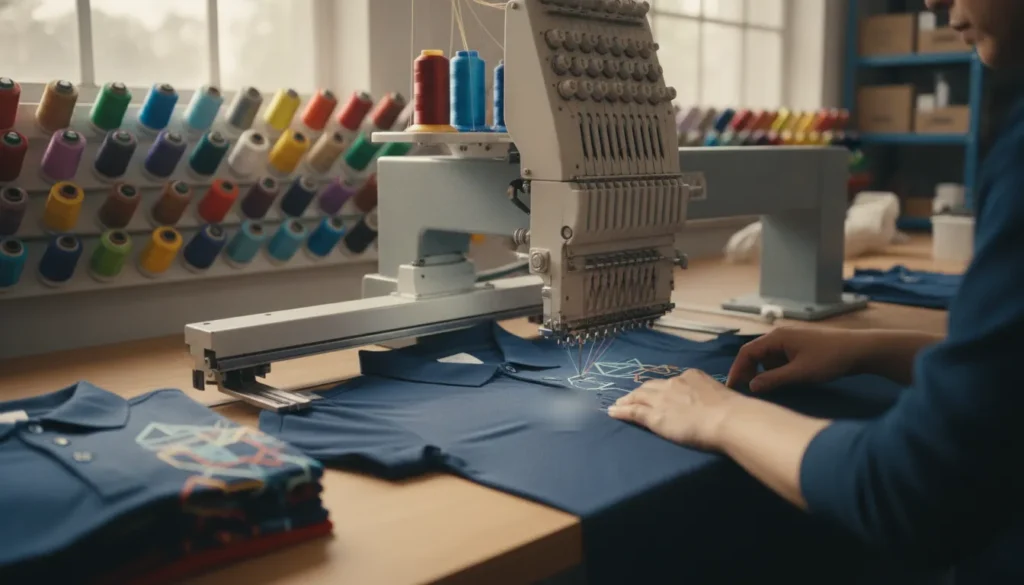
A logo on a work shirt has to do more than identify the wearer. It needs to hold its shape through repeated use, look consistent across teams, and support the level of professionalism your brand expects from every customer, employee, and event interaction.
Start a project with Brand Vessel to plan embroidery placement, digitization, and order volume for your corporate apparel program.
Custom embroidery corporate apparel is often a strong choice when durability, a premium look, and consistent brand presentation matter. Stitched branding can be less vulnerable to the cracking and peeling associated with some printed designs. That makes it a practical fit for polos, jackets, uniforms, caps, and other frequently worn pieces.
The result depends on more than choosing thread over ink. Garment quality, finish, placement, order volume, and accurate logo digitization all shape the final impression. Brand Vessel supports those decisions through Custom Apparel and Creative Decorating for Corporate Brands, helping enterprise teams build apparel programs that feel considered rather than interchangeable.
Why Is Custom Embroidery Corporate Apparel a Strong Choice for Workwear?
Custom embroidery corporate apparel is a strong choice for workwear because stitched thread gives a logo texture, structure, and a durable finish suited to repeated use. For enterprise teams, the combination of perceived quality and practical wear makes embroidery useful across polos, jackets, caps, uniforms, and client-facing apparel.
Workwear represents a company across offices, client meetings, trade shows, recruiting events, and field operations. Decoration quality therefore matters. Embroidery gives a logo a dimensional finish that feels integrated with the garment instead of applied as an afterthought. It can also create a repeatable standard across departments, locations, and job functions.
Embroidery is not automatically the right method for every design. Large graphics, photographic detail, and very soft lightweight fabrics may call for another decorating approach. Brand Vessel combines embroidery with screen printing, patches, custom labels, and other creative decorating methods so the garment and artwork can guide the recommendation. The Branded Merchandise Services & Company Stores page provides a broader view of that service model.
| Consideration | Embroidery | Screen printing |
|---|---|---|
| Visual effect. | Raised thread with a tailored appearance. | Flat layer suited to bold graphics. |
| Common applications. | Polos, jackets, caps, uniforms, and compact logos. | Event tees, large graphics, and detailed color artwork. |
| Wear considerations. | Stitches are anchored into the garment. | Durability depends on ink, fabric, laundering, and abrasion. |
| Best buying question. | Will the garment and logo support a clean stitch pattern? | Will the surface and artwork support a clear printed image? |
Durability that supports repeated wear
A screen-printed design sits on the garment surface. Washing, abrasion, and working conditions can affect that print layer over time. An embroidered logo is formed from thread stitched into the fabric. It may be a better fit when a team expects frequent wear and wants a structured brand mark.
Care still matters. Buyers should confirm the garment care instructions, thread selection, backing, and production quality before placing a large order. The most defensible promise is not that embroidery is indestructible, but that the construction can provide a dependable finish when the decoration and garment are properly matched.
A premium look for brand interactions
Embroidery creates texture and visual weight. Thread catches light differently from surrounding fabric, which can give a polo, jacket, or cap a more finished appearance. That effect is useful for executive apparel, client-facing teams, recruiting programs, and employee merchandise that people should feel comfortable wearing beyond a single event.
Enterprise buyers should evaluate comfort along with appearance. Dense stitching can add weight, and a large design can feel less comfortable than a compact mark. A professional production partner will balance logo size, garment construction, backing, and placement instead of treating the same specification as universal across every item.
- Repeatable decoration standards across departments and regions.
- Garments appropriate for internal teams and customer-facing work.
- Durable pieces that support ongoing wear and planned replenishment.
- Approval workflows for logo, thread color, garment, and placement.
- Consistent sizing and garment sourcing for distributed teams.
- Decoration choices matched to fabric, use case, and logo detail.
- A documented stitch file that supports future reorders.
Which Embroidery Finishes Work Best for Business Wear?
The best embroidery finish for business wear balances visibility, comfort, and durability. Flat or direct embroidery is the standard for most corporate logos. Padded or 3D puff embroidery adds height for selected marks, while specialty threads can create a distinctive effect. The garment, logo detail, brand guidelines, and use case should determine the finish.
A polished corporate program may use one finish across a uniform range or combine techniques across product categories. A left-chest logo on a polo usually needs a different treatment from a bold mark on a cap or an outerwear patch. Review a production proof on the intended garment before approving a broad rollout.
Flat or direct embroidery
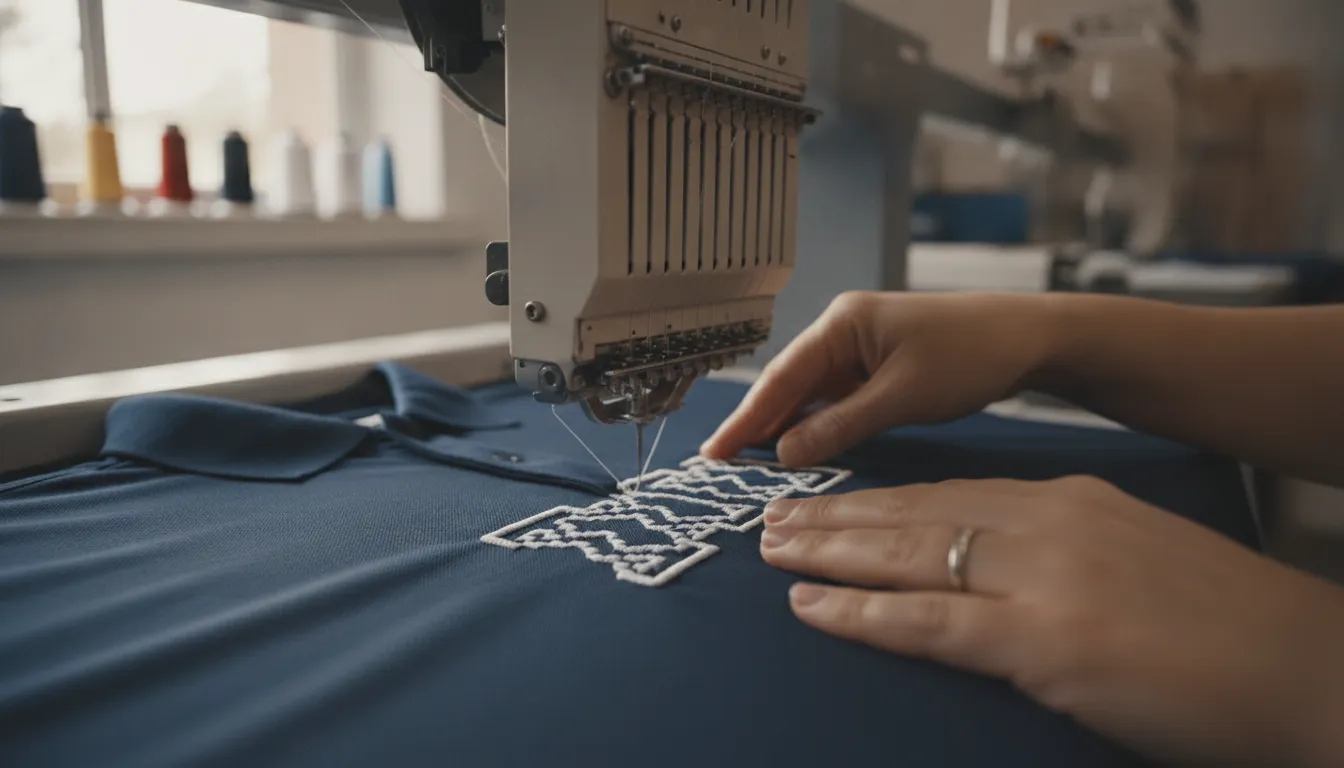
Flat embroidery is the standard choice for many company logos. Stitches are placed directly on the garment to create a clean, professional surface. It works well for left-chest marks, names, and compact designs on polos, button-downs, fleece, jackets, and work shirts.
It is especially useful when a brand needs a repeatable finish across several garment types. The digitizer can adjust stitch direction, density, and underlay to suit the fabric. The same artwork may still require small technical changes between a lightweight polo and a heavier jacket.
Padded or 3D puff embroidery
Puff embroidery uses a layer beneath selected stitches to create additional height. It can make a short wordmark or bold symbol stand out on caps, jackets, and streetwear-inspired employee merchandise. It is less suitable for fine detail, small lettering, or designs with many tight internal spaces.
Use puff selectively rather than treating it as an upgrade for every logo. A proof should confirm that the foam is covered cleanly and that the raised sections do not interfere with the garment’s comfort or care requirements.
Specialty thread and patch applications
Metallic, tonal, glow, and other specialty threads can create a distinct visual effect. The available thread palette and chosen fabric can affect the closest practical color match, so the production team should provide a proof before a large run.
Embroidered patches offer another option when the design needs a defined edge, a removable application, or a heavier visual treatment. Brand Vessel’s work includes patch applications and creative decorating for recognizable corporate brands. Review Brand Vessel’s Work for examples of branded apparel and merchandise programs.
Where Should a Logo Go on an Embroidered Corporate Shirt?
An embroidered corporate shirt most often carries a compact left-chest logo, with upper-back, center-back, sleeve, and cap placements used for specific visibility goals. The right location keeps the mark readable during meetings, events, and daily work without making the garment feel crowded. Define the primary position before adding secondary decoration.
Placement affects both appearance and production. Seams, pockets, zippers, plackets, and fabric stretch can limit the usable embroidery area. A logo that looks balanced on a flat artboard may need a size or position adjustment once it is placed on a curved or constructed garment.
Common placement options
- Left chest: The most common choice for polos, button-downs, and client-facing shirts. It keeps the logo visible while preserving a restrained professional appearance.
- Right chest: Useful for a secondary mark, employee name, department, or partner identity when the left chest carries the primary logo.
- Upper or center back: A larger mark improves visibility from a distance and can suit event teams, field staff, and warehouse groups.
- Sleeve: A secondary identifier can show a location, initiative, or small brand element without competing with the primary chest mark.
- Front-center cap: A strong position for headwear, provided the artwork is digitized for a curved surface and remains legible at the selected size.
- Jacket or outerwear panel: A larger construction may allow a patch or carefully sized stitch design, but zippers, seams, and insulation must be considered.
Build a repeatable placement standard
For a distributed apparel program, document the preferred garment, logo size, placement measurement, thread colors, backing, and approved stitch file. That standard reduces variation between orders and makes review easier when new employees, locations, or seasonal garments are added.
Brand Vessel can help coordinate these specifications with broader merchandise, company store, storage, and fulfillment requirements. A consistent placement standard is especially useful when apparel is ordered through a Custom Company Stores program or replenished over time.
What Minimum Order Quantity Should You Expect for Embroidered Apparel?
Minimum order quantities for embroidered apparel vary by garment, decoration area, production setup, and supplier. Some selected styles may start at quantities as low as 12 pieces, while other products or complex programs require more. Confirm whether the minimum applies per style, color, placement, or full purchase order before approving the project.
There is no universal MOQ that answers every corporate apparel need. A basic left-chest logo on one polo can have different requirements from multiple garments, several placements, specialty thread, or a new digitization setup. Ask for the MOQ, setup cost, digitization cost, sample policy, size-run rules, and reorder terms in writing.
Separate setup economics from inventory planning
Embroidery pricing can include garment cost, decoration cost, digitization, setup, sample approval, and fulfillment. Higher quantities may reduce the per-piece cost because setup and production effort are distributed across more garments. The lowest unit price is not always the best procurement outcome if it creates excess inventory, unused sizes, or unnecessary storage demand.
A better decision compares the immediate need with the replenishment plan. If a company expects new hires, recurring events, or multiple locations, it may benefit from a documented stitch file and a managed inventory approach. If demand is uncertain, a smaller approved run may reduce risk even when its unit price is higher.
Questions to ask before approving a quote
- Does the MOQ apply to each style, color, placement, or combined order?
- Is digitization included, or is it a separate one-time charge?
- Will a pre-production sample or digital proof be provided?
- How are size substitutions and out-of-stock garments handled?
- Can the same stitch file be used for future approved garments?
- What replenishment, storage, kitting, or direct-to-employee options are available?
Brand Vessel does not publish one universal MOQ for every embroidered apparel project. Its team can help align product selection, decoration, order volume, and logistics with the needs of an enterprise program. The right next step is a scoped conversation rather than assuming that one supplier’s minimum applies to every project.
How Do You Submit a Logo for Embroidery Digitization?
To submit a logo for embroidery digitization, provide the best available vector or high-resolution artwork. Identify the garment and placement, share brand color guidance, and approve a proof before production. A professional digitizer then converts the artwork into a machine-ready stitch file for the selected fabric, size, and decorating method.
Digitization is a production translation, not a simple file conversion. The stitch file must account for stitch direction, density, underlay, pull compensation, and small details. It must also reflect how the design will sit on the garment. A file that works on a flat heavyweight jacket may need adjustment for a stretch polo or curved cap.
- Send the strongest available artwork and current brand guidelines.
- Identify the garment, fabric, placement, finished size, and intended quantity.
- Review the digitized proof for legibility, color, density, and placement.
- Record the approved stitch file for future reorders and replenishment.
Send the strongest available artwork
Start with AI, EPS, or SVG vector artwork whenever possible. Vector files give the production team a clear source for logo proportions and shapes. If vector artwork is unavailable, provide the cleanest high-resolution image, approved brand guidelines, and any color references. A low-resolution screenshot can obscure small details and make consistent reproduction harder.
Define the production brief
Include the garment style, fabric, decoration location, finished size, intended quantity, thread color requirements, and any restrictions on modifying the logo. Note whether the apparel is for daily workwear, a client-facing team, an event, a uniform, or an employee store. The use case helps the digitizer make practical choices without changing the brand identity.
Review the proof before the production run
Review the proof for legibility, stitch density, color contrast, placement, and the treatment of small lettering. If possible, approve the design on the actual garment or a comparable fabric. Record the approved version with the purchase order so future reorders use the same standard.
A clean, repeatable stitch file can support employee, event, uniform, and replenishment orders. Brand Vessel’s Branded Merchandise Services & Company Stores model connects creative decorating with sourcing, storage, fulfillment, and distribution for teams that need more than a one-time production run.
Talk with Brand Vessel about your corporate apparel program to review artwork, garment choices, placement, order volume, and fulfillment requirements.
Frequently Asked Questions
What is the typical minimum order for embroidered corporate apparel?
There is no single MOQ for every embroidered apparel project. Selected styles may start at 12 pieces, while other garments, placements, or production programs require more. Confirm the minimum by style, color, placement, and order, then compare it with your replenishment and inventory plan.
Is embroidery more expensive than screen printing?
Pricing depends on the garment, design, size, placement, stitch count, colors, setup, and order volume. Embroidery can carry different setup and production economics than screen printing. Compare the complete project cost and intended use rather than choosing only by decoration price.
What file does a logo need for embroidery?
AI, EPS, or SVG vector artwork is usually the strongest starting point. A clean, high-resolution image can also help when vector artwork is unavailable. Include brand guidelines, approved colors, garment details, placement, and finished size so the digitizer can prepare an accurate stitch file.
How long does custom embroidery take?
Timing varies with artwork readiness, digitization, proof approval, garment availability, production volume, and shipping requirements. Ask for a project schedule that separates artwork approval, sampling, production, and delivery. Reorders may be easier to plan when the approved stitch file is already documented.
When should a company choose embroidery instead of printing?
Embroidery is often a good fit for compact logos on polos, jackets, caps, uniforms, and frequently worn workwear. Printing may be more practical for large graphics, photographic detail, or designs intended for lightweight event tees. A decorating partner can recommend the method after reviewing the artwork and garment.
Start a project with Brand Vessel to create custom embroidery corporate apparel that supports your brand standards, team needs, and long-term merchandise plan.