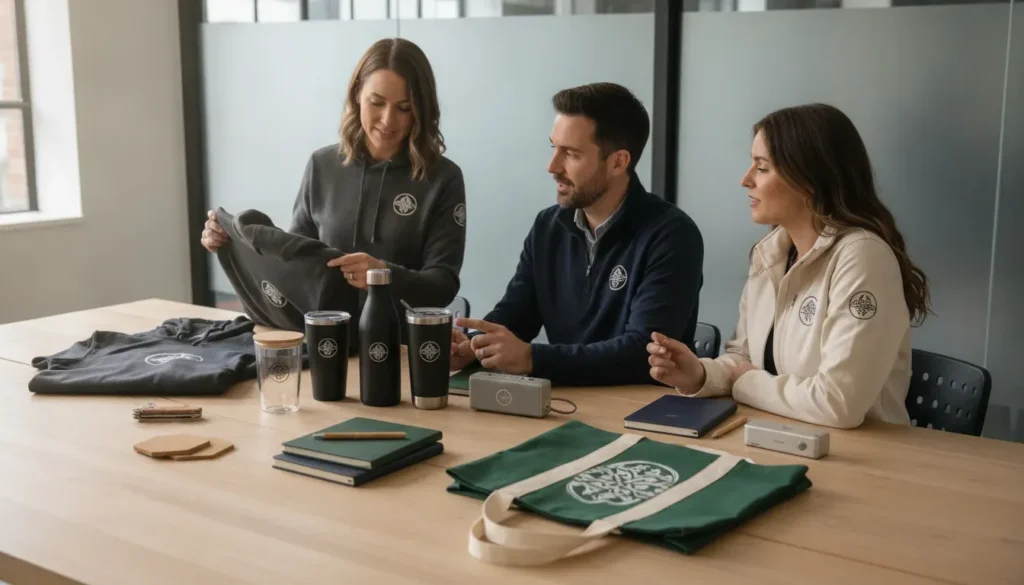
Custom promotional products work best when product choice, decoration, approvals, and fulfillment are planned as one business program. A useful tote, comfortable apparel piece, or well-chosen drinkware item can extend a brand experience long after an event. The challenge is building a repeatable process that protects quality while keeping inventory and delivery manageable.
What are custom promotional products?
Custom promotional products are useful physical items adapted with a company’s approved branding, decoration, packaging, or configuration. They can support employee programs, recruiting, client relationships, events, uniforms, onboarding, and company stores. For a business buyer, the product is only one part of the decision. The decoration method, quality standard, ordering process, and delivery model matter too.
Custom promotional products may include apparel, bags, drinkware, notebooks, accessories, kits, and other merchandise selected for a defined audience. The most effective programs do not begin with a large catalog. They begin with the job the merchandise must do.
- Employee programs: Support onboarding, recognition, internal events, or an ongoing company store.
- Recruiting: Give candidates merchandise that reflects the employer brand and feels useful after an event.
- Client relationships: Create a considered touchpoint for customers, partners, or executive audiences.
- Corporate events: Provide event-ready products, team apparel, or coordinated kits.
- Field and uniform programs: Deliver consistent apparel with decoration that fits the garment and expected wear.
Brand Vessel treats branded merchandise as a connected service area that includes custom apparel, creative decorating, company stores, storage, kitting, fulfillment, shipping, and global distribution. That operating view helps a buyer connect a creative product decision to the work required after the order is approved.
How do you choose custom promotional products for a business program?
Choose custom promotional products by starting with the recipient, use case, setting, lifespan, and distribution plan. Then compare materials, construction, useful features, decoration area, size or color options, availability, and reorder potential. A smaller assortment that people use is usually more valuable than a broad catalog that creates excess inventory.
Start by writing a short product brief. It should explain who receives the item, when they receive it, where they will use it, and what the item should communicate about the brand. A recruiting hoodie, conference giveaway, executive gift, and employee welcome kit should not be judged by the same standard.
| Program use | Product decision | Quality question |
|---|---|---|
| Employee onboarding | Useful items that work together as a kit | Will the set feel intentional when opened and used? |
| Recruiting and employer brand | Wearable or useful items with a clear brand expression | Would a candidate choose to use the item after the event? |
| Trade shows and events | Portable products that fit the audience and venue | Can the item arrive, be distributed, and travel easily? |
| Client or executive gifting | Curated products with stronger presentation | Does the material and finish match the relationship? |
| Uniform or field use | Durable apparel with a practical decoration method | Will fit, fabric, and decoration hold up through normal wear? |
Next, narrow the assortment. Consider comfort, usefulness, durability, storage footprint, decoration compatibility, and replenishment. Product selection should also account for the way the merchandise will be distributed. A product that works for one bulk event may be difficult to store or ship individually to a distributed workforce.
For apparel, product quality and decoration cannot be separated. Brand Vessel’s Custom Apparel for Business Teams Will Actually Wear approach considers fabric, fit, construction, decoration, and the audience together. The same discipline applies to non-apparel items. A logo should not be treated as the only quality variable.
Which decoration and customization choices protect brand quality?
The right decoration method depends on the product material, artwork, placement, quantity, expected use, and desired finish. Embroidery, screen printing, patches, sublimation, and other methods create different visual and tactile results. Approve the decoration on the actual product whenever possible, because a logo that looks correct on a screen may behave differently on fabric or a curved surface.
Decoration should reinforce the product rather than overwhelm it. A small embroidered mark can suit a premium polo. A large screen-printed graphic may be more appropriate for an event shirt. A patch can create a distinct texture on a jacket or bag. The best choice depends on the item and the experience the brand wants to create.
- Embroidery: Consider thread detail, stitch density, garment weight, and how the design will sit on the surface.
- Screen printing: Review ink coverage, color treatment, placement, and the expected wash or wear conditions.
- Patches: Confirm patch size, edge treatment, attachment method, and how it complements the product.
- Sublimation: Confirm that the material and artwork are suitable for the process and intended color result.
- Specialty decoration: Ask for a physical sample when texture, finish, or layered treatment is important to the brand.
Give the decorating partner the complete brand brief, not only a logo file. Include approved colors, artwork versions, placement guidance, product specifications, and any restrictions. Define who can approve an exception and how an updated product specification will be recorded for a reorder.
Brand Vessel’s Branded Merchandise Services & Company Stores connect creative decorating with broader merchandise and logistics support. That matters when a program needs the same decoration standards across apparel, kits, company-store orders, and multiple delivery locations.
What should the approval and quality assurance process include?
A dependable approval process confirms the product specification, decoration, artwork, sample, packaging, quantity, and delivery requirements before production. Quality assurance should define what gets inspected, who approves it, how defects are handled, and how the approved standard is preserved for future orders. That record turns a subjective preference into a repeatable program control.
Use a single approval record for every item or kit. It should include the product name or identifier, material and construction details, available sizes or colors, decoration method, artwork version, placement, packaging, and intended use. If the product is part of a company store or recurring program, add the reorder and inventory assumptions.
A practical review sequence looks like this:
- Review the product: Check fit, material, construction, finish, function, and whether the item suits the recipient.
- Review the decoration: Confirm location, size, color, stitch or print quality, and alignment on the actual product.
- Approve a physical sample: Use a sample or documented production proof when the item is brand-critical or technically complex.
- Document the standard: Save the approved artwork, specifications, photographs, and exception notes in one controlled record.
- Inspect production: Define checks for defects, shade variation, misprints, damage, missing components, and packaging errors.
- Close the loop: Record issues, corrective action, replacement decisions, and any change needed before the next order.
Quality assurance should follow the risk of the program. A one-time giveaway may need a simpler inspection than a uniform, executive gift, or global onboarding kit. The standard should still be clear. Teams should know what is acceptable, what requires rework, and who has authority to release or hold an order.
Do not make the approval record a marketing-only document. Procurement, brand, operations, and the fulfillment team may all depend on it. When the item moves into storage or a company store, the approved record becomes the reference for receiving, picking, packing, and reordering.
How should custom promotional products be stored, kitted, and delivered?
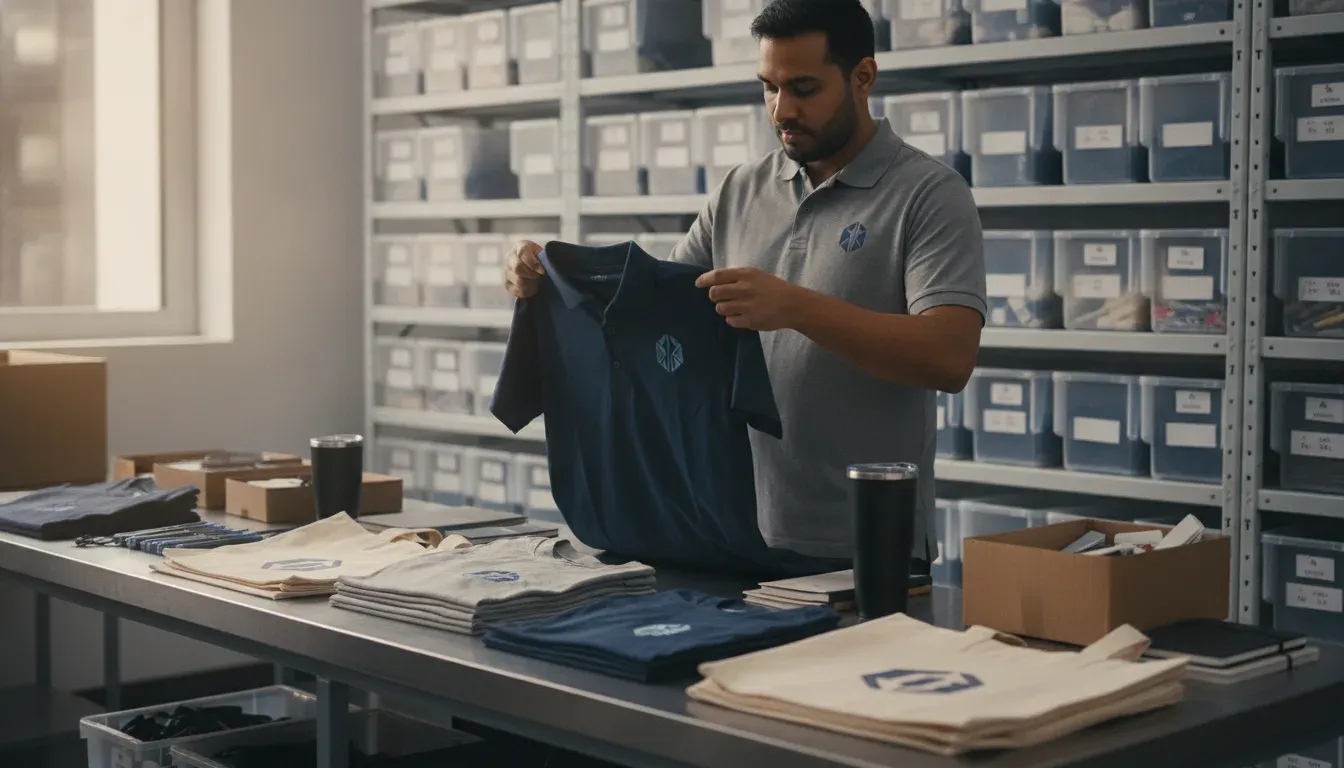
Store and deliver custom promotional products according to how the program will be ordered and used. Set inventory ownership, location, reorder thresholds, packaging rules, kit configurations, shipping destinations, and exception ownership before launch. A fulfillment plan should protect the approved product standard while making the path from inventory to recipient visible.
Storage decisions begin with the assortment. Record what is on hand, what is allocated, what is available, and what is approaching a replenishment point. Apparel may require size and color controls. Kits need component-level visibility. Products destined for separate regions may need different packaging or shipping instructions.
Kitting is useful when several products should arrive as one coordinated experience. An onboarding package may combine apparel, drinkware, a notebook, and other approved items. An event kit may need different components for speakers, staff, or attendees. Define the kit bill of materials, substitution rules, quality checks, and pack-out sequence before assembly starts.
Brand Vessel’s What Is Corporate Kitting? A Complete Guide for B2B Teams explains how product selection, assembly, packaging, and distribution work together. The key point for a buyer is that kitting is an operating process, not simply placing several products in the same box.
- Bulk delivery: Ship coordinated cartons to an office, event venue, or regional team.
- Individual delivery: Send approved merchandise directly to employees, customers, or candidates.
- Company-store ordering: Let eligible users select from an approved assortment while the program retains inventory visibility.
- Recurring programs: Replenish core items and preserve the approved standard across reorders.
- Global distribution: Plan for destination information, customs documentation, regional requirements, and exception handling.
Assign a clear owner for each handoff. Someone should own inventory updates, packaging instructions, recipient data, carrier coordination, customs questions, delivery exceptions, and reporting. This is where a product decision connects to the operational systems needed for a consistent corporate program.
How do you evaluate a custom promotional products partner?
Evaluate a custom promotional products partner across merchandise expertise, decoration quality, approvals, inventory, kitting, fulfillment, communication, and distribution. Ask the partner to walk through a realistic order from brief to delivery, including a product change or shipping exception. The strongest fit is the partner that can explain ownership at every handoff.
Do not compare suppliers only by a product catalog or an initial quote. Ask what happens after the item is selected. A partner may be excellent at sourcing but not equipped for individual shipping. Another may offer warehousing but leave artwork control, quality inspections, and kit assembly to your internal team.
| Evaluation area | Questions to ask | Evidence to request |
|---|---|---|
| Product and decoration | Can you recommend products and decoration based on use, audience, and brand? | Relevant samples and a clear decoration rationale |
| Approval and QA | How is the approved standard documented and checked? | Sample workflow, inspection steps, and issue escalation |
| Inventory | How are available, allocated, and replenishment quantities tracked? | Inventory view, reporting example, and reorder process |
| Kitting and packaging | Can you assemble consistent kits and manage component changes? | Pack-out specification and quality-control checkpoints |
| Distribution | Can you support bulk, individual, and international delivery? | Shipping workflow, exception ownership, and customs approach |
| Service model | Who coordinates decisions when the program changes? | Named contacts, communication cadence, and escalation path |
Run one representative workflow with each finalist. Give the same scenario to every partner: an approved product is ordered, inventory is allocated, a kit is assembled, a shipment is sent, and a delivery exception occurs. Compare the questions each team asks, the information it needs, the status updates it provides, and how it protects the approved brand standard.
Brand Vessel positions itself as a strategic merchandise and logistics partner rather than a commodity product vendor. Its offering combines high-quality custom apparel, creative decorating, company stores, storage and logistics, kitting, fulfillment, global distribution, and in-house customs brokerage. Buyers should still evaluate the fit for their own scope, but that integrated model is relevant when one team needs the creative and operational sides to work together.
FAQs About Custom Promotional Products
The best custom promotional products programs connect a useful item to an approved brand standard and a dependable operating plan. Buyers should evaluate product fit, decoration, samples, quality checks, inventory, kitting, shipping, and reorders together. The answers below address common decisions before a business program moves into production.
What are the best custom promotional products for employees?
The best options are useful, comfortable, durable, and appropriate for the employee audience. Custom apparel, drinkware, bags, notebooks, and coordinated onboarding kits can work well when the product, decoration, and delivery model match how employees will actually use them.
How do businesses ensure promotional product quality?
Businesses can set a written product and decoration specification, review a physical sample, approve artwork, define inspection criteria, and document corrective action. The same approved record should guide production, receiving, storage, fulfillment, and future reorders.
Which decoration method should a company use?
The method depends on the product material, artwork, placement, quantity, desired finish, and expected wear. Embroidery, screen printing, patches, sublimation, and specialty treatments each have different strengths. A merchandise partner should recommend the method against the actual product and use case.
How can a company manage promotional product inventory?
Track product specifications, sizes and colors, available and allocated quantities, reorder thresholds, kit components, and distribution history. A company store or managed fulfillment program can give eligible users a controlled ordering path while keeping program owners informed about demand and stock.
What should a company ask a promotional products vendor?
Ask who owns product sourcing, decoration, proof approval, quality checks, storage, kitting, shipping, customs, returns, reporting, and exceptions. Request a workflow demonstration using your actual audience, product types, delivery locations, and approval requirements.
How can you start a custom promotional products program?
Start with a concise brief that names the audience, program purpose, products, decoration, quality standard, approval team, inventory model, kit or packaging needs, delivery locations, and timing. Then ask a qualified merchandise partner to connect the creative choices to the operational work required for a consistent program.
Brand Vessel can help business teams plan branded merchandise, custom apparel, company stores, storage, kitting, fulfillment, shipping, and global distribution as connected parts of one program. A clear brief gives the team a stronger starting point for product recommendations, samples, approvals, and delivery planning.