
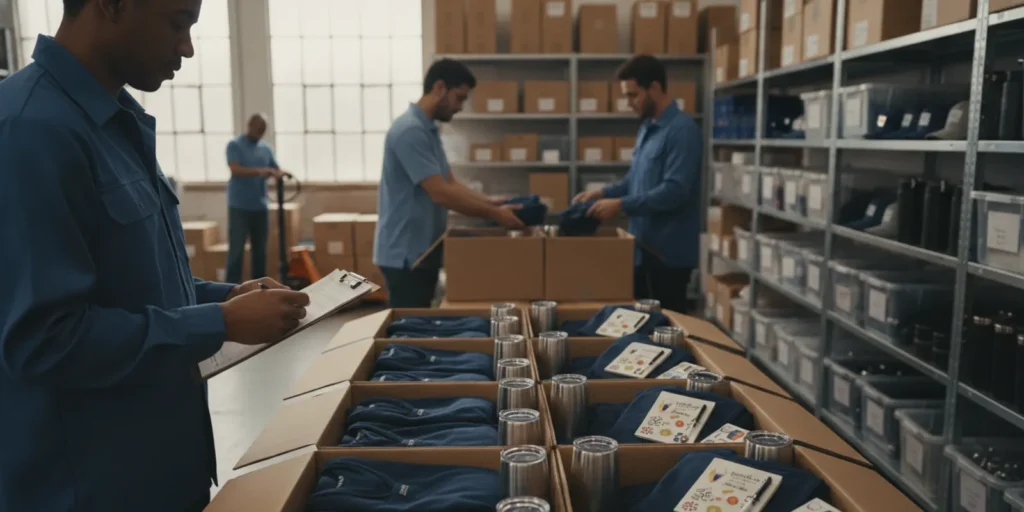
Distributed merchandise orders rarely fail because a team cannot pack a box. They fail earlier, when a request arrives without a clear trigger, recipient data, approval owner, destination, or release date. A governed workflow turns employee onboarding, event shipments, and recurring kits into repeatable operating paths instead of one-off coordination exercises.
Discuss your corporate merchandise workflow with Brand Vessel.
Effective order fulfillment services begin by defining what starts an order, who owns each decision, what information is required, and when the order can move forward. That intake structure gives procurement, marketing, HR, operations, and their merchandise partner a shared record for routing work, resolving exceptions, and coordinating delivery across locations.
Brand Vessel supports this operational approach through its Product Fulfillment Services: From Storage to Delivery and broader Branded Merchandise Services & Company Stores. The practical work begins by deciding what an intake must capture before fulfillment activity starts.
How Do Order Fulfillment Services Start With a Clear Intake?
A clear intake turns a merchandise request into an executable workflow before products move. It records the trigger, order type, requester, destination, deadline, product state, and approval owner. Teams then map the current process, identify missing decisions, and hand off one confirmed request with accountable next steps.
Define the trigger and scope
Start by naming what initiated the request: employee onboarding, an event, a recurring program, a campaign, or a replenishment need. Record the order type and intended destination, then identify the requester who can answer operational questions. The intake should also state whether products are approved, in production, in storage, or still require sourcing or decoration.
Capture the required delivery date as a business deadline, not a vague urgency label. Add the approval owner and the condition that releases the work. For a distributed program, distinguish a single destination from multiple recipient locations. This prevents a request from entering fulfillment with unresolved scope.
Map the current state before adding tools
Review how requests currently move from the originating team to the person coordinating merchandise, inventory, and delivery. Note duplicate data entry, unclear ownership, communication gaps, and points where an address, quantity, or deadline can change. These are practical intake risks, not merely administrative friction.
A NIST MEP case study describes reviewing current systems and processes, then using value-stream mapping to identify process improvements and opportunities for better tools. Use the same logic here: map the existing handoffs first, then decide what information or system change is justified.
Make the intake handoff explicit
Bring together representatives from every function affected by the order, such as marketing, HR, procurement, operations, and the merchandise partner. A cross-functional core team can confirm which decisions belong in the intake and which belong later in the workflow.
The handoff is complete only when the request includes its trigger, order type, requester, destination, deadline, product state, approval owner, and known exceptions. Assign the next action and owner in writing. Brand Vessel can then work from a defined merchandise and logistics brief rather than reconstructing requirements through disconnected messages.
What Belongs in the Order and Recipient Data Contract?
An order and recipient data contract defines the minimum information required before merchandise can be approved, routed, personalized, and released. It gives marketing, HR, procurement, operations, and the merchandise partner one shared record for each order. That discipline reduces rework, protects recipient experience, and makes exceptions visible before they become shipment problems.
Define the order before collecting details
Start with the assortment and its decision rules. Record the approved item or kit, available sizes or variants, decoration or personalization requirements, quantity logic, and whether substitutions are permitted. If an item is part of a recurring program, identify the replenishment owner and the point at which inventory should be reviewed. Inventory management requires decisions about how much to order and when to place the order, so those choices should not remain implicit.
A Custom Company Stores workflow can provide a controlled ordering channel, but the contract still needs an owner for assortment changes, inventory exceptions, and approval of any replacement.
Make recipient and destination data operational
Recipient information should be usable by the team preparing the order, not merely complete on paper. Capture the recipient name, email or other contact method, delivery address, country, location or cost center when relevant, and any required delivery instructions. Separate the destination decision from the recipient record so a single employee event, office shipment, home delivery, or international destination can follow the correct path.
| Data group. | Required decision. | Failure prevented. |
|---|---|---|
| Assortment. | Which approved items, variants, quantities, and substitutions apply? | Wrong product, size, or unapproved replacement. |
| Recipient and address. | Who receives the order, and what verified address and contact details apply? | Misdelivery, unreachable recipient, or returned package. |
| Destination. | Is the route an office, home, event, domestic, or international delivery? | Incorrect routing, carrier handoff, or customs preparation. |
| Personalization. | What name, size, decoration, or other approved variable belongs to each recipient? | Incorrect personalization or unusable merchandise. |
| Inventory. | What stock is available, reserved, replenished, or subject to review? | Stockout, split order, or avoidable fulfillment delay. |
| Correction rules. | Who may edit data, by what cutoff, and who approves the change? | Conflicting edits, duplicate work, or release without approval. |
Set correction and release rules
Do not treat corrections as informal messages scattered across email threads. Define a single source of record, the person authorized to change recipient or order data, the cutoff for edits, and the approval required after a material change. The record should preserve the original value, corrected value, editor, timestamp, and release decision. This creates an auditable path when an address changes, a component becomes unavailable, or inventory no longer matches the original order.
Review the contract with representatives from every functional area in scope. A shared data standard is valuable only when the people requesting, approving, preparing, and receiving merchandise can apply it consistently.
How Should Approval and Routing Rules Work?
Approval and routing rules should turn a complete request into a controlled release decision. Define who approves the merchandise, recipient data, destination, timing, and exceptions before an order reaches fulfillment. Then route each approved request by program type and destination, with a named owner for changes, holds, and final release.
Set approval gates around risk
Use gates that correspond to decisions, not unnecessary layers. A requester can confirm the assortment and purpose, while a program owner confirms brand requirements, recipient data, and the release window. Operations should verify inventory, required components, and shipping information before the order moves to pick, pack, and ship.
This structure separates content approval from operational release. It also creates a record of why an order was held or released. Inventory integrity, receiving, order filling, and shipping are recognized supply-chain functions. So the workflow should give each function a clear handoff rather than treating approval as a single final click. See the supply-chain function examples for context.
Route by the work the request requires
Routing should reflect the event, recipient, inventory, and destination conditions attached to the order. A practical decision sequence is:
- Employee onboarding: route through the approved employee or manager request, validate the recipient address and personalization, then release from available inventory or send the shortage to replenishment planning.
- Event shipments: route to an event owner who confirms quantities, delivery location, receiving contact, and required arrival window. Hold release until the shipment plan and any split destinations are approved.
- Recurring kits: route through a repeatable assortment and replenishment rule. Confirm the current recipient or location file, component availability, and any changes before authorizing kitting and shipment. Brand Vessel combines merchandise, storage, logistics, kitting, and fulfillment for these connected workflows.
- International destinations: route through a destination review that confirms country, address format, recipient information, shipping requirements, and customs responsibility. Brand Vessel supports international shipping with in-house customs brokerage, but the workflow should still assign an owner for missing or changing destination details.
Define release criteria and holds
Release only when the required approvals are recorded, recipient and destination data are complete, inventory or replenishment status is understood, and the shipping path is assigned. A missing address, unresolved stock variance, unapproved substitution, or customs question should create a visible hold with an owner and next action. Documenting these states helps distributed teams avoid silent handoff failures and keeps the order path reviewable as programs change.
How Do Teams Handle Fulfillment Exceptions?
Teams handle fulfillment exceptions by defining the required response before an order is released. A practical workflow records the issue, assigns one owner, protects the customer promise, and documents the resolution. This approach keeps incomplete data, inventory variance, address changes, delivery delays, returns, and customs questions from becoming disconnected email threads.
Classify the exception before changing the order
Start with a shared exception record tied to the order, recipient, program, and requested delivery date. Record what is known, what is missing, who discovered the issue, and which decision is required. The team can then route the case to the right owner instead of asking every stakeholder to investigate the same facts.
- Incomplete data: Hold release until the required recipient, quantity, decoration, delivery, or approval field is confirmed.
- Unavailable component: Identify whether the component is essential to the kit, whether an approved substitute exists, and who can authorize a change.
- Inventory variance: Reconcile the recorded quantity with the physical count, then decide whether to replenish, split the order, or revise the release plan.
- Address correction: Validate the corrected destination and document whether the shipment can be updated before handoff or needs a carrier intervention.
These categories make exception trends visible. A recurring data error may require an intake change, while repeated inventory variance may require a cycle-count or replenishment review. NIST describes process review, value-stream mapping, and cross-functional discovery as useful ways to identify workflow improvement opportunities.

Set response paths for delivery, returns, and customs
A delayed delivery should trigger a defined review, not an improvised promise to the recipient. Confirm the latest carrier status, the delivery requirement, and whether the order supports a partial or alternate shipment. Assign one person to communicate the approved update while the operations owner manages the next physical action.
Returns need the same discipline. Record the reason, condition, destination, disposition, and any replacement or credit decision. For recurring programs, review return patterns by item, location, or order type. Reverse logistics and lifecycle management are recognized supply-chain functions, so returns belong in the workflow design rather than as an afterthought.
Customs questions should be routed through a documented international path. Capture the destination country, shipment contents, commercial information, and the specific question before escalating. Brand Vessel supports international shipping and in-house customs brokerage, which can give a merchandise program a defined operational owner for cross-border questions. For the broader planning context, see International Fulfillment Services: Buyer Checklist.
Close the loop and improve the rule
An exception is not closed when someone sends a reply. Close it when the order status, owner, customer communication, and next action are recorded. Review unresolved cases at a regular operating cadence, looking for patterns such as missing approvals, repeated address corrections, or inventory mismatches.
For distributed employee programs, document which questions stay with the program team and which move to the fulfillment partner. A clear boundary reduces duplicate work across regions and makes escalation easier. Brand Vessel’s global distribution capabilities can support this operating model when teams need a consistent process across locations. See Global Fulfillment Services for Employee Programs for the distributed-program context.
A useful governance record includes the exception type, order impact, decision owner, resolution, communication status, and prevention step. Over time, that record can guide changes to the intake form, approval gate, inventory control, or routing rule. The goal is not to eliminate every exception. It is to make each exception visible, owned, and useful for improving the next order.
Who Owns Each Handoff in a Distributed Merchandise Workflow?
A distributed merchandise workflow works when every handoff has one accountable owner, a defined input, and a visible release condition. Procurement governs scope, marketing protects the brand, HR or people teams validate recipient needs, operations controls timing, the merchandise partner executes logistics, and recipients report delivery issues. Global programs also assign destination and customs ownership.
Build an ownership matrix before orders move
Use a simple responsibility matrix for each order type rather than assuming that the person who requests merchandise owns every downstream decision. One person can hold several roles, but each decision should still have a named accountable owner. The matrix should identify who prepares the information, who approves it, who performs the handoff, and who resolves an exception.
| Workflow decision. | Accountable owner. | Required handoff. |
|---|---|---|
| Budget, quantity, and commercial scope. | Procurement. | Approved purchase scope and cost center to operations. |
| Artwork, assortment, and brand standards. | Marketing. | Released artwork and product specification to the merchandise partner. |
| Recipient eligibility and employee data. | HR or people team. | Validated recipient file and correction window to operations. |
| Release date, routing, and priority. | Operations. | Final order instructions and service-level decision to the merchandise partner. |
| Storage, kitting, fulfillment, and shipment status. | Merchandise partner. | Exception report and tracking information to operations. |
| Address correction or delivery issue. | Recipient. | Accurate response and issue details through the designated support path. |
This matrix also clarifies where a company store or recurring program fits. A Custom Company Stores can collect approved selections and recipient details, but the organization still needs owners for eligibility, inventory policy, and exception decisions. For the physical assembly stage, see What Is Corporate Kitting? A Complete Guide for B2B Teams.
Use a defined escalation path for exceptions
Escalation should follow the failed handoff, not the loudest stakeholder. The first responder records the order or recipient affected, the missing or conflicting input, the deadline, and the decision needed. Operations then routes the issue to the accountable owner and sets a release decision. This prevents a warehouse, customer service, or marketing contact from making an unapproved substitution.
- Data issue: HR or the requesting team corrects the recipient, address, or eligibility record.
- Brand or product issue: Marketing confirms artwork, assortment, personalization, or an approved alternative.
- Budget or quantity issue: Procurement confirms scope, funding, and purchase authorization.
- Timing or routing issue: Operations prioritizes the order and confirms the next feasible release path.
- Storage, assembly, or shipment issue: The merchandise partner documents status, constraints, and available recovery actions.
Brand Vessel can support the connected merchandise and logistics workflow through branded merchandise, custom apparel, storage, kitting, fulfillment, US-wide distribution, international shipping, and in-house customs brokerage. Its role is strongest when the client retains clear internal decision ownership and receives operational visibility at each handoff. Related physical assembly guidance is available in Kitting and Assembly Services: What Businesses Need to Know.
Assign global responsibility by destination
International distribution requires a destination owner in addition to a central program owner. The destination owner validates local recipient data, delivery constraints, language needs, and any required customs information. The central operations owner maintains the master release plan, while the merchandise partner coordinates the applicable shipping and customs process. Marketing, HR, and procurement should not assume that a US-approved workflow transfers unchanged to every country.
Review the matrix after each event, onboarding cycle, or recurring shipment. Look for repeated corrections, late approvals, address failures, and unclear escalation paths. Those patterns identify a workflow design problem that should be corrected at intake, before the next distributed order reaches fulfillment.
How Should Teams Measure and Improve the Workflow?
Teams should review order fulfillment services as a governed workflow, not only as a delivery result. Track order accuracy, incomplete recipient or order data, exception types, inventory variance, delivery status, and recurring root causes. Review those signals with the people who own intake, approvals, routing, inventory, and recipient communication, then make controlled changes.
Which measures show where the workflow is weakening?
Start with measures that connect directly to an action. Order accuracy can reveal whether the approved assortment, personalization, quantity, and destination were carried into fulfillment correctly. Incomplete data points to an intake or recipient-record problem. Exception type distinguishes an address correction from an unavailable component, inventory variance, customs question, or delivery delay. Each category should have a named owner and a documented next step.
Review inventory variance alongside order lines and replenishment decisions, rather than treating stock as a separate warehouse issue. Inventory management affects the ability to satisfy demand, while ordering decisions depend on demand, supply locations, and the timing of replenishment. Delivery status should show whether an order is awaiting release, in transit, delayed, delivered, or requiring intervention. For context on timing dependencies, see Merch Fulfillment Lead Times: What to Expect.
How often should distributed teams review the signals?
Use an operational review cadence that matches the program. Review open exceptions and delivery status frequently enough to protect active shipments. Review order accuracy, incomplete data, and inventory variance after each meaningful order cycle or campaign. At a broader monthly or quarterly review, group recurring root causes by intake, approval, routing, inventory, or communication. A cross-functional core team can keep the review grounded in the realities of procurement, marketing, HR, operations, and the merchandise partner.
How can teams improve without creating new risk?
Choose one recurring cause, document the current workflow, change one control, and compare the next comparable cycle against the same measures. Examples include making a recipient field mandatory, clarifying an approval owner, adding a release check, or changing an escalation path. Do not change several controls at once if the team cannot tell which adjustment affected the result.
Keep the change reversible and record who approved it, which order types it covers, and what evidence will trigger another review. Brand Vessel combines branded merchandise with company stores, storage, logistics, kitting, and fulfillment. So its role can extend across connected workflow steps without removing the client’s ownership of decisions. Examples of completed merchandise work are available on Work.
Plan your corporate merchandise fulfillment workflow with Brand Vessel.
Frequently Asked Questions About Order Fulfillment Services Workflow
Workflow questions about order fulfillment services are best answered by defining the records, approvals, routing rules, and exception paths that let a distributed merchandise program operate consistently. These answers focus on governance and handoffs, not the broad service overview covered by the canonical fulfillment guide.
What should an order intake form collect?
Capture the request trigger, order type, requester, destination, deadline, product or assortment, personalization requirements, recipient and address data, inventory status, and approval owner. Include a correction process so incomplete or changed information has a defined route before the order is released.
How do approval gates prevent fulfillment errors?
Approval gates require the right owner to confirm key decisions before work moves forward. A marketing, HR, procurement, or operations owner can verify quantities, personalization, recipients, budget authority, destination details, and timing. Separating review from release helps catch errors before picking, kitting, or shipping begins.
What is an exception path in order fulfillment?
An exception path is the documented response when an order cannot follow its planned workflow. It classifies the issue, assigns an owner, records the decision, communicates the impact, and defines the next action. Common examples include missing data, an inventory variance, an unavailable component, an address correction, a delayed delivery, a return, or a customs question.
How do distributed teams coordinate international shipments?
They use shared order and recipient data, clear handoff ownership, destination-specific routing rules, and visible shipment status. International workflows should identify customs and documentation responsibilities before release. Brand Vessel supports international shipping and in-house customs brokerage, which can keep merchandise, logistics, and customs coordination connected across distributed programs.
Ready to make your corporate merchandise workflow easier to govern? Brand Vessel can help you map the path from intake through approvals, routing, fulfillment handoffs, and exception ownership. Bring the order types, recipient requirements, destinations, approval points, and recurring problem areas your team manages today. Together, you can clarify who decides what, how exceptions move, and where teams need better visibility across employee, event, and recurring programs.
Map your corporate merchandise order workflow with Brand Vessel