
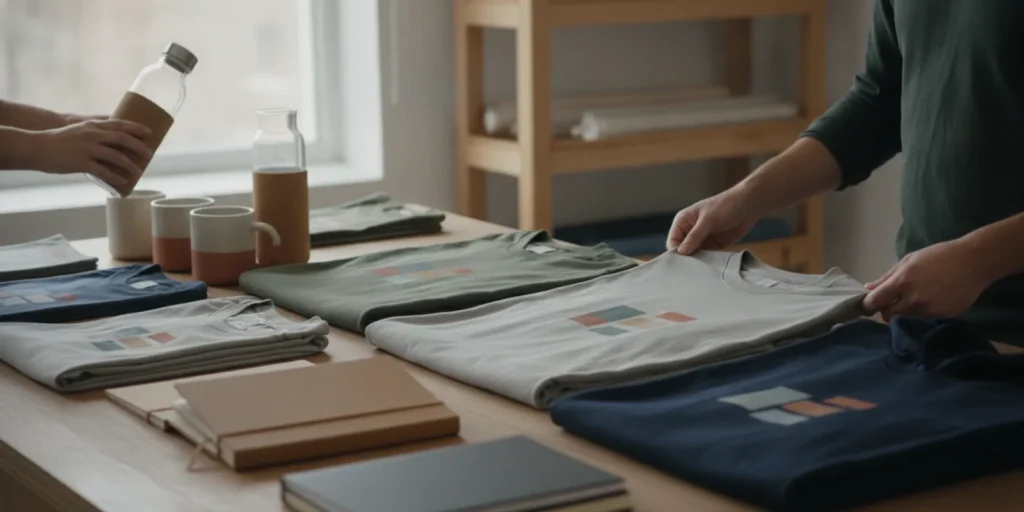
Low minimum quantity promotional products can help a growing business test a design, serve a small team, or support a focused event without buying excess stock. But the advertised minimum is only one part of the decision. Buyers should also check setup fees, decoration limits, available inventory, quality controls, and whether the same item can be reordered later.
Discuss a small-run merchandise plan
What does a low minimum really tell you?
A low minimum usually describes the smallest quantity a supplier will accept for a particular product and decoration method. It does not tell you the full delivered cost, how much artwork setup is required, or whether the product will be available for a repeat order. Treat the minimum as an entry point for evaluation, then compare the complete order conditions.
Minimums can vary by blank product, color, decoration, and production process. A simple one-color imprint on a stock item may work at a lower quantity than custom-woven labels, multiple decoration locations, or a made-to-order product. Ask which exact combination the quoted minimum covers, rather than assuming the minimum applies to every option.
Small runs can make sense when you are:
- Testing a new design or product before a larger commitment.
- Equipping a small department, pilot group, or leadership team.
- Supporting a limited event or a specific recipient group.
- Creating a first order while requirements are still being defined.
- Replacing a small quantity of damaged or outdated items.
For a wider program, consider whether a Custom Company Stores approach could manage changing demand, rather than treating every small order as a separate purchasing exercise. A company store does not remove the need to confirm product and decoration constraints, but it may help organize ordering for a defined program.
How should buyers compare the total cost?
Compare the complete cost at the quantity you actually need, not just the unit price or minimum. Include setup, decoration, packaging, freight, and any other stated charges, then compare the per-piece total at two or three quantities. A modest increase in quantity can lower the unit cost, but only if the extra stock has a clear use and does not create waste.
Request a written quote that separates one-time and per-unit charges. Ask whether setup fees recur for reorders, whether different sizes or colors affect the price, and what happens if artwork changes. This makes it easier to compare options on equal terms.
- Product unit price: Does the price change at the minimum and at higher quantity breaks? Why it matters: Shows the cost effect of ordering more or less.
- Setup or digitizing: Is it one-time, and does it apply again to a reorder? Why it matters: Small runs can carry a higher effective per-piece cost.
- Decoration: Which method, colors, and locations are included? Why it matters: Added complexity can change price and production feasibility.
- Packaging and freight: Are these included, estimated, or billed separately? Why it matters: Provides a more realistic delivered-cost comparison.
- Reorder conditions: Can the product and decoration be repeated, and on what terms? Why it matters: Helps avoid a one-off item that cannot be matched later.
Calculate the effective unit cost by dividing the full expected order total by the usable pieces received. If some units are reserved for samples, replacements, or size exchanges, account for them in your plan. For a cost comparison across a broader program, see Corporate Swag ROI: A Practical Measurement Guide.
Consider a simple comparison before approving an order. If your team needs 24 pieces, request totals for 24, 36, and 48, then record the delivered total, usable pieces, and planned recipients for each option. The lowest unit cost may be the 48-piece option, but if the additional 24 items have no likely use, the higher total spend and storage burden may outweigh that discount. If the next event or onboarding cycle is already scheduled, those extra pieces may instead represent planned inventory.
Also separate costs that are fixed from those that scale with quantity. A setup charge spread across a small order can materially affect the effective unit cost, while freight may change based on carton count or shipping destination. Ask for an estimate that reflects the actual delivery plan, especially if recipients are in multiple locations. Comparing quotes with identical quantities, specifications, and delivery assumptions prevents a low headline price from disguising excluded work.
Which decoration and product limits should you confirm?
Before approving a small run, confirm that the product surface and chosen decoration can deliver the brand treatment you expect at that quantity. Ask for the specific method, placement, color range, and file requirements in writing, and review an appropriate proof before production. A minimum that technically qualifies may still not support every design detail.
Check these points with the supplier:
- Whether the requested product is available in the full color and size range.
- Which decoration methods are available at the stated minimum.
- How many colors and imprint locations the price includes.
- Whether fine details, gradients, or small lettering need simplification.
- What physical or digital proof is provided and who approves it.
- Whether the approved design file can be retained for future orders.
For apparel, look beyond the logo treatment. Confirm the size run, garment consistency, and how decoration may look across different fabric colors. For drinkware or hard goods, ask about usable decoration area and placement. Brand Vessel works across branded merchandise and custom apparel, so the product and decoration should be considered together rather than selected as separate decisions.

When the artwork includes fine lines, small type, or several brand colors, ask for a production-ready proof at a realistic scale. A proof should make it possible to review spelling, proportions, placement, and contrast against the actual product color. If a design must be simplified to work within the quantity or method, agree on that change before the order moves forward. Keep the final approved version with the purchase record so later buyers do not rely on an outdated file.
Product availability also deserves a specific check. A supplier may have an item in stock in some colors and sizes but not others, or availability may change between quote and approval. Ask when inventory will be confirmed, whether the quoted quantities are reserved, and how a backorder or substitution will be handled. These details are especially useful when a small run is tied to a fixed event date or a coordinated employee rollout.
How can you protect quality on a smaller order?
Smaller quantity does not mean skipping quality controls. Define the acceptable product, decoration placement, color expectations, and packaging before production, then agree on what will be checked when the goods arrive. A clear approval step prevents assumptions about what “approved” means.
Use a simple inspection plan:
- Approve the specification. Record the exact item, color, sizes, decoration method, placement, and packaging.
- Review the proof. Check spelling, logo proportions, color treatment, and location at the intended scale.
- Set a reference. Keep the approved proof or sample details with the order record for comparison.
- Inspect the delivery. Check representative pieces for product defects, decoration alignment, and consistency.
- Document exceptions. Note affected quantity and issue details promptly, using the supplier’s agreed resolution process.
For a first run, a physical sample may be useful when the material or decoration is difficult to judge on screen. Confirm whether sample costs and timing are separate. Brand Vessel’s Branded Merchandise, Company Stores & Fulfillment Services can be discussed as a connected merchandise program when product selection, storage, and distribution need to work together.
Decide in advance how many pieces to inspect and what counts as an exception. For a very small batch, checking every item may be practical; for a larger limited run, examine several pieces from different cartons or size groups. Look at the product itself as well as the decoration: seams, surface finish, color consistency, placement, and packaging can all affect whether the finished item is ready to distribute. Photograph and record any issue, along with the quantity affected, so the supplier can respond to clear information rather than a general concern.
Plan the receiving window too. The person approving the proof may not be the person who opens the shipment, so share the accepted specification and any critical details with the receiving team. Keep some time between delivery and the event or handout date to identify problems and discuss a resolution. This is a useful control for a small order because replacing even a few pieces can matter when the total quantity is limited.
How do you make a small run repeatable?
A repeatable small run depends on preserving the decisions that made the first order successful. Keep the approved artwork, item identifiers, decoration specifications, sizes, and supplier notes together, and ask how long the product is expected to remain available. A documented reorder path makes future purchases easier, though it cannot guarantee that a product or color will remain in stock indefinitely.
Before placing the initial order, ask:
- Can the same blank product be ordered again, or is a comparable substitute likely?
- Will the decoration setup be retained, and can it be reused?
- What lead time should the team plan for on repeat orders?
- Can stock be held, or should each order be checked for availability?
- Who approves a substitute if the original item is discontinued?
- How will size, color, and artwork changes be documented?
If repeat orders involve multiple offices or recipient groups, include distribution needs in the original plan. Brand Vessel provides storage, logistics, kitting, and fulfillment services alongside merchandise programs. A What Is Corporate Kitting? Guide for Enterprise Teams can help buyers distinguish a simple product order from a coordinated assembly and distribution requirement.
A reorder record works best when it is concise and usable by someone who did not manage the first purchase. Include supplier and product identifiers, approved artwork version, decoration location and colors, size or color breakdown, packaging details, final specifications, and the date of the last availability check. Add the quote and proof, but note which elements are fixed and which should be reconfirmed. That distinction helps future buyers avoid treating an old estimate or inventory status as current.
For programs that issue small orders throughout the year, assign a clear owner to maintain that record and approve changes. Decide who may request a reorder, who verifies the recipient count, and who can authorize substitutions or updated artwork. If a team store or distribution workflow is part of the program, clarify how individual requests connect to the central specifications. Brand Vessel’s Custom Company Stores for Enterprise Teams is relevant when ordering needs to be organized across a defined employee program.
What is a practical decision framework for growing businesses?
Choose the smallest order that meets the real use case without compromising the required product, decoration, or quality checks. Compare the delivered cost at a few quantities, assess whether the extra units have a planned destination, and secure a workable reorder record. This balances budget discipline with a consistent brand presentation.
Use this sequence when comparing proposals:
- Define the job. Identify recipients, timing, quantities, and how the product will be used.
- Set non-negotiables. Record product quality, decoration, color, size, and packaging requirements.
- Compare true costs. Evaluate the minimum and sensible quantity breaks, including setup and delivery charges.
- Check repeatability. Confirm stock, artwork retention, reorder process, and substitution approval.
- Choose for the program. Select the option that meets current needs and can be explained to future buyers.
Do not increase quantity only to reach a lower unit price. Conversely, do not judge two offers as equivalent because both advertise the same minimum. One may include a more suitable decoration method, clearer proofing, or a more reliable route to repeat the order.
For example, a team ordering pieces for a pilot group could choose a slightly higher effective unit cost if doing so keeps the initial commitment small and lets employees evaluate the item. If feedback is positive, the buyer can use the saved product and decoration specifications to build the next order with more confidence. If the item is for a one-time event, by contrast, the team should prioritize date certainty and recipient count over a hypothetical future reorder.
Before approving, summarize the choice in a short decision note: why this quantity fits the demand, what total delivered cost was compared, which quality checks are required, and what conditions apply to a repeat order. This gives finance, procurement, and program owners a shared record. It also makes a later review more useful because the team can compare the original assumptions with actual use, remaining stock, and any production issues.
Branded Merchandise Work & Case Studies offers examples of merchandise programs, while the About Brand Vessel | Enterprise Merchandise Partner page provides company context. Review those options against your organization’s actual quantities and operating needs.
Plan your next merchandise order
Frequently asked questions about low minimum quantity promotional products
Does a low minimum mean there are no setup fees?
No. A supplier may accept a small quantity and still charge a one-time setup, digitizing, or artwork fee. Ask for a quote that separates setup and per-unit costs, and confirm whether setup applies again to reorders.
Can small runs use the same decoration as larger orders?
Sometimes, but the available method and design complexity depend on the specific product and production process. Confirm the decoration method, colors, placement, and included options for the exact minimum quantity you are considering.
How can we avoid inconsistent repeat orders?
Keep an approved proof and written record of the product, color, sizes, decoration, and packaging. Ask whether the same item and setup can be used again, and require approval before accepting a substitute.
Should we order extra pieces to lower the unit cost?
Only when the additional units have a reasonable planned use, such as replacements or a near-term second group. Compare the total spend and storage needs, not just the lower per-piece price.
Low minimums are useful when they support a defined need and come with clear costs, suitable decoration, and an agreed quality and reorder process. With those details documented, a small order can be a practical first step toward a consistent merchandise program.