
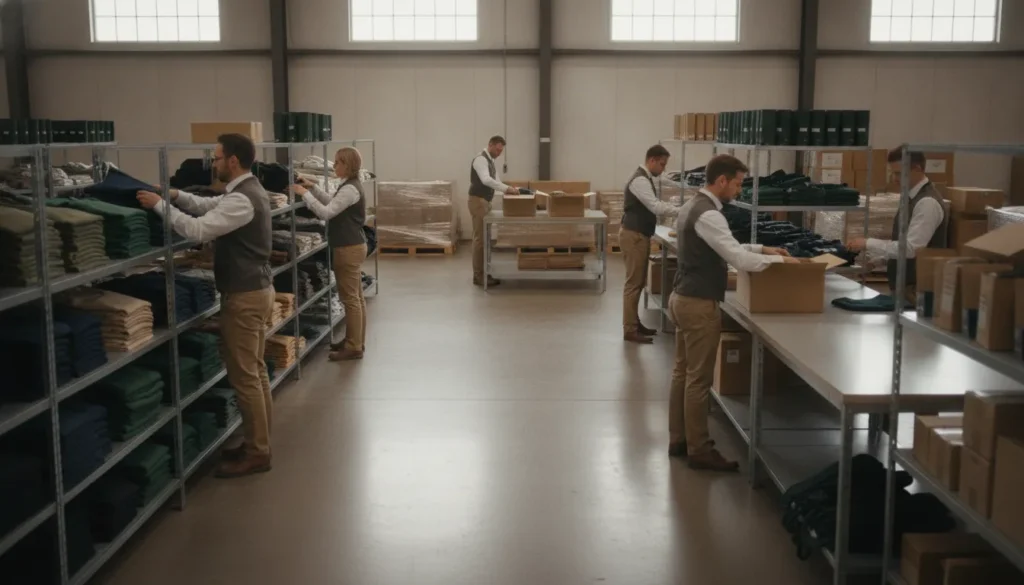
As branded merchandise programs grow, the warehouse becomes more than a place to hold inventory. It connects production, stock control, employee orders, packing, shipping, and international delivery. For procurement, HR, and brand teams, that makes the logistics partner’s scope as important as the merchandise itself. Brand Vessel brings these capabilities together through Branded Merchandise Services & Company Stores.
Warehouse fulfillment services should give growing merchandise programs coordinated storage, inventory management, professional packing, shipping, and distribution. They should also provide the controls needed for individual and bulk orders. The right partner may connect company stores, kitting, and customs brokerage so teams can manage a broader program without disconnected vendors.
This guide focuses on practical criteria for comparing providers, starting with the service scope behind a reliable merchandise operation.
What Should Warehouse Fulfillment Services Include?
Warehouse fulfillment services for branded merchandise should cover more than holding boxes. A complete program connects secure storage, inventory management, order picking, professional packing, shipping, returns handling, and international logistics. For global programs, customs brokerage and clear visibility into stock and orders are also important parts of the operating model.
Storage is the starting point, not the full service
Storage-only arrangements place merchandise in a facility until someone requests it. That can be appropriate for a limited inventory need, but it leaves your team responsible for the work around the warehouse. Buyers may still need to reconcile stock, coordinate picks, prepare shipments, manage packaging, and resolve returns across multiple vendors or internal processes.
A broader service should include storage conditions suited to the merchandise, organized receiving, and inventory controls that help teams understand what is available. Brand Vessel documents storage facilities, climate-controlled environments for sensitive materials, and real-time inventory tracking as part of its warehouse operations. Those controls matter when branded apparel, event kits, and other merchandise must remain usable and accounted for between campaigns.
End-to-end scope connects inventory to delivery
Look for a partner that can manage the operational handoffs after goods arrive. Core capabilities can include:
- Receiving and organizing branded products in storage.
- Inventory management that supports stock visibility, returns, and reorders.
- Picking items for individual orders, team shipments, or larger campaigns.
- Professional packing and preparation for shipment.
- In-house shipping, including direct-to-employee and centralized bulk delivery models.
- Global distribution and customs brokerage for country-specific requirements.
Inventory management deserves particular attention because merchandise programs can face stockouts, overstocking, returns, and reorders at the same time. The guide Corporate Merch Inventory Management: Returns and Reorders covers those issues in greater depth. A useful evaluation question is whether the provider can connect inventory records to the decisions your team makes about replenishment and distribution.
For enterprise buyers, the practical distinction is integration. A warehouse partner may store products, while a fulfillment partner connects storage with packing, shipping, distribution, and the compliance work required for international delivery. Brand Vessel’s documented model combines branded merchandise, company stores, storage and logistics, and kitting and fulfillment. Allowing buyers to evaluate those functions as one merchandise ecosystem rather than isolated tasks.
How Do Warehouse Fulfillment Services Work for Branded Merchandise?
Warehouse fulfillment services move branded merchandise through a controlled sequence. The work typically covers receiving, storage, inventory tracking, order processing, packing, delivery, and returns. A strong process also supports direct-to-employee shipments, centralized bulk delivery, and quality checks that protect the brand experience.
A typical workflow includes the following stages:
- Receive and verify merchandise. The warehouse receives decorated apparel, promotional products, packaging, and other program materials. Staff verify quantities and item details against incoming documentation. They identify exceptions and prepare inventory for storage.
- Store items under appropriate conditions. Products move into designated storage locations. Climate-controlled environments may be available for sensitive materials when needed. The goal is to keep goods secure and easy to locate as orders arrive.
- Track inventory continuously. Inventory records should reflect receipts, allocations, shipments, adjustments, and returns. Real-time tracking gives merchandise stakeholders a clearer view of what is available. It can also surface stockouts, overstocking, returns, and reorder needs before they disrupt a program. Brand Vessel documents warehousing, inventory management, and real-time inventory tracking as part of its logistics scope.
- Pick and assemble each order. When an order is submitted, warehouse staff select the required items and confirm the contents. Some orders involve one product. Others combine multiple pieces into an employee shipment, event package, or company distribution. For coordinated assembly, Kitting and Assembly Services: What Businesses Need to Know explains how kitting, assembly, quality control, and fulfillment fit together.
- Pack for the delivery model. Professional packing should reflect whether merchandise is going to one recipient, a group of employees, or a centralized destination. Individual cartoning and bulk preparation require different handling decisions. Accurate labels, complete contents, and suitable packaging matter for both models.
- Ship individually or in bulk. A warehouse fulfillment partner may ship directly to employees. This supports remote and distributed workforces. The partner may also consolidate merchandise for centralized bulk delivery. Brand Vessel documents both models, along with in-house shipping and global distribution capabilities. International orders may require attention to country-specific requirements and customs processes.
- Process returns and perform quality checks. Returns should be recorded in the inventory system, assessed, and routed according to program requirements. Quality checks can confirm the right items were picked. They can also confirm that branding, decoration, packaging, and shipment contents meet the order before departure.
This sequence gives procurement, HR, and brand teams a practical way to assess a provider. Look for documented controls at every handoff, not just a storage location. The strongest model connects receiving, inventory, kitting, packing, shipping, and returns so the merchandise program operates as one system.
Which Capabilities Matter as Your Merchandise Program Grows?
As order volume and distribution complexity increase, warehouse fulfillment services should give your team more control, not just more storage space. Compare providers on real-time inventory visibility, ordering workflows, reporting, integrations, shipping models, international support, and lead-time planning. The right capabilities connect merchandise operations to the way employees, teams, and customers actually receive products.
The most valuable capabilities are the ones that connect inventory visibility to ordering, picking, packing, shipping, and reporting. Growing merchandise programs should compare real-time stock controls, employee ordering, integrations, direct-to-recipient and bulk distribution, international support, and clear lead-time dependencies before choosing a fulfillment partner.
| Capability | What to look for | Why it matters |
|---|---|---|
| Inventory visibility | Real-time tracking, inventory records, and reporting access | Helps teams coordinate replenishment, allocations, and reorders with better information. |
| Ordering and integrations | Self-service ordering, approvals, budget controls, HRIS, SSO, and API connections | Reduces manual administration as more employees and departments participate. |
| Distribution model | Direct-to-employee shipping alongside centralized bulk delivery | Supports remote workforces, events, office replenishment, and team shipments through one operating model. |
| International support | Global distribution and guidance on country-specific customs requirements | Gives procurement and brand teams a clearer path for serving distributed employees and locations. |
| Lead-time planning | Defined steps for receiving, inventory availability, picking, packing, and shipping | Helps teams plan launches, onboarding waves, events, and replenishment around operational dependencies. |
Visibility should connect ordering to fulfillment
Reporting is most useful when it reflects the full movement of merchandise. A growing program should be able to review inventory status, order activity, shipment information, and returns without stitching together disconnected spreadsheets. Company store platforms can support self-service employee ordering, automated inventory management, reporting and analytics, budget allocation, approval workflows, HRIS connections, SSO, and API integrations. These controls are especially useful when several teams share one merchandise program.
Distribution flexibility also matters. A provider may need to ship individual orders directly to employees while sending larger quantities to an office, event, or regional team. Brand Vessel documents both direct-to-employee shipping and centralized bulk delivery, as well as global distribution. Buyers should confirm how these models fit their workforce and review Merch Fulfillment Lead Times: What to Expect when building launch and replenishment plans.
Plan for the operating model you are building
International programs add another layer of coordination. In-house customs brokerage can help address country-specific requirements, but buyers should still ask how information, approvals, and exceptions are handled. They should also evaluate whether the provider can connect warehousing with employee ordering and broader merchandise services. For teams considering that model, Custom Company Stores can provide a useful reference point for evaluating ordering and governance capabilities.
How Should You Evaluate Warehouse Fulfillment Services?
Evaluate warehouse fulfillment services as an operating partner, not as a storage quote. Compare the provider’s service scope, inventory controls, technology, shipping models, international compliance, scalability, and ability to reduce vendor complexity. The right fit should connect warehousing to the way your merchandise is ordered, decorated, packed, distributed, and managed.
Use the following scorecard in discovery meetings and proposal reviews:
- Service scope: Confirm whether the provider handles receiving, storage, inventory management, professional packing, pick-and-pack, shipping, returns, and any required kitting. Storage alone may not solve the operational problem.
- Inventory controls: Ask how stock is tracked, how often data is updated, and how the team identifies stockouts, overstocking, returns, and reorders. Real-time inventory visibility is especially important when multiple teams draw from the same merchandise pool.
- Storage conditions: Match the facility and handling process to the merchandise. Ask how sensitive materials are protected, how items are organized, and how receiving and quality checks are documented.
- Systems and integrations: Review the ordering, reporting, approval, and data workflows your teams already use. For employee merchandise programs, relevant capabilities may include automated inventory management, analytics, HRIS connections, SSO, and API integrations.
- Distribution flexibility: Make sure the partner can support both direct-to-employee shipments and centralized bulk delivery. The right model may vary by onboarding program, event, office, or geographic region.
- Global compliance: For international programs, ask who manages country-specific requirements, documentation, and border processes. What Is Customs Brokerage for Branded Merchandise? can help clarify why this responsibility matters.
- Scalability: Evaluate whether the operating model can support changing order patterns, distributed employees, new destinations, and larger merchandise programs without forcing a separate process for every use case.
- Vendor consolidation: Consider whether one partner can connect merchandise production, storage, fulfillment, and distribution. Fewer handoffs can simplify ownership, but only when the provider has the documented depth to manage the full scope.
- Service model: Clarify who owns communication, exception handling, reporting, and continuous program coordination. Enterprise teams often need an extension of their operations team, not a low-touch warehouse contact.
Finally, ask each provider to map its capabilities to your actual workflows. Brand Vessel documents an integrated model that combines branded merchandise, company stores, storage and logistics, and kitting and fulfillment, with global distribution and in-house customs brokerage. Treat those as documented capabilities to evaluate against your requirements, not as automatic guarantees for every program.
Why Connect Warehousing, Kitting, and Company Stores?
Connecting warehousing, kitting, fulfillment, and ordering through one operating model can make a growing merchandise program easier to manage. The right partner aligns inventory, packaging, employee ordering, and distribution so each activity supports the next. This approach can reduce vendor complexity while giving brand, procurement, and people teams a clearer view of how merchandise moves from production to recipient.
One operating model for different merchandise needs
Merchandise programs rarely have one fulfillment pattern. A company may need individual employee shipments for remote workers, bulk deliveries for offices, and assembled kits for onboarding, events, or campaigns. When warehousing and kitting are disconnected, each use case can require separate instructions, handoffs, and quality checks. A connected model gives the operating partner responsibility for coordinating storage, item selection, packing, and shipment according to the program’s requirements.
That coordination is especially useful when inventory includes several products, decoration methods, packaging components, or recipient groups. Kitting can bring those elements together before distribution, while warehouse inventory management provides the foundation for knowing what is available. Brand Vessel documents a service model that combines branded merchandise, company stores, storage and logistics, and kitting and fulfillment in one merchandise ecosystem.
Better alignment between ordering and fulfillment
A company store can give employees or approved groups a controlled way to order merchandise rather than relying on disconnected requests. Documented company store capabilities may include self-service ordering, automated inventory management, reporting and analytics, budget allocation, approval workflows, HRIS connections, SSO, and API integrations. Connecting those ordering tools to the physical fulfillment operation helps align what people can request with how items are stored, assembled, and shipped.
For procurement and brand teams, that alignment also supports consistency. Approved products, packaging standards, and distribution rules can be managed as part of the broader program instead of being recreated for every campaign. A Custom Company Stores approach may be appropriate when employee ordering needs to work alongside managed inventory and fulfillment workflows.
When an integrated partner makes sense
This model is worth evaluating when merchandise volume is growing, stakeholders are multiplying, or the program spans offices, remote employees, and international destinations. It can also fit teams that want one strategic partner to connect creative production with storage, fulfillment, and distribution. The goal is not to remove every specialist from the process. It is to establish clearer ownership, shared information, and an operating structure that can support different merchandise use cases without adding unnecessary handoffs.
Frequently Asked Questions
What is included in warehouse fulfillment services?
Warehouse fulfillment services can extend beyond storing merchandise. A complete program may include receiving, inventory management, pick-and-pack, professional packing, shipping, returns processing, and distribution. For branded merchandise, buyers should also ask whether the provider can support kitting, company-store orders, and both individual and bulk shipments.
How do warehouse fulfillment services support remote employees?
A fulfillment partner can ship merchandise directly to individual employees instead of sending every order to one office. That model is useful for distributed teams, onboarding kits, recognition programs, and remote events. Buyers should confirm how employee addresses, order approvals, inventory visibility, and returns are managed.
When should a merchandise program add kitting to its fulfillment scope?
Kitting makes sense when several items need to be assembled, packed, and shipped as one coordinated package. Examples include event kits, new-hire packages, and campaign-specific bundles. Ask how the provider handles assembly instructions, quality checks, packaging choices, and inventory updates before orders leave the facility.
What should buyers ask about international merchandise fulfillment?
Ask how the provider handles country-specific requirements, customs documentation, shipping coordination, and destination-level exceptions. In-house customs brokerage can help a global branded merchandise program navigate international regulations and border processes. But the provider should explain its actual role and supported destinations rather than promise identical service everywhere.
How can a company compare warehouse fulfillment providers?
Compare each provider across inventory visibility, storage conditions, order accuracy controls, integrations, shipping models, returns, kitting, international compliance, and reporting. Also evaluate whether one partner can connect merchandise sourcing, company stores, warehousing, and distribution. A broader fit may reduce vendor complexity as the program grows.
Ready to discuss your fulfillment program?
A thoughtful warehousing and fulfillment plan can help your team coordinate branded merchandise across inventory, orders, and distribution needs. To discuss your operation and the support that may fit it, start a project with Brand Vessel. You can share your current workflow, program priorities, and areas where a merchandise logistics partner could help. Brand Vessel can then learn more about your needs and discuss an appropriate next step.