
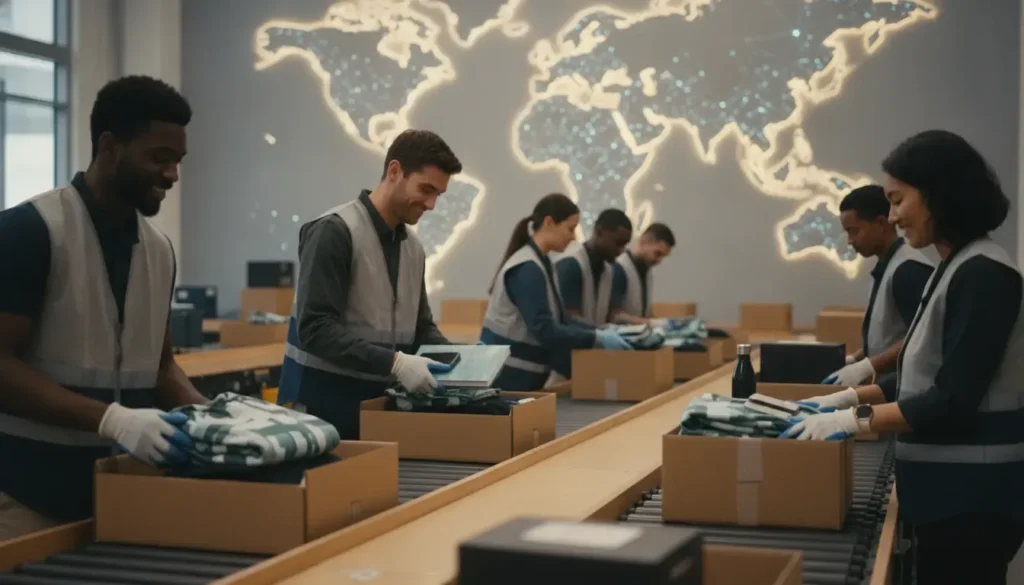
Global fulfillment services become complicated when a merchandise program serves employees in several countries, uses multiple ordering paths, and still needs to feel like one brand experience. A provider may store inventory, pack kits, ship individual orders, and help with customs, but the real buying decision is whether those pieces work together. This guide shows procurement, people, and brand teams how to evaluate the operational model behind a global employee merchandise program.
Start A Project to discuss a distributed employee merchandise program with Brand Vessel.
What Are Global Fulfillment Services?
Global fulfillment services coordinate the storage, preparation, shipment, and exception handling required to deliver products across national borders. For employee merchandise, that can include branded apparel, onboarding kits, recognition gifts, event materials, and company-store orders. The best service model connects inventory, ordering, packaging, shipping documentation, and support instead of treating each order as an isolated transaction.
That distinction matters because international delivery is not only a transportation problem. A provider also needs a clear process for:
- Receiving and storing branded merchandise
- Maintaining inventory visibility across programs and product variants
- Picking, packing, kitting, and quality-checking orders
- Routing individual and bulk shipments to the right destinations
- Managing customs documentation and country-specific delivery requirements
- Handling address corrections, damaged parcels, returns, and replacement requests
- Reporting on orders, inventory, exceptions, and program performance
For a distributed workforce, these capabilities turn a central merchandise catalog into an operating system employees can actually use. The provider does not need to own every part of the program, but responsibilities should be visible, documented, and easy to manage.
Why Do Distributed Employee Programs Need a Different Fulfillment Model?
Distributed employee programs have a different fulfillment profile from a single bulk delivery. Orders may be triggered by new-hire dates, recognition moments, team events, or employee self-service. Recipients may have different sizes, addresses, delivery constraints, and expectations. A global model must preserve brand consistency while adapting the transaction to the employee and destination.
Common operational differences include:
- Order volume: A program may combine one-off employee orders with planned bulk shipments.
- Product mix: Apparel adds size, color, decoration, and replacement considerations.
- Timing: An onboarding kit and a conference shipment have different deadlines and tolerance for delay.
- Destination rules: Countries can differ in documentation, duties, taxes, and carrier requirements.
- Data inputs: People teams may supply recipient information through a company store, spreadsheet, HR workflow, or approved request process.
- Brand controls: A global program needs consistent product standards even when orders are shipped separately.
A useful provider should help the buyer map these use cases before recommending a shipping workflow. That planning prevents a common mistake: selecting a carrier first and discovering later that inventory, customs, or employee support has no clear owner.
How Should You Design the Inventory and Ordering Model?
A global fulfillment program works best when inventory and ordering rules reflect how employees will receive merchandise. The buyer should define which products are stocked, which are made to order, which destinations are supported, and which events require reserved inventory. Those decisions shape costs, lead times, service levels, and the employee experience long before an order is placed.
Start by separating the catalog into operating groups:
- Core items: Consistent apparel or merchandise that employees can request throughout the year.
- Program-specific kits: Predefined combinations for onboarding, recognition, field teams, or internal events.
- Seasonal or campaign items: Products tied to a launch, conference, milestone, or limited window.
- Exception items: Special sizes, replacement products, or region-specific merchandise that needs a separate replenishment rule.
Then establish the controls that keep the model manageable:
- Minimum and maximum inventory thresholds
- Reserved quantities for known employee or event commitments
- Approval rules for higher-value or nonstandard requests
- Reorder ownership and review cadence
- Product substitutions when an item is unavailable
- Disposition rules for discontinued or excess merchandise
Company stores can make these controls easier to operate by giving employees a structured ordering path and giving program owners a central place to manage products and requests. Brand Vessel provides Custom Company Stores & Fulfillment for programs that need a branded storefront connected to fulfillment operations.
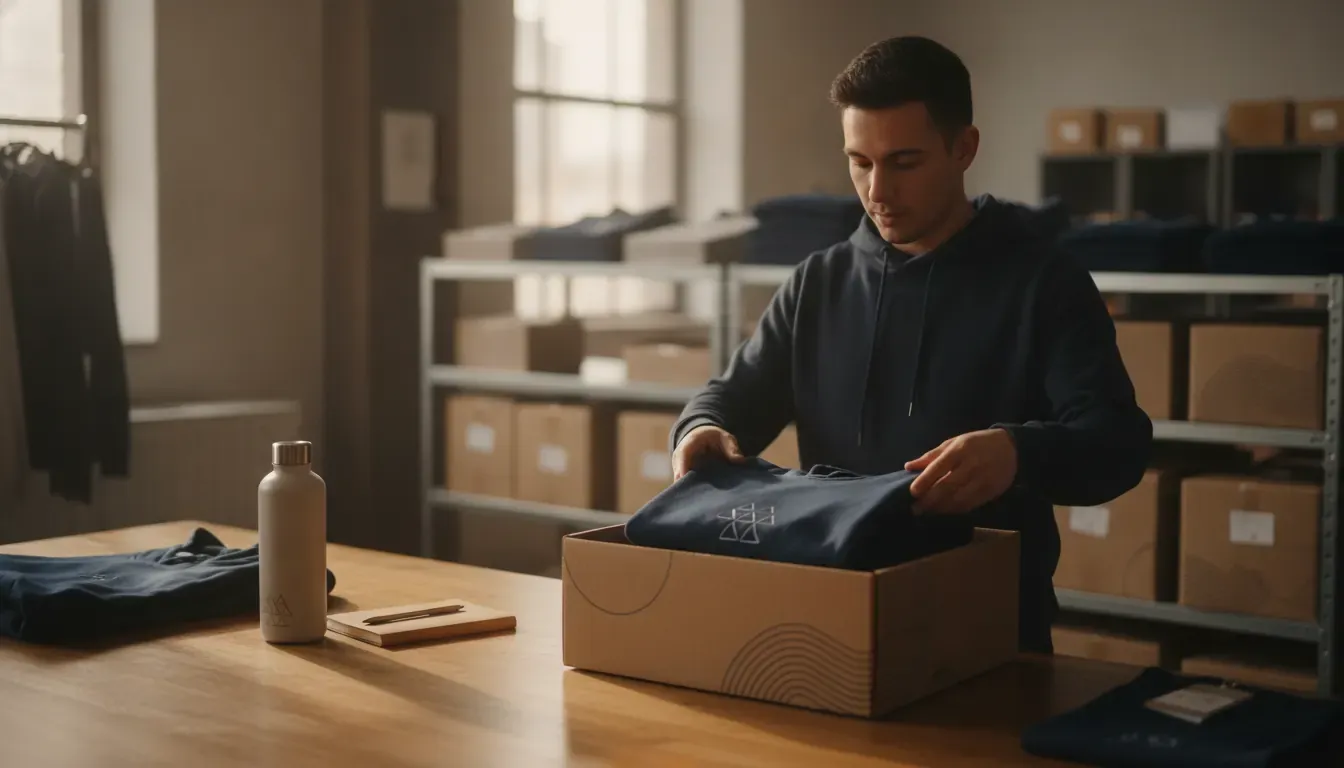
What Should a Provider Manage Before an International Shipment Leaves?
Before an international shipment leaves, the fulfillment provider should confirm that the order, packaging, address, carrier route, and customs information are ready for the destination. The exact requirements vary by shipment and country, so buyers should ask how the provider identifies missing information, who resolves it, and how exceptions are communicated to the program owner.
A practical pre-shipment workflow may include:
- Validating the recipient address and contact details
- Confirming the products, quantities, sizes, and decoration requirements
- Checking packaging, inserts, and kit contents against the order
- Preparing the shipment record and required customs information
- Selecting the delivery method based on destination and service need
- Providing tracking or status visibility to the appropriate stakeholders
- Escalating incomplete data before the parcel enters the carrier network
Ask prospective providers to explain the handoff between warehouse staff, shipping specialists, customs brokers, carriers, and customer support. A strong answer names accountable roles rather than saying that a generic logistics team will handle everything. Brand Vessel emphasizes in-house shipping and expert customs brokerage as part of its broader merchandise and logistics offering.
How Do Customs and Exceptions Affect the Employee Experience?
Customs and delivery exceptions affect more than transit time. They can create an unexpected employee request, a missed onboarding moment, or a support burden for the people team. A global fulfillment partner should define how duties, documentation questions, address problems, carrier delays, returns, and replacements are surfaced and resolved, without forcing the buyer to investigate every parcel.
During evaluation, ask:
- Who reviews shipment data before international dispatch?
- Who owns a customs documentation question?
- How are duties, taxes, or other destination-specific charges communicated?
- What happens when an employee is unavailable or an address is incorrect?
- How are damaged, lost, refused, or returned shipments handled?
- Which events trigger a proactive notification to the program owner?
- Can the provider report recurring exceptions by country, carrier, product, or program?
These questions help separate a coordinated service from a label-printing workflow. The goal is not to promise that every shipment will be frictionless. The goal is to make the likely points of friction visible and give each one an owner, response path, and reporting method.
How Can a Company Store Support Global Fulfillment?
A company store can give distributed employees a consistent way to request approved merchandise while keeping product, budget, and fulfillment rules under program control. It is most useful when the store is connected to the operational model behind it, including inventory, packing, shipping, and reporting. A storefront alone does not solve international fulfillment; the workflow around it does.
For a company-store evaluation, look for:
- Catalog controls for approved products, sizes, colors, and decoration
- Ordering paths for individuals, departments, and planned bulk requests
- Budget or approval rules that match the program’s governance
- Inventory visibility and replenishment reporting
- Address collection and order-status communication
- Integration options that reduce manual re-entry where appropriate
- A fulfillment partner that can support both store orders and non-store programs
This is where service design matters. An employee may place an order through a store, while a people team may trigger a new-hire kit through a separate approved process. Both should reach the same standards for product quality, packing accuracy, shipping visibility, and exception support.
Brand Vessel’s Branded Merchandise Services & Company Stores combine merchandise, company-store, storage, logistics, and fulfillment capabilities for organizations that want one strategic partner rather than a disconnected set of vendors.
Which Questions Should You Ask During a Fulfillment Review?
A fulfillment review should test the provider’s operating discipline, not only its warehouse footprint or carrier list. Ask for a clear description of how a real employee order moves from request to delivery, including inventory allocation, quality checks, customs preparation, status updates, exception handling, and reporting. The provider’s ability to explain the handoffs is an important buying signal.
| Area | Question to ask | What a useful answer includes |
|---|---|---|
| Inventory | How do you prevent stockouts and over-allocation? | Thresholds, reserved inventory, replenishment ownership, and reporting |
| Quality | How do you confirm an order is complete before dispatch? | Pick-and-pack checks, kit standards, and a correction process |
| International shipping | How do you prepare orders for different destinations? | Address validation, documentation review, routing, and accountable roles |
| Exceptions | What happens when a shipment is delayed or returned? | Escalation timing, recipient communication, replacement, and return handling |
| Visibility | What can the program owner see each week? | Order status, inventory, exception, destination, and trend reporting |
| Program fit | Can you support stores, kits, events, and individual orders? | A unified operating model with use-case-specific workflows |
For a broader comparison of provider capabilities, use Brand Vessel’s Corporate Swag Vendor With Logistics: A Buyer’s Guide alongside this operational checklist. The two resources should work together: one frames the vendor decision, while this review focuses on the mechanics of distributed delivery.
Start A Project to map your inventory, company store, shipping, and customs requirements with Brand Vessel.
What Does a Strong Global Fulfillment Partner Look Like?
A strong global fulfillment partner brings merchandise judgment and logistics discipline together. It can support the physical work of storage, kitting, packing, and shipping while also helping the buyer make better decisions about product standards, ordering controls, customs ownership, and reporting. The right partner makes a distributed program easier to govern as it grows.
Look for a partner that can:
- Understand branded merchandise and custom apparel, not only generic parcels
- Support individual employee orders and planned bulk distribution
- Coordinate storage, inventory management, kitting, packing, and shipping
- Explain international documentation and customs responsibilities clearly
- Preserve product quality and brand standards across destinations
- Provide a company store or another controlled ordering experience when needed
- Report on delivery performance, inventory health, and recurring exceptions
- Work as an extension of the procurement, people, marketing, and brand teams
Brand Vessel serves companies that need branded merchandise, custom company stores, storage and logistics, kitting, fulfillment, and global distribution in one connected relationship. That combination is especially relevant when a program must support both employee experience and operational accountability.
Frequently Asked Questions
What do global fulfillment services include?
Global fulfillment services can include inventory storage, order processing, picking, packing, kitting, international shipping, customs support, tracking, returns, replacements, and reporting. The exact scope depends on the provider and the program. Buyers should confirm who owns each step for employee merchandise, especially address validation, documentation, duties, and delivery exceptions.
Are global fulfillment services only for ecommerce?
No. Distributed employee programs use fulfillment services for onboarding kits, recognition gifts, internal events, company-store orders, apparel programs, and other branded merchandise. The operating model may combine individual shipments with bulk deliveries. A provider should be able to support the use cases the organization actually runs, rather than forcing every request into one order type.
How should procurement compare global fulfillment providers?
Compare providers on inventory controls, product and decoration quality, kitting accuracy, international shipping processes, customs ownership, exception handling, ordering technology, reporting, and support. Ask each provider to walk through a realistic employee order from request to delivery. That scenario exposes handoff gaps that a capabilities list may not reveal.
Can Brand Vessel support distributed employee merchandise programs?
Brand Vessel offers branded merchandise, custom apparel, company stores, storage and logistics, kitting, fulfillment, in-house shipping, customs brokerage, and global distribution. Program requirements vary, so the right next step is to outline the products, employee use cases, destinations, ordering paths, and service expectations before selecting an operating model.
Start A Project to plan a connected global fulfillment approach for your employee merchandise program.