
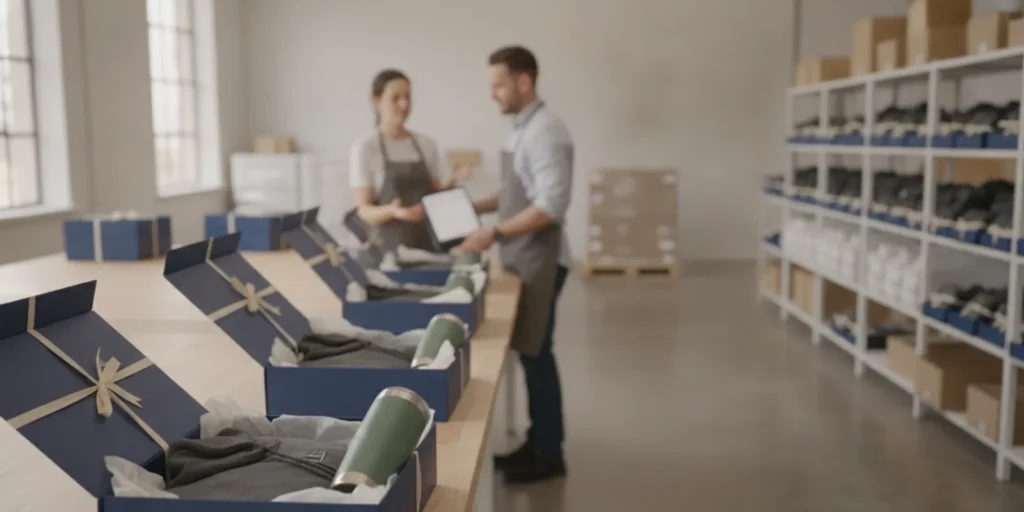
Corporate gift fulfillment is the operating work behind getting the right gift to the right client or employee, at the right time, with a consistent brand experience. For enterprise teams, the challenge is not just choosing an item. It is coordinating recipients, inventory, packaging, shipping rules, and exceptions across a program that may span offices, home addresses, or countries.
Talk through your gift fulfillment needs
What does corporate gift fulfillment include?
Corporate gift fulfillment connects the decisions made by a gifting program to the delivery each recipient experiences. It typically includes preparing and holding merchandise, receiving approved orders or recipient files, assembling the right items, packing them, shipping them, and resolving delivery or data exceptions. The exact workflow depends on the program’s audience, timing, and distribution model.
That definition matters because a gift order is not always one bulk shipment. A company may send a coordinated gift to hundreds of employees at home, ship separate packages to a list of clients, or provide a store where eligible recipients make selections. Those workflows share the same need for accurate item, recipient, and delivery information, but they require different controls.
For procurement and program owners, treat fulfillment as a connected process rather than a final shipping step. Decisions about gift selection affect packaging and inventory. Decisions about who can order affect store access and approval. Address collection affects privacy, timing, and international documentation. If these decisions are made separately, a polished gift concept can still become a difficult operating project.
It helps to distinguish fulfillment from adjacent services. Kitting is the assembly of multiple items into a set; fulfillment is the broader work of storing, processing, packing, and delivering orders. A program may need both. Teams planning multi-item packages can review What Is Corporate Kitting? Guide for Enterprise Teams to understand where assembly fits into the wider delivery workflow.
Brand Vessel brings branded merchandise, company stores, storage and logistics, kitting, and fulfillment together as related capabilities. The right scope depends on whether a team needs a one-time coordinated distribution, an ongoing ordering program, or support across both. Start by mapping what recipients should experience, then work backward through the operations required to deliver it.
How do you plan a corporate gift fulfillment workflow?
A reliable workflow starts with a defined audience and a single source of truth for each order. Before merchandise moves, assign owners for recipient eligibility, address collection, item selection, approvals, and exceptions. Then document the sequence from inventory readiness through dispatch and delivery confirmation. Clear handoffs prevent teams from discovering missing information after packages are packed.
- Define the program and audience. Identify whether gifts go to clients, employees, event attendees, or a combination. Set eligibility rules, quantities, regions, and the occasion or send window. Avoid mixing audiences with different gift rules in a single uncontrolled file.
- Choose the ordering route. Decide if the team will supply a final recipient list, allow recipients to select or confirm details, or use a company store. A store can support ongoing or distributed programs, while a fixed list can fit a defined one-time send. The choice affects access controls, approvals, and how late changes are handled.
- Confirm the merchandise and packout. Record item variants, sizes, colors, personalization, quantities, and approved substitutions. For a gift set, document the contents and packing order so each package follows the same specification. Make approval samples or proofs part of the process when decoration or packaging needs review.
- Set up inventory and timing. Confirm what is available, what must be produced, when it will be ready, and where it will be held. Build time for approvals, data cleanup, assembly, and carrier handoff into the schedule. For more detail on planning around timing, see Merch Fulfillment Lead Times: What Buyers Should Know.
- Validate recipient and shipping data. Establish required fields and accepted formats before collecting information. Check for missing apartment or suite details, duplicate records, invalid postal codes, or conflicting item selections. Restrict access to recipient information to the people and systems that need it for the work.
- Approve, pack, and dispatch. Define who releases orders, how packages are labeled, and what carrier or service rules apply. For bulk distribution, confirm carton counts and destination details. For individual shipments, make sure each order can be matched to the correct recipient without exposing unnecessary personal data.
- Track completion and exceptions. Decide which status updates matter to the program owner, such as orders received, packed, shipped, delayed, or returned. Create a route for undeliverable packages and late address changes. Close the loop with an agreed final report or reconciliation.
Put these steps into a short operating brief that names an owner, the required input, approval point, and completion signal for each handoff. For example, the HR or client team may own recipient eligibility, while a program lead approves the packout and a fulfillment partner manages storage and dispatch. Roles vary by organization; the important point is that every task has a clear owner.
Organizations that need multiple items assembled for a defined group can use a workflow similar to Kitting and Assembly Services: What Businesses Need to Know. Where the program includes branded packaging or a recipient-specific insert, write that requirement into the approved packout rather than relying on informal instructions.
Which fulfillment model fits your gift program?
The best fulfillment model depends on how often gifts are sent, who selects them, and how much recipient-level variation is involved. A one-time shipment from a confirmed list may call for a different setup than a year-round recognition program or an employee store. Compare the operating demands before choosing a route, not only the gift assortment.
| Program model | Works well when | Key controls to plan | Watch for |
|---|---|---|---|
| Single bulk shipment | One destination or a small number of offices receive a coordinated quantity. | Carton counts, receiving contact, delivery window, and onward distribution owner. | Packages may arrive before the local team is ready to distribute them. |
| Individual recipient send | A fixed audience needs gifts delivered to separate business or home addresses. | Address validation, privacy, item-to-recipient matching, and failed-delivery handling. | Late or incomplete addresses can disrupt a synchronized send. |
| Recipient choice or company store | Recipients need to choose a size, item, or delivery detail within program rules. | Eligibility, ordering window, inventory limits, approval rules, and close date. | Open ordering without defined limits can make inventory and timing harder to manage. |
| Recurring or event-triggered program | Gifts are sent for repeated milestones, events, or onboarding cycles. | Replenishment, triggers, ownership, standard packout, and reporting cadence. | One-off manual decisions may create inconsistent experiences across sends. |
A company store can be useful when a program needs a managed place for eligible recipients to order or select approved merchandise. It does not remove the need for decisions about catalog, access, inventory, shipping, and exceptions. Review Custom Company Stores for Enterprise Teams for more on how a store can support a merchandise program, and use How to Set Up a Company Store for Employees when evaluating the implementation sequence.
For a one-time send, a fixed list may be simpler if the audience and details are stable. If recipients must choose among items or confirm an address, self-service can reduce repeated collection tasks, but it introduces a response window and follow-up requirements. Consider who will manage reminders, late responses, and choices that are no longer available before settling on that model.
Ask how the model will scale when volume or geography changes. A process that works for one office may need different inventory locations, documentation, or communication when recipients are distributed across the United States or internationally. Brand Vessel provides storage and logistics services and global distribution support, including in-house customs brokerage. The applicable process should be confirmed for the specific destinations and merchandise involved.
What controls protect the recipient experience?
Recipient experience depends on dependable details behind the scenes: the approved item arrives as expected, the package is addressed correctly, and the recipient knows what to do if something goes wrong. Set controls for data, quality, timing, and exceptions before launch. These controls make the program easier to manage without promising that every carrier or delivery issue can be prevented.
Start with recipient data. Keep the working file limited to fields needed for fulfillment, such as recipient identifier, name, delivery address, approved item or size, and any required delivery notes. Separate eligibility decisions from address handling when possible, and agree how files will be transferred, corrected, retained, and removed. A partner should understand the data flow and the team’s expectations before receiving a live list.
Build a pre-production check for merchandise and presentation. Confirm decoration placement, color, size assortment, personalization spelling, inserts, packaging, and the number of items in each kit. A documented sample or approval record gives the team a reference point if questions arise during assembly. If an approved item becomes unavailable, use a defined substitution process rather than making an unreviewed change.

Timing controls should include more than the desired arrival date. Work backward from the recipient date and include production, inbound shipping, receiving, inspection, kitting, address correction, and outbound transit. Build a decision deadline for any approval that could affect production. If the plan includes a time-sensitive event, agree what the team will do if inventory or recipient data is not ready by the cutoff.
Write down exception paths in plain language. Common scenarios to plan for include:
- An address is incomplete, invalid, or changes after an order is released.
- A recipient is missing from the approved list or appears more than once.
- A size or selected item is unavailable when the order is processed.
- A shipment is delayed, returned, or marked delivered but not received.
- A package arrives damaged or an item is missing from a kit.
- An international shipment needs additional information or review.
For each case, define who receives the alert, who can approve a correction, and what information is required to close it. Avoid promising a replacement or resend before the program owner confirms eligibility, inventory, and budget. A clear escalation route gives the recipient a response while protecting the organization from inconsistent decisions.
For international sends, ask early about country-specific documentation, shipping arrangements, and customs considerations. Product type, destination, and declared information can affect the process. Brand Vessel’s in-house customs brokerage is relevant to its global distribution work, but teams should still review the particulars of their merchandise and destination with the fulfillment partner before committing to dates.
How should you evaluate a corporate gift fulfillment partner?
Evaluate a partner on the fit between your workflow and its operating capabilities, not on a broad promise to ship packages. Ask for specifics about storage, order intake, company stores if needed, kitting, shipping, international support, reporting, and exception ownership. The goal is to learn who does each task and how your team will see progress.
- Scope and handoffs: Which steps are managed by the partner, which stay with your team, and where do approvals occur?
- Inventory visibility: How are received, held, allocated, and remaining items tracked, and how are discrepancies raised?
- Order and data intake: What format is accepted, what checks happen before release, and how are updates handled?
- Assembly and quality: How are packout instructions followed, decoration reviewed, and missing or damaged items escalated?
- Distribution: Can the model support bulk and individual shipments, and what changes when the recipient list spans multiple regions?
- Store operations: If a store is part of the program, who manages access, ordering windows, item availability, and order approvals?
- Reporting and exceptions: What status information is available, how frequently is it shared, and who resolves a delayed or returned shipment?
- Program continuity: How are specifications, approved artwork, and operating instructions maintained for a repeat send?
Then test the answers against a realistic scenario. Give the partner a sample workflow such as sending a fixed gift set to a distributed employee group, including a late address change and one item variant. Ask them to walk through intake, approval, assembly, dispatch, and exception handling. You are looking for a consistent process and clear ownership, not an unsupported guarantee about timing or results.
Brand Vessel positions itself as a merchandise partner with branded merchandise, company stores, storage and logistics, and fulfillment capabilities. Its Branded Merchandise, Company Stores & Fulfillment Services page describes the service areas. For a broader operational comparison, Product Fulfillment Services: From Storage to Delivery explains how storage and delivery fit into fulfillment. Together, these resources can help a team prepare focused questions before a project discussion.
Finally, align the proposal and operating brief. Confirm the items in scope, information your team must provide, decision deadlines, reporting expectations, and how changes are approved. Avoid treating assumptions as commitments. If the program involves a store, personalization, multiple destinations, or customs, spell out those requirements during planning so the operating model can be reviewed before launch.
Discuss a corporate gift fulfillment project
Frequently asked questions about corporate gift fulfillment
Corporate gift fulfillment can describe several different workflows, so buyers should clarify what is included before comparing providers. These answers address common planning questions about scope, timing, stores, and international shipments; the right setup still depends on the program’s items, audience, destinations, and approvals.
Is corporate gift fulfillment the same as corporate kitting?
No. Kitting is the assembly of multiple items into a set. Fulfillment can include kitting, but it also covers related work such as inventory storage, order processing, packing, shipping, and exception management. A program with a single item may need fulfillment without a kit, while a multi-item package may need both.
Should we send gifts in bulk or directly to recipients?
Choose based on where recipients are, who will distribute packages after delivery, and how much recipient-specific handling is needed. Bulk delivery can suit a central office or event team that will distribute gifts. Individual shipping can serve a geographically distributed audience but requires accurate addresses, recipient matching, and a plan for delivery exceptions.
Can a company store support a gift program?
It can support programs where eligible recipients need a managed way to order or select approved merchandise. The team still needs rules for access, item availability, order windows, approvals, and delivery. A store is one possible operating model, not a substitute for defining the fulfillment workflow.
What should we prepare before requesting a fulfillment proposal?
Prepare an estimated audience and destination mix, the gift or kit concept, expected send timing, ordering model, known item variants, and any personalization or international requirements. Also note what is still undecided. This gives a potential partner enough context to discuss workflow and responsibilities without treating early assumptions as final specifications.
With recipient data, ownership, inventory, and exception handling planned together, corporate gift fulfillment becomes easier to assess and manage. Start with the recipient experience you want, then select the operating model and partner that can support the work required to deliver it.