

How do I choose sustainable branded merchandise without relying on a green label or a product’s first impression? Start by defining the purpose, then compare how well each option will be used, how its materials and claims can be substantiated, and how it will be packed and delivered. The best choice is the one that fits your program and stands up to scrutiny.
What should your sustainable merchandise brief establish?
Before comparing products, define the audience, use, quantity, and delivery plan. These choices determine which sustainability considerations matter most. A useful brief sets priorities that buyers can verify, rather than asking suppliers for something broadly “green.” It also makes tradeoffs visible to brand, procurement, people, and operations teams before a product is approved.
Begin with the job the merchandise needs to do. Is it for employee onboarding, a customer event, a company store, a recognition moment, or a long-running program? A durable item that suits one purpose may be wasteful or impractical for another. Specify who will receive it, where it will be used, and whether recipients need to choose a size, color, or other option.
Then distinguish requirements from preferences. A requirement may be a defined material composition, a minimum expected service life, or packaging that avoids unnecessary components. A preference may be a particular color or product style. Make clear which requirements need documentation and who reviews that documentation. This gives suppliers a fair, consistent basis for proposing options.
- Audience and context: Who receives the item, and what will they use it for?
- Program goal: What should the merchandise support: welcome, recognition, an event, or everyday use?
- Product requirements: Which function, size range, design, and quality characteristics are essential?
- Evidence needs: What information must accompany material or environmental claims?
- Distribution: Will items go to one location, individual addresses, or international recipients?
- Program limits: What budget, deadline, storage capacity, or packaging conditions apply?
- Decision owners: Who approves the product, its claims, artwork, and final order?
A clear brief also helps prevent over-ordering. Estimate quantities using actual recipients and plausible replacement needs rather than ordering a large amount simply to reduce the unit price. If participation is optional, plan for realistic take-up. For a recurring program, review remaining inventory and prior demand before repeating an order.
Set a short list of decision criteria before asking for samples. For example, a team might weight usefulness and construction above novelty, while requiring clear composition details for any material claim. Keep the criteria proportionate to the purchase: a one-time event giveaway does not need the same review process as a year-round global merchandise program.
It can help to write the brief as a one-page decision record. Include the intended audience, approved quantity range, essential product functions, acceptable alternatives, and the evidence reviewers need. Record which claims the organization is willing to make publicly and which are only supplier descriptions. This reduces the chance that an attractive sample moves into production before procurement or communications has checked the underlying information.
For example, a team planning an employee welcome item might compare a useful drinkware piece with a multi-item box. The right answer depends on employees’ needs, shipping expectations, and the evidence available for each option. If the box adds items that have no clear role, a single well-chosen piece may better meet the brief. If several items serve distinct purposes, packaging and assembly can be assessed as part of the same decision.
Brand Vessel’s Branded Merchandise, Company Stores & Fulfillment Services | Brand Vessel page outlines the service areas that may support a broader program. Bringing merchandise selection and the planned delivery model into the brief early helps keep the product decision connected to real operating needs.
How do you evaluate products, materials, and sustainability claims?
Compare products on usefulness, durability, material transparency, and fit for the recipient—not on a single sustainability adjective. Ask what a claim refers to, what documentation supports it, and whether it applies to the whole item or only one component. Then balance that evidence with the product’s function, quality, decoration, and likely use in your specific program.
Use a consistent review for each proposed item. Ask for the product’s material composition and, where relevant, the composition of separate parts such as lids, linings, coatings, or packaging. If a supplier describes an item as recycled, responsibly sourced, reusable, or lower impact, clarify the exact basis of the statement. Request applicable supporting documentation and note who has reviewed it. Do not treat a broad label as proof of every possible environmental benefit.
Product usefulness deserves equal attention. A reusable item only makes sense when the recipient has a reason and opportunity to use it. A well-made garment can work for an employee program when the fabric, fit range, and decoration suit regular wear. For apparel options and construction considerations, teams can review Premium Corporate Apparel: Wardrobe Your Team Will Wear. For drinkware, consider capacity, care instructions, and whether the item fits the audience’s routine; Corporate Branded Drinkware for Enterprise Programs is a related product-planning resource.
Inspect samples instead of judging only a product listing. Check seams, closures, finish, weight, usability, and the quality of any decoration. For apparel, assess the garment itself and the decoration as a combined product. For an item expected to be used repeatedly, ask how it is cleaned or maintained. These checks help reveal whether a product is likely to stay useful or be set aside after a short time.
Keep sample reviews comparable. Use the same reviewers and checklist for each finalist, and note whether a sample is production-representative or only a visual mock-up. Ask what may change between sample approval and the finished order, including color, decoration placement, packaging, or component substitutions. Save the approved specification so receiving teams can check the delivered goods against what was reviewed. If a product is not available for hands-on review, request detailed specifications and clear images, while noting what remains unverified.
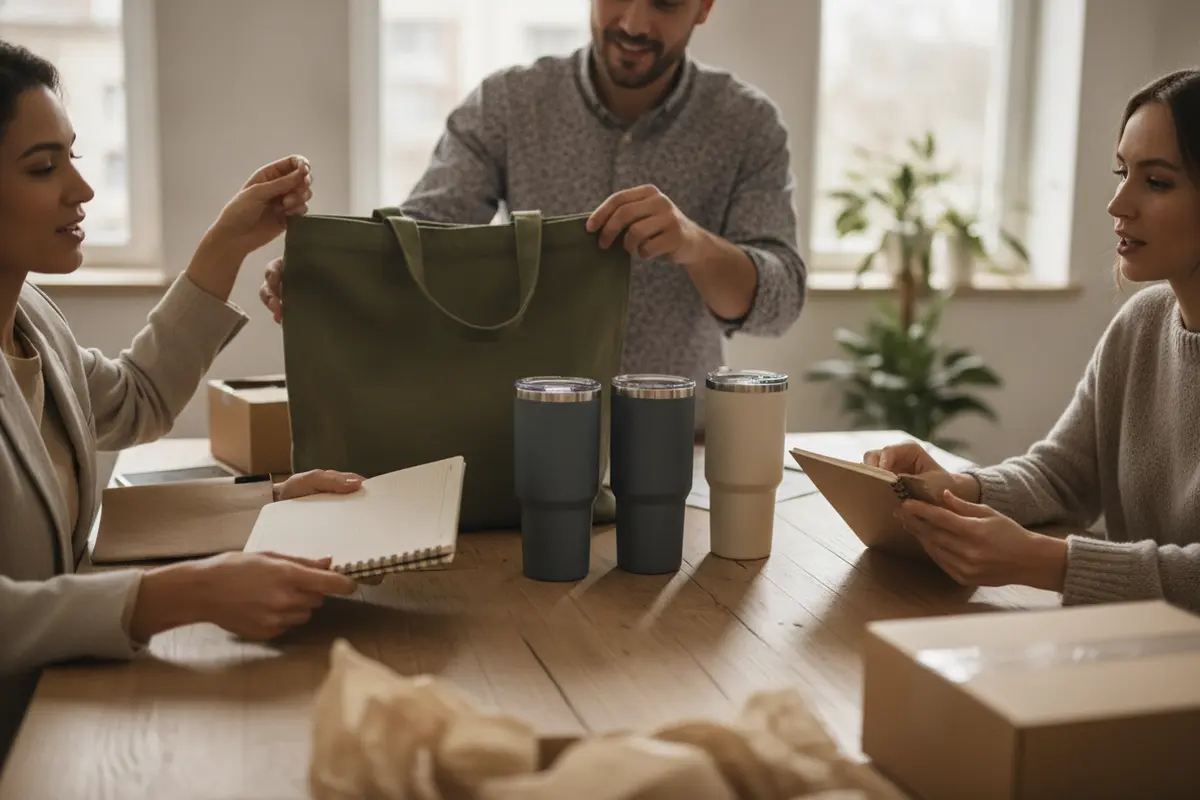
Use a comparison table to keep claims, unknowns, and program fit separate. These are evaluation prompts, not blanket claims about a product category; suppliers should confirm details for the specific item being proposed.
| Option | What to evaluate | Evidence or question to request | Program fit to check |
|---|---|---|---|
| Reusable drinkware | Construction, care, practical design, and packaging | What materials make up the vessel and each component? What care guidance applies? | Will recipients use it regularly, and can it be shipped safely? |
| Apparel | Fiber composition, stitching, fit, decoration, and expected wear | Can the supplier document the material description and explain the decoration process? | Does the style and size range suit the intended team or event? |
| Bags and totes | Construction, capacity, material, and useful design | What is the material composition, and what supports any sourcing claim? | Is it a practical replacement for something the audience already carries? |
| Notebooks and desk items | Paper or component details, binding, and writing or work utility | Which components are included in a material or recycled-content statement? | Does the item match the recipients’ work habits and event context? |
| Multi-item kits | Each item’s value, combined packaging, and assembly | Can components and packaging be reviewed separately? | Will every item serve a clear purpose for the recipient? |
Use the table to compare evidence rather than to produce a simplistic score. A lower-impact claim that cannot be explained may deserve further review; a product with clear materials and strong practical value may be a better fit even if it is not perfect across every dimension. Record open questions, ask for clarification, and avoid presenting a supplier’s unverified wording as your company’s own claim.
Consider decoration as part of the item. Branding can affect appearance, comfort, and how often someone chooses to use apparel or accessories. Ask to see the proposed decoration method on a comparable sample when possible. If a logo treatment makes a useful product feel less appropriate for everyday use, explore a restrained design rather than assuming a larger mark is better.
How should packaging, fulfillment, and program operations shape the choice?
A product decision is incomplete until the team understands how items will be stored, packed, and delivered. The right approach depends on order size, recipient locations, timing, and what each shipment must contain. Review packaging and freight requirements alongside item claims, and plan inventory so useful merchandise reaches the intended people without creating avoidable leftovers.
Start by mapping the path from production to recipient. Will all items arrive at one office, be held for later events, or ship individually to employees and customers? A central event may call for consolidated cartons, while a distributed team may need address collection, order windows, or individual fulfillment. The implications depend on the actual shipment plan, so request a clear description rather than assuming one distribution model suits every program.
Ask how items will be packed and whether the packing configuration is required for protection, presentation, or handling. Review packaging at the component level: product packaging, protective materials, kit packaging, and outer cartons may serve different purposes. Where a team wants to reduce excess packaging, confirm that the proposed alternative still protects the merchandise during storage and transport.
Inventory planning matters too. If the program is recurring, establish who tracks quantities, monitors reorder points, and approves replenishment. Use prior demand and upcoming program dates to guide quantities. A company store can help teams manage access to merchandise and ordering; Brand Vessel’s Custom Company Stores for Enterprise Teams | Brand Vessel page describes its company store offering. For broader planning context, see What Is a Company Store? Enterprise Procurement Guide.
For kits or multi-item shipments, check whether every component earns its place. A kit assembled for onboarding may need items with distinct functions, but additional filler can increase cost and packaging without improving the experience. Clarify kit contents, assembly sequence, quality checks, and how substitutions are handled if one component becomes unavailable. The Corporate Kitting & Fulfillment Guide | Brand Vessel offers context on kitting and fulfillment.
International distribution adds further questions. Confirm the intended countries, delivery expectations, and responsibility for shipping documentation and customs processes. Do not treat a product’s material description as the only consideration in a global program; the ability to coordinate accurate, timely delivery is part of a workable decision. Teams can also review Brand Vessel’s Branded Merchandise, Company Stores & Fulfillment Services | Brand Vessel service overview when assessing the operational scope.
Before approving a recurring order, define how the program will be reviewed. Track inventory remaining, orders or participation, delivery exceptions, and feedback that indicates whether recipients found items useful. These measures do not prove environmental impact by themselves, but they can reveal avoidable surplus, poor fit, or fulfillment issues that a future order can address.
Consider a distributed team ordering from a central inventory. If recipients can select only sizes or colors that suit them, the program may improve product fit, but it also needs clear ordering windows and stock visibility. If a team ships kits directly, the review should include the condition of items on arrival and whether the full set was useful. These are operational questions, not universal rules: compare the alternatives against the actual recipient experience and service requirements.
A simple approval sequence can keep decisions moving:
- Program owner confirms audience, purpose, quantity, and delivery plan.
- Brand and procurement reviewers assess product fit, decoration, and evidence for stated claims.
- Operations confirms storage, packaging, kitting, shipping, and timing requirements.
- Approvers review a final sample or specification before production begins.
- The program owner records the decision and schedules a post-delivery review.
For examples of work across merchandise programs, see Branded Merchandise Work & Case Studies | Brand Vessel. The relevant comparison is not simply which product looks most environmentally appealing; it is which option meets a defined need, has supportable claims, and can be handled responsibly within the program’s real constraints.
Discuss your merchandise program
Frequently asked questions about sustainable branded merchandise
What makes branded merchandise sustainable?
There is no single attribute that answers this for every product. Evaluate its usefulness, expected durability, material details, substantiation for any environmental claims, packaging, and distribution plan. A product should fit a real audience need, and its claims should be specific enough for your team to review and describe accurately.
Should we choose recycled or reusable products?
Those descriptions can be useful starting points, not automatic purchasing decisions. Ask what the description applies to, which components are included, and what documentation supports it. Then check whether the item suits the recipient and is likely to be used. Compare the full product and program context rather than relying on one feature.
How can a team avoid ordering too much?
Base quantities on the intended recipients, actual program participation where available, and existing inventory. For ongoing programs, set a review point before replenishment and identify slow-moving items. If merchandise is distributed through a store or event, establish who can order it, when orders close, and how leftover stock will be handled.
What should we ask a merchandise supplier?
Ask for the item’s material composition, details behind any environmental statement, available samples, decoration specifications, packaging configuration, lead-time assumptions, and distribution options. Also clarify how substitutions, quality issues, inventory, and delivery exceptions will be managed. Request answers in a format your internal reviewers can assess.
Can sustainable merchandise work for a global program?
It can, but product selection needs to be considered with the countries served, delivery plan, timing, and documentation requirements. Confirm which party coordinates international shipping and customs processes, and check that the chosen item can be supplied and delivered as planned. Review the full program before setting a global standard for every location.
Choosing sustainable branded merchandise is a disciplined procurement decision: define the need, check the evidence, inspect quality, and plan the route to recipients. Revisit the results after distribution so the next order can better match what people actually use.